
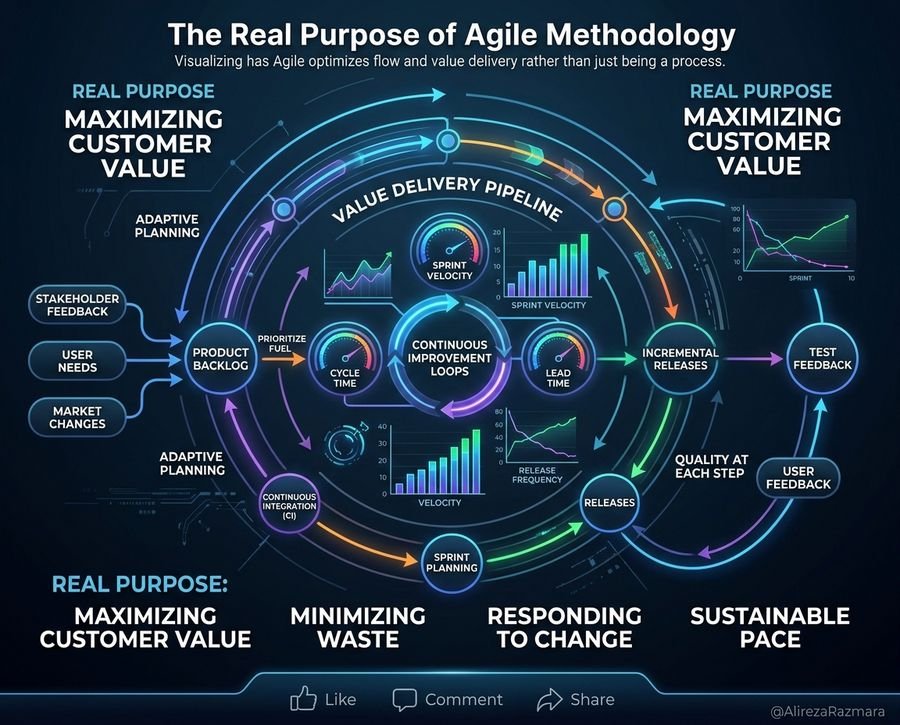
What is the Real Purpose of Agile Methodology?
Agile methodology is a project management approach designed to deliver value iteratively while actively managing high levels of uncertainty. It is not meant for highly predictable, fixed-scope projects. Instead, it thrives when requirements are expected to evolve based on user feedback and changing market conditions.
We love fast feedback loops, continuous delivery, and self-organizing teams. As an Agile Coach, my default stance leans heavily toward iterative delivery. But let’s be honest with ourselves: forcing Agile onto every single project is a recipe for wasted budgets, team burnout, and operational chaos.
Most organizations misunderstand Agile as a synonym for speed. It isn’t. Agile is about adaptability. If your destination is perfectly clear and the road is paved, you do not need a compass that recalculates your route every two weeks. You just need to drive. But if you are navigating a dense forest where the terrain shifts daily, that compass becomes your primary survival tool. Agility isn’t about blindly following Scrum ceremonies; it is about strategically managing the unknown.
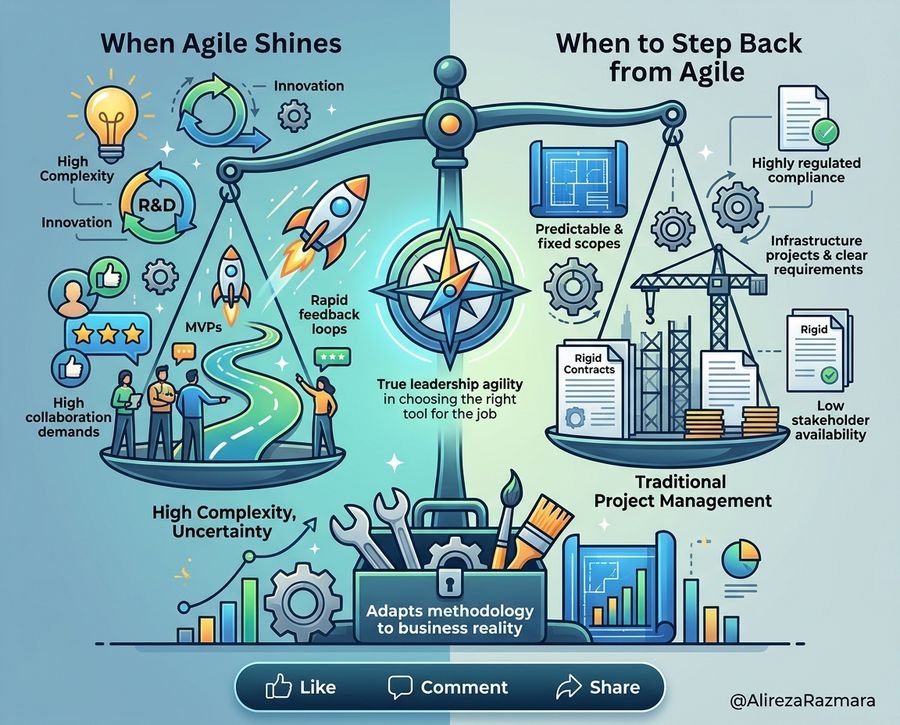
When Agile Shines: The Sweet Spots for Iterative Delivery
You should use Agile frameworks when your project faces high complexity, requires rapid innovation, or has a high cost of delay. It is the optimal choice for environments where early user feedback dictates the product roadmap and stakeholders are highly available.
High Complexity and Uncertainty
If your end product isn’t fully defined upfront, Agile is your best bet. Modern software development usually falls into this category because user needs constantly shift. Iterative cycles allow your development team to pivot without sinking millions of dollars into the wrong feature set. By breaking work down into manageable sprints, you systematically de-risk the project by proving small assumptions rather than betting the entire budget on a massive, unvalidated release.
Innovation and R&D Initiatives
Are you building something completely new? You need empirical data, not boardroom guesswork. Agile allows teams to release small, functional increments, test hypotheses in the real world, and adjust based on actual usage. This is where the feedback loop becomes a competitive advantage. When you operate in an environment of discovery, you need the flexibility to scrap a feature that looked great on paper but fails with actual users.
High Cost of Delay (The MVP Advantage)
Sometimes, getting an imperfect product to market quickly creates exponentially more value than waiting a year for a flawless, polished release. Releasing a Minimum Viable Product (MVP) generates immediate return on investment and crucial operational learnings. If capturing market share today is more important than feature completeness tomorrow, an Agile approach ensures you deliver the core value as quickly as possible.
High Stakeholder Collaboration
Agile requires active, ongoing engagement from the business side. If your product owners and business leaders are ready to be in the trenches—reviewing increments, prioritizing backlogs, and making iterative decisions—Agile will hum like a well-oiled machine. The methodology relies on a partnership between those who build the product and those who define its business value.
When to Step Back: The Danger Zones for Agile
You should avoid Agile and opt for traditional methodologies when projects have strictly fixed scopes, rigid contracts, or low stakeholder availability. Forcing Agile into highly regulated, predictable environments often creates unnecessary overhead and operational friction.
Predictable and Fixed Scopes
Think about data center migrations, regulatory compliance updates like GDPR or SOC2, or large-scale hardware rollouts. If the requirements are 100% clear on day one and cannot change by law or physics, traditional Waterfall methods generally win. Sprint reviews are entirely pointless if the scope is completely locked. You don’t need to ask stakeholders how they feel about a server rack migration halfway through; you just need to execute the blueprint flawlessly.
Fixed-Price, Rigid Contracts
Agile fundamentally assumes that scope is flexible while time and budget are fixed. If a client signs a rigid contract demanding a specific set of features for a specific price on a specific date, you are operating in a Waterfall reality. Pretending it is Agile by holding daily standups and dividing the work into arbitrary two-week blocks just creates Dark Agile. This toxic hybrid frustrates developers, confuses clients, and inevitably leads to massive scope creep without the budget to back it up.
Low Stakeholder Availability
If business leaders only want to see the final delivery after six months and refuse to engage in sprint reviews, pure Agile will immediately stall. A core pillar of agility is continuous feedback. Without it, development teams end up guessing, building the wrong things in a vacuum, and facing massive, expensive rework during the final reveal. If stakeholders cannot commit to the cadence of Agile, protect your team by utilizing a phased, milestone-based approach instead.
The Symptoms of Forced Agile (Dark Agile)
How do you know if you are forcing Agile where it doesn’t belong? The symptoms usually show up in your team’s culture and delivery metrics before they hit the bottom line. Recognizing these red flags early can save a project from completely derailing.
- Endless Backlog Refinement: Your team spends hours debating points and estimating tickets for regulatory requirements that absolutely must be built regardless of how long they take.
- Standups as Status Reports: Daily standups morph into grueling, hour-long status updates for micromanaging executives, completely losing their purpose as a team synchronization event.
- The Infinite Sprint Zero: Your organization spends three to four months in Sprint Zero mapping out exact architectural designs, creating a comprehensive Gantt chart disguised as a product backlog.
- Zero Scope Negotiation: When a sprint fails to meet its arbitrary goal, the team is forced to work weekends to catch up because the release date and scope were set in stone a year ago.
If you see these patterns, you are not practicing Agile. You are practicing heavily micromanaged Waterfall with Agile terminology slapped on top.
How to Choose the Right Delivery Methodology
To choose the right methodology, evaluate your project based on scope flexibility, stakeholder availability, and the level of unknown variables. Use Agile for discovery and adaptation, and rely on traditional methods for the execution of known, repeatable processes.
Before you kick off your next initiative, ask yourself a few brutally honest questions. Can the scope actually change based on feedback? Are we exploring unknown territory, or are we executing a well-documented blueprint? Are our stakeholders willing to act as co-creators every single week? Your answers will dictate your methodology.
True leadership agility is choosing the right tool for the job. Do not fit the problem into your favorite framework—adapt your methodology to the business reality. Stop treating Agile like a religion. A hammer is fantastic for driving nails, but it is terrible for driving screws. If you force a methodology where it doesn’t belong, you will ultimately damage trust between your technical teams and the business.
Sometimes, traditional project management is the absolute smartest strategic choice you can make. Own it. Run a fantastic, well-structured Waterfall project. Your delivery teams will thank you for the clarity, and your stakeholders will thank you for the predictable delivery.
Over to You
Have you ever seen Agile forced onto a project where it clearly didn’t belong? What was the outcome for the team and the product? Navigating the gray area between Agile and Traditional delivery is one of the hardest parts of project leadership, and real-world stories are the best way we learn.