
The Brutal Reality of Modern Sprints
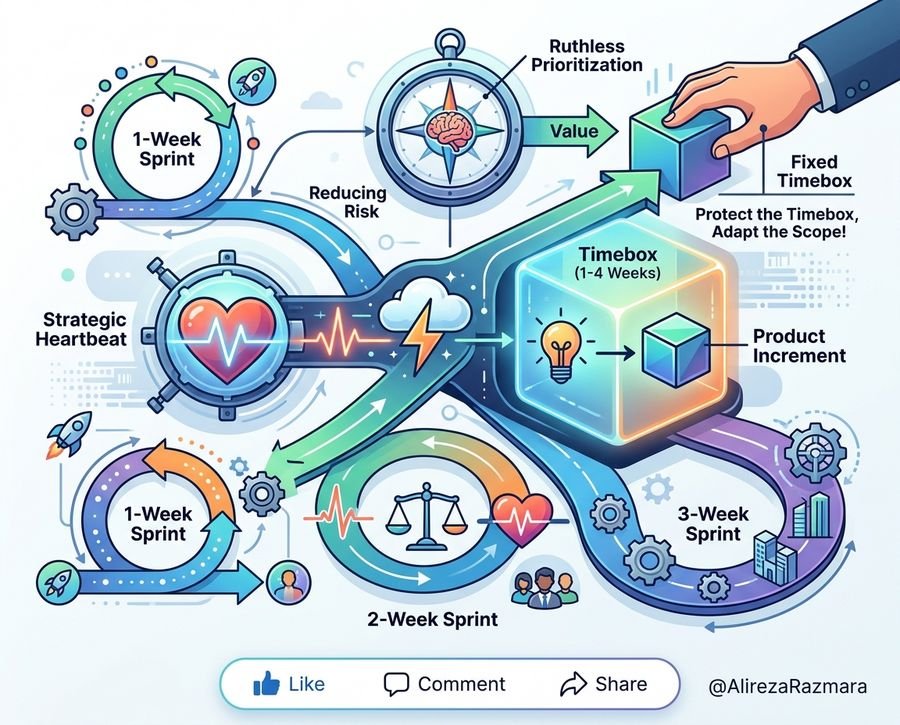
Let’s get straight to it. Most engineering teams claim they practice Scrum. In reality, a significant portion of them are just executing mini-waterfalls wrapped in a recurring calendar invite. A Sprint is not just a deadline to push tickets across a digital board. It is the strategic heartbeat of your product delivery engine.
At its core, a Sprint is a fixed timebox designed to turn ambiguous ideas into a concrete, usable product Increment. Every cycle should reduce risk, validate assumptions, and deliver tangible value to the user. Yet, the most common question I hear from Tech Leaders, Product Owners, and Project Managers remains unchanged: What is the ideal duration for our Sprint?
They want a magic number. They want a template. But the agile truth is far more nuanced. Below, we break down how to choose a Sprint cadence that actually works, how to stop faking your agility, and how to master the art of the timebox.
What is the Ideal Sprint Duration?
There is no single universal answer for the perfect Sprint duration, only trade-offs based on your feedback loops, deployment maturity, and risk tolerance. The ideal length is the shortest amount of time your team needs to deliver a meaningful vertical slice of value, while maintaining a sustainable pace.
According to the Scrum Guide, a Sprint must be a fixed timebox of one to four weeks. If you blindly force a standard duration onto a team without evaluating their specific context, you will create friction. You must look at how quickly your stakeholders need to see changes, how mature your CI/CD pipeline is, and how easily your Product Owner can slice the backlog.
Let’s break down the real-world scenarios for each timebox, starting with the fastest cadence.
The One-Week Sprint: Maximum Agility, High Overhead
One-week Sprints work best for high-volatility environments, early-stage startups, and struggling teams that need to fix broken dynamics. You sacrifice operational time to ceremony overhead, but in return, you gain absolute maximum agility and ultra-low risk per cycle.
When you run a one-week Sprint, there is absolutely nowhere to hide. If your deployment pipeline is broken, you will feel the pain immediately. If your Product Owner is writing vague user stories, the team will grind to a halt by Tuesday. I frequently place highly dysfunctional teams on one-week cycles as a diagnostic tool. The compressed timeframe forces them to face their delivery bottlenecks.
Pros:
- Incredibly tight feedback loops.
- Pivot direction rapidly without wasting months of engineering budget.
- Forces teams to slice work into tiny, manageable pieces.
Cons:
- High ceremony fatigue. Doing Planning, Daily Scrums, Review, and Retrospective every single week can exhaust developers.
- Requires a highly automated testing and deployment infrastructure. Manual QA simply cannot keep up with this pace.
The Two-Week Sprint: The Industry Sweet Spot
Two-week Sprints are the best choice for most cross-functional tech and software engineering teams. This duration provides the perfect equilibrium between sustainable developer flow state and timely stakeholder feedback.
It is easy to see why this is the default for most agile transformations. Two weeks gives engineers enough breathing room to tackle meaningful technical complexity, execute deep work, and peer-review code without constantly looking at the clock. At the same time, it prevents stakeholders from feeling disconnected from the product’s progress.
During a two-week cycle, week one is typically focused on deep execution, tackling the hardest architectural unknowns, and unblocking dependencies. Week two shifts toward integration, rigorous testing, backlog refinement for the next cycle, and polishing the Increment.
However, complacency is the hidden danger here. Because two weeks feels comfortable, teams often let bad habits creep in. They might start tolerating spillover, assuming they can just wrap it up in the next comfortable two-week block. Do not let the comfort of this cadence soften your discipline.
Three to Four-Week Sprints: For Complex Domains
Three to four-week Sprints are best suited for complex architectural domains, hardware-software integrations, or highly predictable legacy industries. The primary risk of this longer timebox is the massive expansion of your feedback loops, which drastically increases the risk of scope drift and unvalidated assumptions.
In modern SaaS and consumer software, 30 days is an eternity. I rarely recommend a four-week Sprint for web or mobile application teams. If you go this route, your backlog refinement must be absolutely flawless. If you spend an entire month building something based on a flawed assumption, you have just burned a massive amount of capital and time.
There are valid use cases, though. If your team builds firmware, integrates with physical hardware manufacturing, or works in heavily regulated environments (like medical devices or aerospace) where every release requires exhaustive compliance auditing, a longer cycle is often necessary. You need that extra time to ensure safety, integration, and regulatory sign-off.
Are Your Sprints Mini-Waterfalls in Disguise?
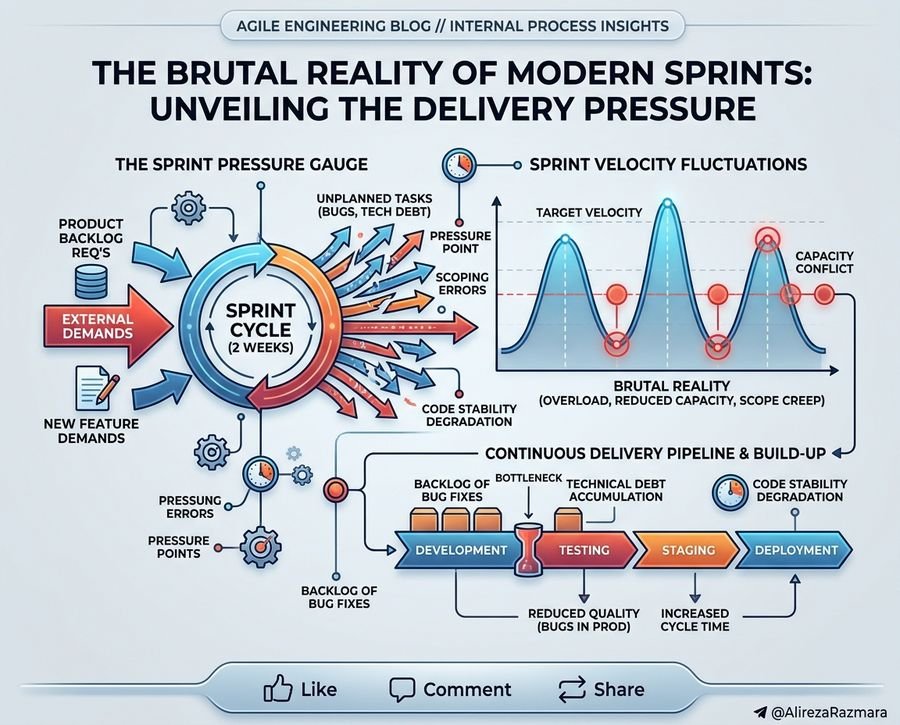
If your team spends the first few days of the Sprint designing, the middle chunk coding, and the final days testing, you are not doing Agile; you are executing a mini-waterfall. This sequential handoff completely defeats the purpose of Scrum and destroys cross-functional collaboration.
I see this anti-pattern in nearly every organization I consult for. The developers write code for eight days, then throw a massive batch of work over the wall to QA on a Thursday afternoon. Predictably, QA finds bugs, the developers scramble to fix them on Friday morning, and the team fails to deliver a done Increment by the Sprint Review.
To fix this, you must adopt vertical slicing. Instead of building the entire database layer, then the entire API layer, and finally the UI, you must slice through all layers of the stack to deliver a tiny, fully functional piece of a feature within the first few days of the Sprint. QA should be testing small increments of value by Tuesday of week one, not waiting until Thursday of week two.
If you cannot slice your work vertically, your user stories are too large, or your team lacks the necessary cross-functional skills.
The Senior Coach’s Rule on Timeboxing
A Timebox is not a constraint to lock you in; it is a boundary to force ruthless prioritization. If your team is constantly moving the finish line or extending the Sprint to complete work, you aren’t managing time—you are avoiding hard trade-offs. Protect the timebox, adapt the scope.
Here is the reality of software delivery: We are terrible at estimating. Complexity always hides just beneath the surface. When you realize mid-Sprint that a feature is vastly more complicated than you initially thought, you have two choices. You can work nights and weekends to force it across the finish line, sacrificing quality and team morale. Or, you can negotiate the scope with the Product Owner.
Always choose the latter. The timebox is sacred. Never extend a Sprint by a few days to let someone finish their code. When you extend the Sprint, you destroy your velocity metrics, mask organizational dysfunction, and enable poor planning behaviors.
If the timebox expires and the work isn’t done, it isn’t done. The unfinished work goes back into the Product Backlog. You inspect why the failure happened during the Retrospective, and you adapt your planning for the next cycle. That is the essence of empiricism.
Aligning Your Cadence to Value Delivery
Ultimately, the duration of your Sprint matters far less than what happens inside it. Whether you run one-week cycles or four-week cycles, the primary directive remains identical: deliver a high-quality, usable Increment of value.
Stop obsessing over perfect Jira hygiene and start obsessing over flow. Challenge your team this week: Look at your current Sprint board. Are the tickets representing technical tasks, or do they represent actual value to the end user? Are you collaborating daily to push items to completion, or are you working in isolated silos?
Pick a Sprint length that forces you to face your bottlenecks. Honor the timebox relentlessly. Slice your work vertically. If you commit to these principles, you will stop running mini-waterfalls and start building a high-performing product delivery engine.