
What is the True Role of a Scrum Master?
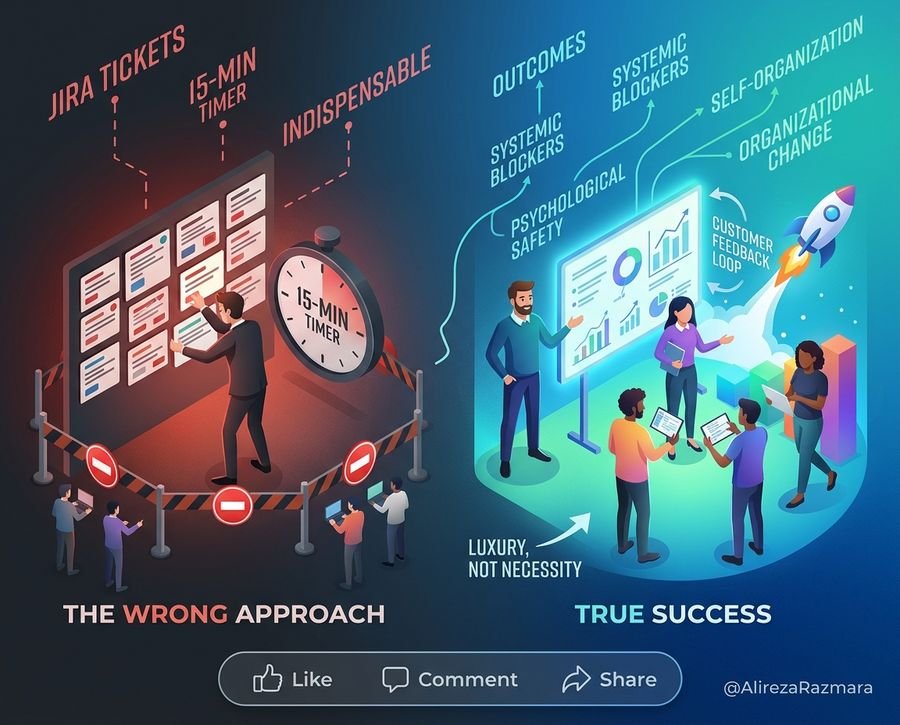
The true role of a Scrum Master is to build a team so autonomous, resilient, and high-performing that their own daily presence becomes unnecessary. They act as servant leaders who remove systemic organizational blockers, coach self-organization, and shift the team’s focus from tracking output to delivering tangible business outcomes. If a Scrum Master is just managing Jira tickets or acting as a 15-minute timer during Daily Standups, they are failing the team.
Let me be blunt. I have walked into countless sprint rooms where the Scrum Master is treated like a glorified administrative assistant. They update the board, ping developers for status updates, and take meeting minutes. This is a massive organizational anti-pattern. A Scrum Master who makes themselves indispensable to daily operations is severely limiting the team’s potential. True success looks entirely different. It requires stepping away from the keyboard, stepping back from the control mechanisms, and stepping up to actual leadership.
Focusing on Outcomes Over Output
Great Scrum Masters measure success strictly by the business value delivered and the speed at which customer feedback is gathered, not by how many velocity points were burned in a sprint. They understand that maximizing output is a factory metric, whereas optimizing for outcomes is a product delivery metric. Your customers do not care about your sprint velocity; they care if your software solves their problems.
In many tech organizations, there is a dangerous obsession with predictable velocity. The Scrum Master is often pressured by leadership to ensure the team burns exactly 50 points every two weeks. When this happens, the team naturally games the system. They inflate story points, avoid risky but valuable experiments, and push technical debt under the rug just to keep the burndown chart looking pretty.
An exceptional Agile Coach intercepts this pressure. They pivot the conversation with stakeholders away from “How much did we build?” to “What did we learn?” and “Did this feature move the needle on our key performance indicators?” By ruthlessly prioritizing outcome-driven metrics, they protect the team from the treadmill of feature factories and align engineering efforts with real business strategy.
Dismantling Systemic Blockers
Exceptional Scrum Masters look far beyond team-level impediments to actively tackle organizational dysfunctions, cross-silo friction, and delivery bureaucracy. A broken laptop or a missing software license is a trivial impediment that a self-managing team can usually handle themselves. The real work of a Scrum Master lies in hunting down the invisible, systemic bottlenecks that choke product delivery.
Consider the typical enterprise software pipeline. A team might write brilliant code in a matter of days, only to have it sit in a Change Advisory Board (CAB) queue for three weeks waiting for a manual approval. A junior Scrum Master will just report this delay in the daily standup. A senior Scrum Master will take action. They will track the wait times, quantify the cost of delay in actual dollars, and take that data directly to leadership to negotiate a streamlined, automated compliance check.
This requires political capital, negotiation skills, and a thick skin. Systemic blockers are often disguised as “the way we have always done things.” Dismantling them means challenging corporate bureaucracy, bridging gaps between deeply siloed departments like QA, security, and development, and actively redesigning workflow structures to enable continuous delivery.
Building True Psychological Safety
Scrum Masters cultivate psychological safety by establishing an environment where developers feel entirely safe to experiment, fail fast, speak truth to leadership, and challenge the status quo without fear of retaliation. Psychological safety is not about being nice; it is about creating a space where absolute candor drives continuous innovation and risk mitigation.
When a production deployment fails, watch how the Scrum Master reacts. Do they immediately look for the person who merged the bad code? Or do they facilitate a blameless retrospective focused entirely on how the system allowed the bad code to reach production? The latter builds trust; the former builds a culture of hiding mistakes.
You cannot buy psychological safety. It is earned through consistent, daily actions. It means backing up a junior developer when they push back against an unrealistic deadline requested by a demanding Product Owner. It means allowing the team to take calculated technical risks and serving as a shield when those experiments do not pan out. When engineers know their Scrum Master has their back, they stop playing it safe and start building extraordinary products.
Coaching Self-Organization
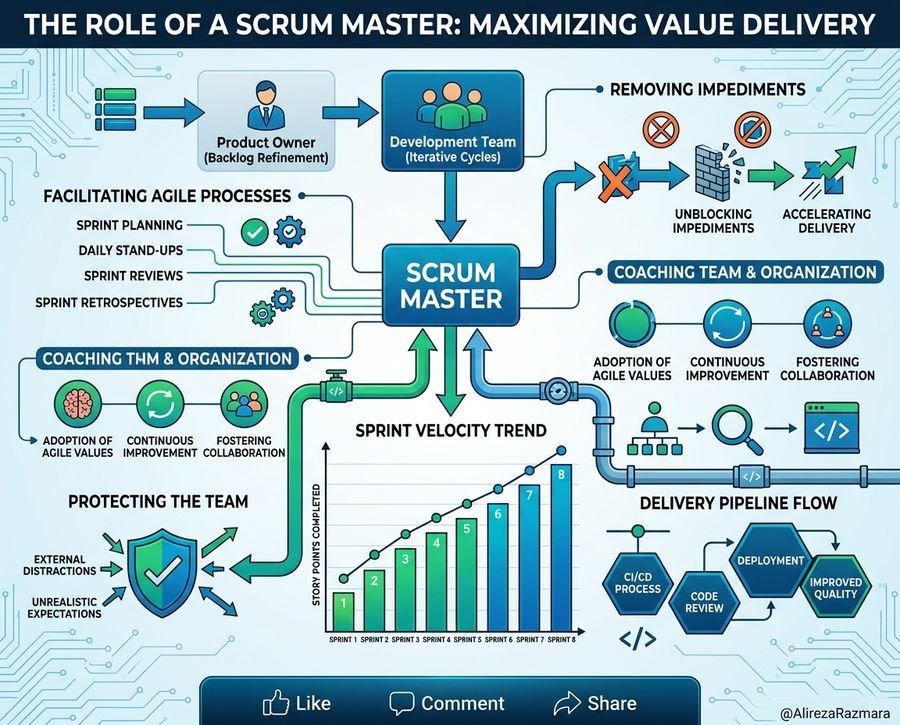
Instead of prescribing solutions, a successful Scrum Master asks powerful questions and teaches the team how to solve problems rather than solving problems for them. When a team encounters a conflict or a technical hurdle, the instinct of a conventional project manager is to step in and fix it. An Agile coach does the exact opposite.
Imagine a scenario where the team is consistently failing to meet their sprint commitments due to poorly refined user stories. The Jira jockey will take it upon themselves to rewrite the stories for the team. The exceptional Scrum Master will bring the issue to the retrospective and ask, “What is missing from our refinement process that is causing these delays?”
- Stop being the dispatcher: Do not assign tasks. Let the developers pull work based on priority and capacity.
- Step out of the middle: If two developers are arguing over an architectural decision, do not mediate unless absolutely necessary. Encourage peer-to-peer resolution.
- Teach the frameworks: Equip the team with root-cause analysis tools like the “Five Whys” so they can diagnose their own workflow issues without needing a facilitator every time.
Servant leadership is fundamentally about empowerment, not control. If you solve every problem for your team, you are training them to be helpless. If you coach them to solve their own problems, you are building a resilient machine.
Driving Organizational Change
Great Scrum Masters do not stop at the team boundary; they continuously educate stakeholders and executive leaders to drive the shift from merely doing Agile to truly being Agile. A single high-performing team cannot survive long inside a rigidly traditional, waterfall organization. The corporate immune system will eventually attack them.
This means the Scrum Master must act as an organizational change agent. They spend a significant portion of their time outside the sprint room. They sit with product managers to refine roadmaps. They shadow executives to understand market pressures. They coach middle management on how to shift from resource utilization metrics to flow metrics.
Agile transformation fails when it is treated as a process rollout rather than a cultural shift. Exceptional Scrum Masters know that implementing two-week sprints and calling them “Agile” is just putting lipstick on a pig. Real agility requires changing how an organization funds projects, manages risk, and rewards its employees. The Scrum Master must be at the forefront of this systemic evolution, armed with data, empathy, and immense persistence.
The Vacation Test: The Ultimate Metric of Success
The true metric of a great Scrum Master is not how smooth their sprint ceremonies are, but how accountable, high-performing, and autonomous the team remains when the Scrum Master goes on vacation for a month. If the team falls apart, misses their goals, or stops holding retrospectives the minute you leave, you have not built an agile team—you have built a dependency.
Take a hard look at your current operations. If you were unreachable for the next three sprints, would your developers still ruthlessly prioritize their backlog? Would they still swarm on blockers? Would they still hold each other accountable for code quality and sprint goals?
If the answer is yes, congratulations. You have achieved the ultimate goal of a Scrum Master. You have made your presence a luxury, not a necessity. You have empowered a group of individuals to become a self-sustaining force of product delivery.
Over to You
I have shared what I believe separates the Jira administrators from the true Agile leaders. Now, I want to hear your perspective. What is the single most critical trait you look for in an exceptional Scrum Master? Let’s discuss it.