Listen In: Fixed Projects versus Continuous Value Engines (15 min)
The Illusion of the Linear Project Plan
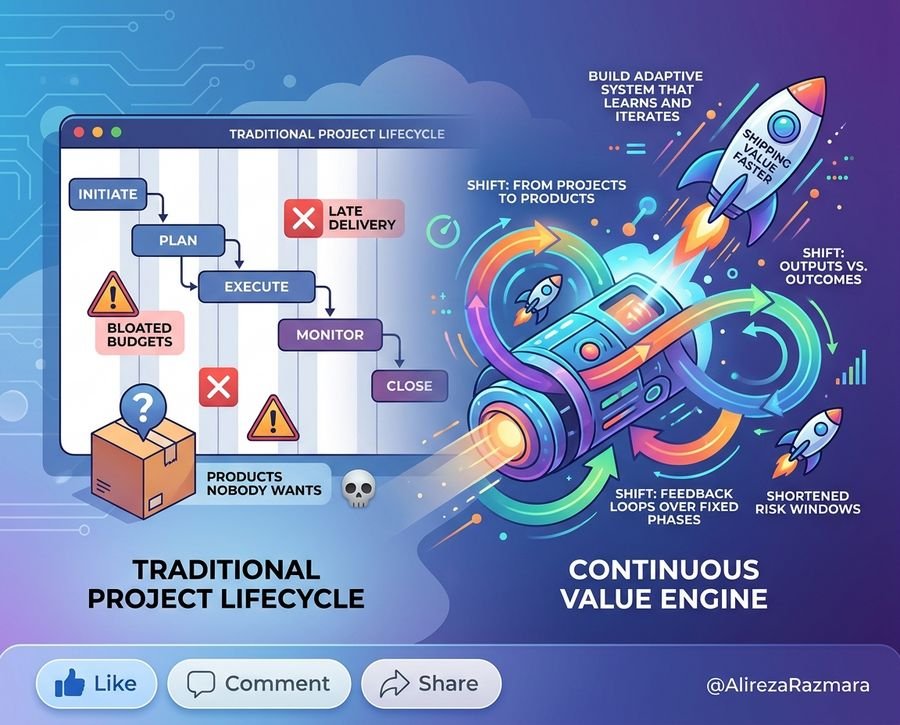
Traditional project management teaches us a comforting, predictable lie. Initiate, plan, execute, monitor, and close. It looks pristine on a Gantt chart. You lock the scope, assign the resources, track dependencies, and manage milestones until you cross a neatly defined finish line. But if you lead tech delivery, you already know the harsh reality. Rigid linear lifecycles usually result in late software, bloated budgets, and deliverables nobody actually wants to use.
As tech leaders, Scrum Masters, and Agile practitioners, we have to stop treating software development like constructing a bridge. Code is not concrete. Market demands shift overnight. We need to transition our organizational mindset from managing a finite Project Lifecycle to operating a Continuous Value Engine. Great leaders do not just check off phase gates; they continuously optimize the flow of value to the customer.
What is a Continuous Value Engine?
A continuous value engine is an agile operating model that replaces rigid, linear project phases with iterative, product-centric feedback loops. Instead of focusing on finite delivery dates and fixed scopes, it optimizes for ongoing customer outcomes, rapid adaptation, and sustained product health.
In a classic project framework, success is defined by checking off the “Close” phase on time and under budget. The problem? That definition completely ignores whether the customer actually cares about what you just built. A value engine flips this dynamic entirely. It compresses the massive, heavy lifecycle into tiny, manageable iterations. You build a slice of functionality, ship it, measure the reaction, and adjust your trajectory. It is about building an adaptive system that learns and delivers value faster than your competitors can schedule their next steering committee meeting.
From Temporary Projects to Long-Term Products
Moving from projects to products means shifting your focus from hitting temporary deadlines to sustaining long-term product health and customer satisfaction. Projects eventually end and disband, but true value creation requires ongoing investment, maintenance, and technical adaptation over years.
Think about how typical enterprise project teams are formed. You borrow a database engineer from one silo, a UI designer from an agency, and a few developers from a shared pool for a six-month initiative. Once the project “closes,” you disband the team and reassign everyone. All that shared context, operational rhythm, and domain knowledge vanishes overnight. When critical bugs inevitably surface or the market demands an update, the original builders are gone, and a new group has to start from scratch.
Product-centric organizations keep teams intact. They fund persistent, cross-functional squads dedicated to a specific user journey or business capability. Instead of handing off a finished project to an under-resourced maintenance desk, the team owns the product from inception through its entire lifespan. This shift creates genuine ownership. Developers care about architectural standards and technical debt because they know they will be the ones dealing with the codebase next quarter, not just sprinting away after the “Execute” phase.
Measuring Outcomes Instead of Just Outputs
Outputs are the specific features, code deployments, and story points your team ships, while outcomes are the measurable changes in customer behavior those features create. Hitting every stage-gate on a traditional timeline is practically useless if the final deliverable provides zero actual market impact or solves no real user pain points.
We have all lived through this scenario. A massive, eighteen-month initiative is delivered perfectly to spec. The stakeholders applaud, the project management office (PMO) sends out a congratulatory email, and then nothing happens. User adoption is flat. Customer churn remains unchanged. Revenue does not move. This happens because the organization optimized entirely for outputs—delivering the requested widget—rather than outcomes, which is solving the customer’s actual problem.
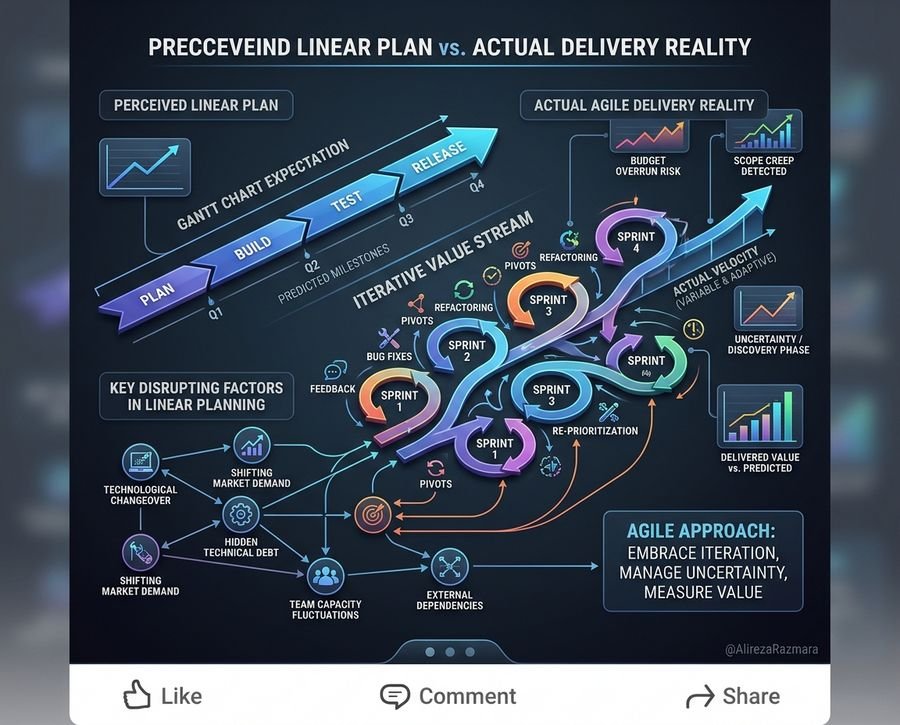
To build a continuous value engine, you must validate value incrementally. Ask your Product Owners to define success by actionable metrics like reduced processing times, increased cart conversions, or lower support ticket volumes. If you ship a small piece of functionality and the metrics do not move, you pivot immediately. You stop building the rest of that feature set. In a traditional lifecycle, stopping early is viewed as a failure. In an Agile value engine, it is a successful prevention of wasted effort and misallocated capital.
Why Feedback Loops Beat Fixed Project Phases
Feedback loops prioritize real-world user data over rigid upfront planning and assumed requirements. Discovering that your scope needs to change during development is not a failure of planning; it is a strategic pivot driven by actual market reality and user feedback.
Traditional lifecycles treat change as an enemy to be managed. You establish a strict change control board, force product managers to fill out extensive justification forms, and defend the original baseline plan at all costs. But the original plan was created during the “Initiate” phase—the exact moment when you knew the absolute least about the complexity of the work and the needs of the user.
Agile frameworks like Scrum rely on empiricism. You put working software in front of real users as quickly as possible, gather their feedback, and adapt the backlog accordingly. A fixed-phase model forces you to wait until the “Monitor” phase—often months later—to see if things are working. By replacing long phases with tight, integrated feedback loops, your product backlog becomes a dynamic reflection of what your customers need today, not what an executive guessed they needed twelve months ago.
Shortening Risk Windows Through Micro-Lifecycles
Agile does not eliminate the project lifecycle; it compresses it from months into micro-lifecycles run every single Sprint. This guarantees that if a technical approach or feature fails, you only waste a few weeks of effort rather than destroying an entire annual budget.
In the classic Initiate-Plan-Execute-Monitor-Close model, risk compounds in the shadows. You might spend six months in the “Execute” phase before anyone realizes the database architecture cannot handle the production load or the API integrations are fundamentally flawed. That is a catastrophic, late-stage failure that requires months of expensive rework.
When you treat every Sprint as a micro-lifecycle, you initiate, plan, execute, monitor, and close a piece of work within a two-week boundary. You force technical integration. You force automated testing. You force a stakeholder review of working software. Because of this, the risk window shrinks drastically. The absolute worst-case scenario is that you lose two weeks of time. This compressed rhythm allows teams to experiment safely, fail fast, and correct course without requiring a massive, demoralizing organizational rescue mission.
Building Your Organization’s Value Engine
To transition your organization into a continuous value engine, leadership must immediately align team incentives with customer success rather than arbitrary delivery dates. This requires breaking down departmental silos, integrating automated DevOps practices, and giving teams the autonomy to iterate based on real feedback.
- Stop Disbanding High-Performing Teams: Move away from project-based funding. Fund persistent product teams. Let them build deep trust, establish a predictable velocity, and take total ownership of a specific business domain.
- Redefine the Sprint Review: Sprint Reviews should never be one-way status updates or dry demonstrations of mere outputs. Use that critical time to review user analytics, discuss which product hypotheses were proven or disproven, and collaborate with stakeholders on what to build next.
- Evolve the PMO into a VMO: Transition your Project Management Office into a Value Management Office. Instead of asking teams for RAG (Red/Amber/Green) status charts and Gantt updates, leadership should be asking, “What customer value did we validate this week, and what organizational blockers can I remove for you?”
The traditional project lifecycle might look highly organized on an executive slide deck, but it is dangerously fragile in a complex, rapidly shifting tech landscape. The organizations that win are not the ones that perfectly execute a massive, multi-year plan. They are the ones that build an adaptive system, listen closely to their users, and continuously accelerate the flow of validated value.