
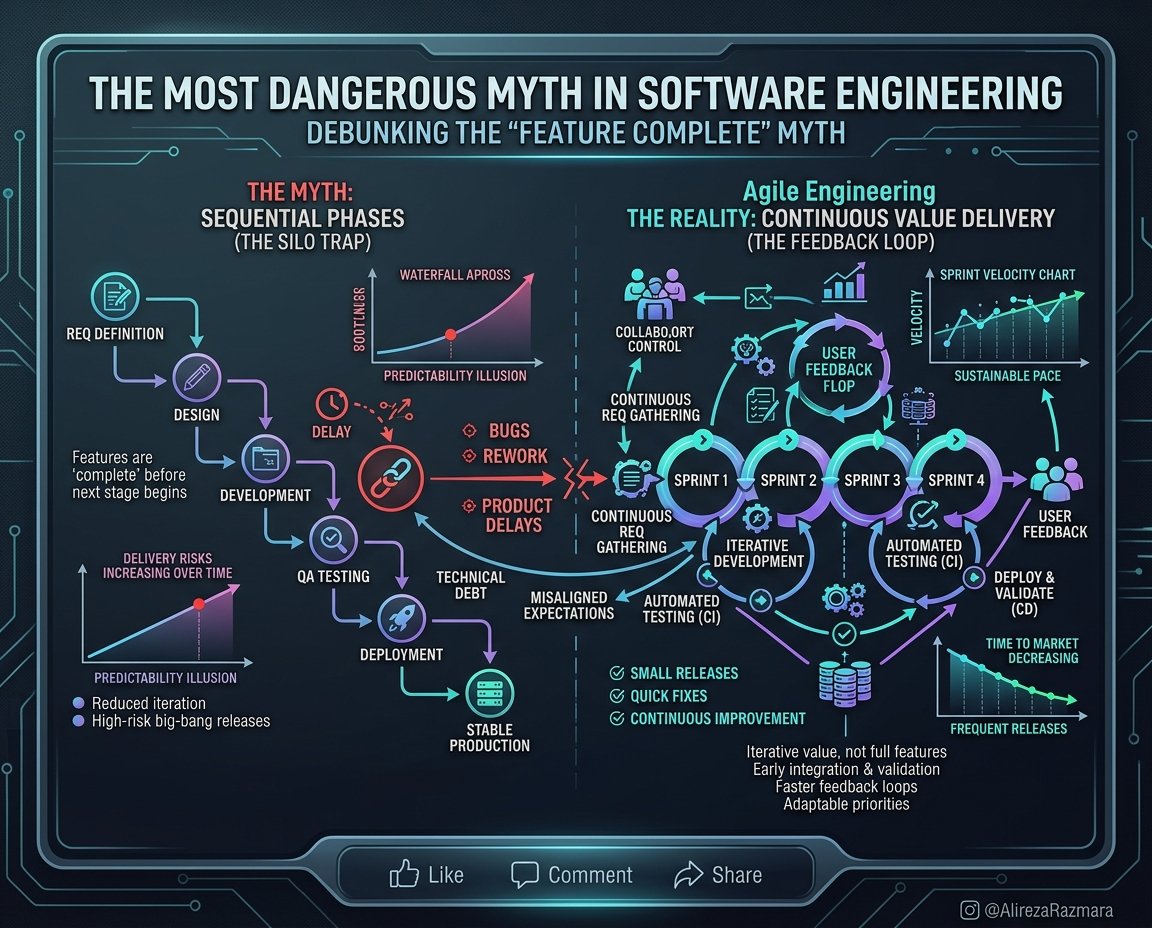
The Most Dangerous Myth in Software Engineering
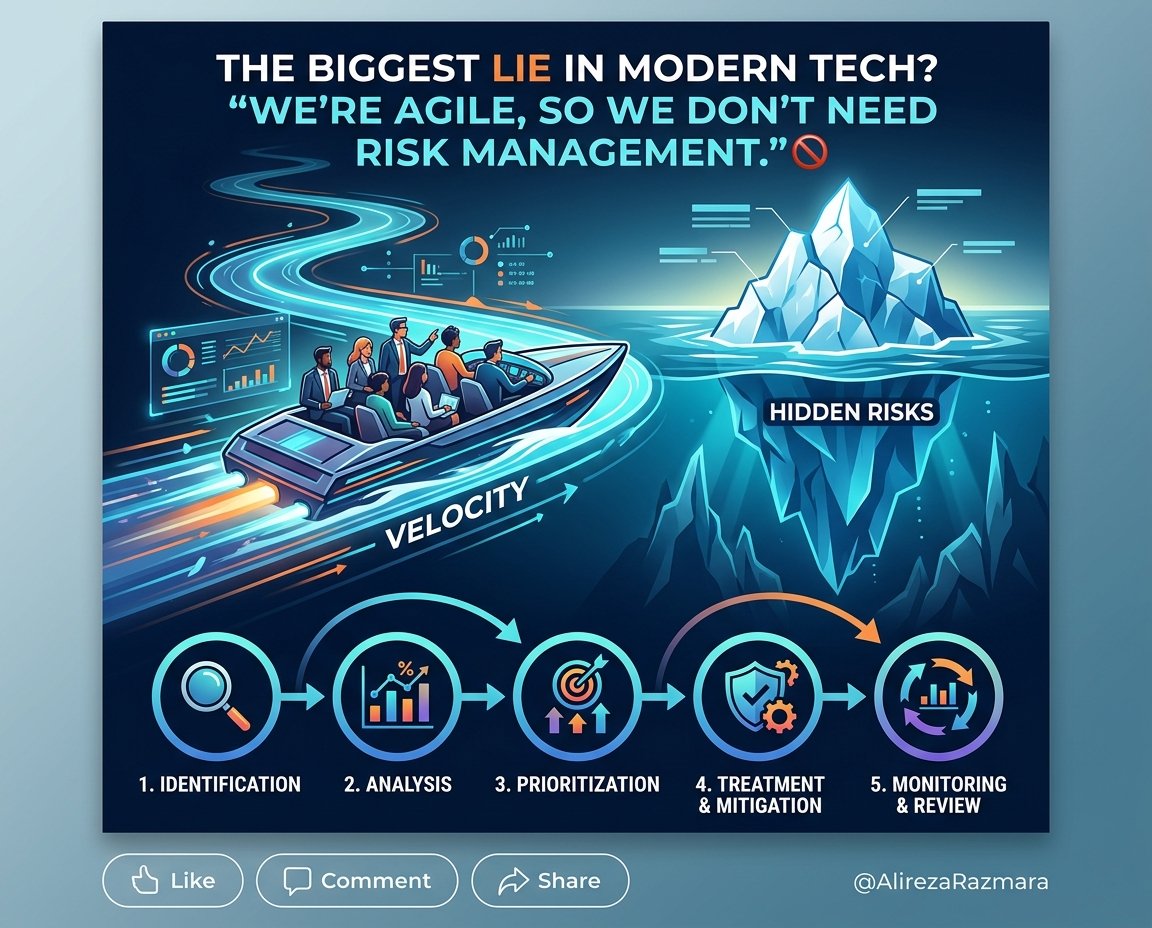
Agile risk management is the continuous, proactive practice of identifying, analyzing, and mitigating technical and delivery threats within iterative development cycles. The biggest lie circulating in modern tech right now is the idea that because a team is Agile, they no longer need formal risk management. Let’s get one thing straight. Agility without proactive risk management isn’t fast. It’s reckless.
In fast-paced engineering environments, uncertainty is guaranteed. Requirements pivot, dependencies break, and technical debt compounds. But getting blindsided by preventable bottlenecks? That is rarely a framework issue. It is a leadership choice.
Far too many organizations confuse responding to change with waiting for failure. They treat risk management as a relic of Waterfall project management, assuming that working in two-week sprints magically protects them from catastrophic system failures or missed market deadlines. Great Scrum Masters, Agile Coaches, and Tech Leaders know the truth. They do not just manage tasks and facilitate ceremonies. They continuously de-risk value delivery across the entire product lifecycle.
The 5 Critical Phases of Agile Risk Management
Implementing a risk-aware culture does not mean slowing down your pipeline with bureaucratic approval gates. It means building feedback loops that catch threats while they are still cheap to fix. Here is how high-performing teams systematically master risk across five distinct phases.
1. Identification (Spot the Iceberg Early)
Risk identification in Agile means actively surfacing architectural flaws, dependency traps, and delivery blockers before they manifest into production incidents. You must do this early and often, specifically during Backlog Refinement and Sprint Planning. Do not wait for code to break in staging to realize you have a problem.
If your development team is completely silent during planning, your risks are not absent—they are just hiding. Developers often hesitate to raise concerns about technical debt or third-party API limitations because they feel pressured to deliver features rapidly. As an Agile leader, you have to create the psychological safety required to unearth these hidden threats.
- Ask targeted questions: Instead of asking, ‘Are there any risks?’ ask, ‘If this feature fails in production next week, what is the most likely reason?’
- Map dependencies: Visually map out internal and external team dependencies. Often, your biggest risks sit entirely outside your team’s direct control.
- Watch for the ‘Watermelon Status’: Projects that look green on the outside but are bleeding red on the inside usually suffer from a lack of transparent risk identification.
2. Analysis (Measure Probability & Impact)
Risk analysis is the process of measuring the specific probability of a threat occurring and the quantitative impact it will have on your release. Not all risks are created equal, and treating them as such leads to massive wasted effort. You need to quantify the blast radius immediately.
When a team member raises a red flag, your next step is to evaluate the severity. Is this a minor UI glitch that might annoy a fraction of your user base, or is it a critical API bottleneck that will derail the entire launch and cause a data breach? Agile teams must balance speed with precision during this phase. You cannot spend three weeks analyzing a risk for a two-week sprint.
Use a simple matrix to evaluate threats based on likelihood and impact. High-probability, high-impact risks demand immediate architectural spikes or exploratory testing. Low-impact risks can often be accepted, knowing that the cost of fixing them outweighs the cost of the potential failure.
3. Prioritization (Evaluate & Rank)
Risk prioritization is the act of ranking identified threats to create a risk-adjusted Product Backlog, focusing team energy where failure is most expensive. Once you know the blast radius, you have to decide what to do about it in the context of your overall product goals.
One of the most effective frameworks for Agile teams is ROAM. During planning or refinement, assign every major risk to one of four categories:
- Resolved: The team has already taken action to eliminate the risk entirely.
- Owned: A specific team member takes responsibility for monitoring and managing the risk. It is not solved yet, but someone is actively watching it.
- Accepted: The risk is acknowledged, but the cost of mitigation is too high. The team accepts the potential consequences.
- Mitigated: A plan is in place to reduce the impact or likelihood of the risk to an acceptable level.
By forcing risks into these categories, you eliminate the ambiguity that usually surrounds technical threats. A risk-adjusted backlog ensures that mitigation work is treated as a first-class citizen alongside new feature development.
4. Treatment & Mitigation (Take Decisive Action)
Risk treatment involves taking decisive, actionable steps—such as creating technical spikes, pivoting architectures, or building automated guardrails—to neutralize a prioritized threat. Listing risks on a whiteboard or a Jira dashboard is entirely useless without an executable action plan.
This is where Agile truly shines compared to legacy methodologies. Instead of writing a massive risk management plan document, you convert your mitigations directly into actionable user stories and pull them into your active Sprint. If you identify a major unknown regarding a third-party payment gateway, you write a timeboxed technical spike to test the integration before committing to the full feature.
Sometimes, treatment means negotiating scope with the Product Owner. If delivering the full feature introduces unacceptable performance risks, you slice the story. Build a safer, smaller increment, deploy it, and gather real-world data. Automation is also your best friend here. Build automated regression tests, establish CI/CD pipeline guardrails, and implement feature flags to decouple deployment from release. These are concrete risk treatments.
5. Monitoring & Review (Inspect & Adapt)
Risk monitoring is the continuous inspection of your risk profile during Daily Scrums, Sprint Reviews, and Retrospectives. Risk management is not a one-time ceremony you perform at the start of a quarter. As your codebase evolves, so do your vulnerabilities.
Your environment is highly dynamic. A risk that was marked ‘low probability’ yesterday can become ‘imminent’ today due to a change in market conditions, a staffing shift, or a deprecated software library. Use your Agile events to maintain a pulse on these shifts.
- The Daily Scrum: This is your 15-minute pivot. Team members should flag emerging risks blocking their sprint goal daily.
- The Sprint Review: Discuss mitigated risks with stakeholders. Show them the technical spikes and explain how de-risking the architecture ensures long-term product stability.
- The Retrospective: Analyze risks that slipped through the cracks. If a preventable production incident occurred, use the retro to figure out why the team failed to identify or analyze the threat in earlier phases.
Integrating Risk into the Sprint Backlog
How do you practically handle this workflow? Many legacy project managers advocate for maintaining a separate, isolated Risk Register spreadsheet. In Agile engineering, an isolated spreadsheet is where information goes to die.
Instead, integrate risk tickets directly into your Sprint Backlog. Make the invisible work visible. If a developer is spending three days mitigating a database scaling issue, that effort must be represented on the Kanban board. Tag these items clearly so the Product Owner understands the balance between risk mitigation and feature delivery.
The Takeaway for High-Performing Teams
High-performing engineering teams do not avoid risks. They systematically master the feedback loops that neutralize threats before they impact the customer. They understand that psychological safety, rigorous analysis, and actionable backlog integration are the actual mechanisms of speed.
The next time someone claims risk management slows down Agile delivery, remind them that nothing halts momentum faster than a catastrophic, entirely preventable production failure. Build the guardrails early, rank your threats brutally, and execute your mitigations directly within your sprints.