
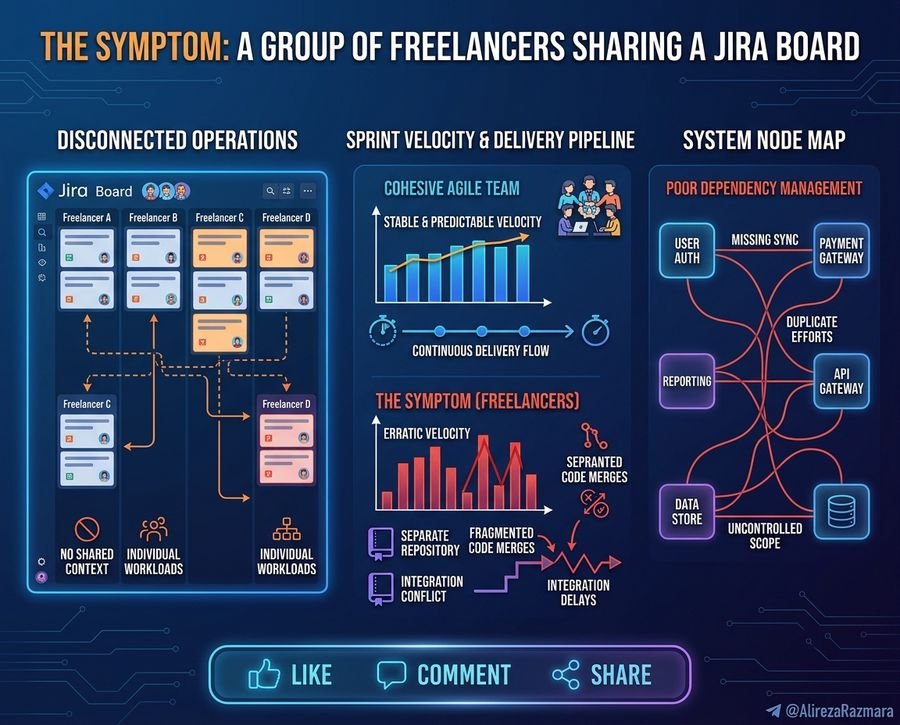
The Symptom: A Group of Freelancers Sharing a Jira Board
“I only do backend.”
“That task looks too complex.”
“I’ll just take the quick bug fixes.”
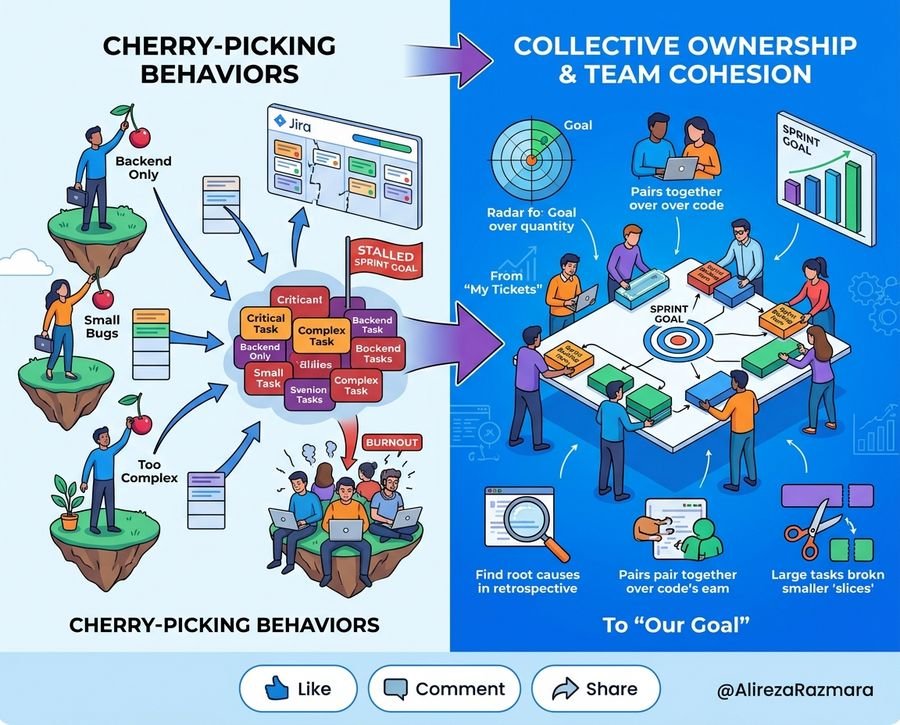
If you have spent any time listening in on daily standups, you have heard these phrases. They sound harmless at first. Developers want to work on what they know. But when team members start cherry-picking tasks, a subtle and dangerous shift happens. Your team stops operating as a cohesive Scrum unit. Instead, they act like a group of independent freelancers who just happen to be working out of the same Jira project.
The consequences hit hard by the end of the Sprint. The easiest, lowest-value tickets get closed quickly, giving the illusion of progress. Meanwhile, the critical, complex tasks—the ones actually tied to the Sprint Goal—sit untouched. They get pushed to the end of the iteration, risking the delivery, building technical debt, and ultimately forcing your senior engineers to pull heroics to save the release. As an Agile leader, you have to fix this. But if you revert to assigning tasks top-down, you kill self-organization entirely.
What is Task Cherry-Picking in Agile?
Task cherry-picking occurs when developers selectively pull backlog items based on personal preference, technical familiarity, or perceived ease, rather than prioritizing work that achieves the Sprint Goal. This behavior actively undermines shared accountability.
When a team is truly Agile, the collective goal dictates the work. When cherry-picking takes root, individual comfort zones dictate the work. You will notice this happening when your burn-down chart looks flat for the first week, or when certain “messy” tickets roll over sprint after sprint. Over time, this creates severe knowledge silos. The database expert only ever touches database tickets. The junior frontend developer only updates UI copy. Cross-functional growth stagnates, and the team’s bus factor becomes dangerously low.
The Hidden Causes: Why Do Developers Cherry-Pick?
Developers rarely cherry-pick tasks out of laziness. Avoidance is almost always a symptom of systemic friction. It is usually driven by a lack of domain knowledge, ambiguous acceptance criteria, or an intense fear of making a mistake in an unfamiliar codebase.
To stop the behavior, you must stop treating it as a character flaw and start treating it as a workflow problem. Let’s break down the three usual suspects.
- Fear of Breaking Things: If your CI/CD pipeline lacks adequate automated testing, developers will avoid touching legacy code. The risk of causing a regression is simply too high.
- Ambiguity: If a Product Owner writes a one-sentence ticket with no clear definition of done, developers will skip it. Cognitive load is a real barrier. People naturally gravitate toward tickets that clearly state what needs to be done.
- The “Not My Stack” Syndrome: In highly specialized environments, developers feel imposter syndrome when stepping outside their core competencies. They stick to what they know because they want to look productive.
The 4-Step Playbook to Restore Collective Ownership
How do we solve task avoidance without resorting to assigning tasks and micromanaging the development team? You change the environment so that taking on the right work becomes the easiest, most rewarding path. Here is a field-tested approach.
1. Focus on the Sprint Goal, Not Ticket Volume
Success in an Agile sprint is determined entirely by whether the team achieves the agreed-upon Sprint Goal, not by how many story points an individual developer burned down. You have to shift the daily narrative to reflect this reality.
Start by changing how you run the Daily Scrum. The traditional “What did I do yesterday, what will I do today” format often devolves into an individual status report. Developers feel pressured to justify their paycheck, so they grab quick tickets to say they “finished something.”
Instead, try walking the board from right to left. Look at the items closest to completion. Ask the team, “What do we need to do together to get this specific item across the finish line today?” Once that is blocked or handled, move to the next item. This forces the conversation away from individual utilization and directly targets the flow of priority work.
2. Normalize Swarming and Pair Programming
Pair programming is the act of two developers working together at one workstation, which naturally breaks down knowledge silos and dramatically reduces the fear of failure on complex tasks. Swarming expands this concept, pulling multiple team members onto a single high-priority bottleneck.
If a team member is actively avoiding a high-priority task, pair them up with someone else. Do not make it a punishment; frame it as a standard practice for complex work. Tell the team, “This ticket is critical for the Sprint Goal and it looks tricky. Let’s put two sets of eyes on it.”
When developers swarm on complex work, the intimidation factor disappears. They share the cognitive load. Over a few months of consistent pairing, the junior developers learn the legacy backend, and the senior backend engineers learn the frontend framework. The excuses of “I only do backend” fade away naturally because cross-functional skills have been built organically.
3. Slice Tasks Smaller
If a high-priority item sits untouched at the top of the backlog for days, it is usually because the scope is too big, the requirements are too vague, or the technical approach is unresolved. You must break the work down until taking the next step feels effortless and low-risk.
Massive tickets create paralysis. If a developer sees an 8-point story labeled “Refactor Payment Gateway,” they will skip it and grab a 2-point CSS fix instead. The brain seeks the path of least resistance.
Coach your Product Owner and technical leads on vertical slicing. How can we break “Refactor Payment Gateway” into a 2-point story that just builds the API endpoint? How can we make the acceptance criteria so binary and clear that anyone on the team knows exactly when they are done? When tickets are small, well-defined, and achievable within a single day, the temptation to cherry-pick evaporates.
4. Uncover the Root Cause in Retrospectives
The Sprint Retrospective is the ideal venue for identifying the missing domain knowledge or gaps in backlog refinement that lead to task avoidance. You fix the system here, not the person.
As a Scrum Master or Agile Coach, bring data to the retro. Point out the trends without pointing fingers. You might say, “I noticed the data migration ticket sat in the ‘To Do’ column until day seven, and then Sarah had to work late to finish it. What made that ticket so hard to start?”
Listen closely to the answers. They will often tell you that the team did not understand the database schema, or that the ticket lacked access credentials, or that they were waiting on a third-party dependency. Once you identify these systemic blockers, you can create action items to prevent them from happening in the next sprint.
The Bottom Line: Coaching Shared Accountability
High-performing Agile teams do not ask, “What should I work on today?” They ask, “What can WE finish today to reach our goal?”
Eliminating task cherry-picking takes time because you are fighting against human nature and traditional corporate conditioning that rewards individual performance over team success. Stop managing task assignments. Step back and start coaching shared accountability. When you build an environment of psychological safety, clear requirements, and deep collaboration, developers will stop hunting for the easy way out and start tackling the work that matters.