
The Anatomy of a Missed Sprint Commitment
You pull up the sprint burn-down chart during the retrospective. Instead of a smooth, predictable glide path, it looks like a jagged cliff face. The team just missed their Sprint commitments again, and velocity resembles an unpredictable roller coaster. When this happens, leadership usually jumps to the easiest, laziest conclusion: “The team isn’t working hard enough.”
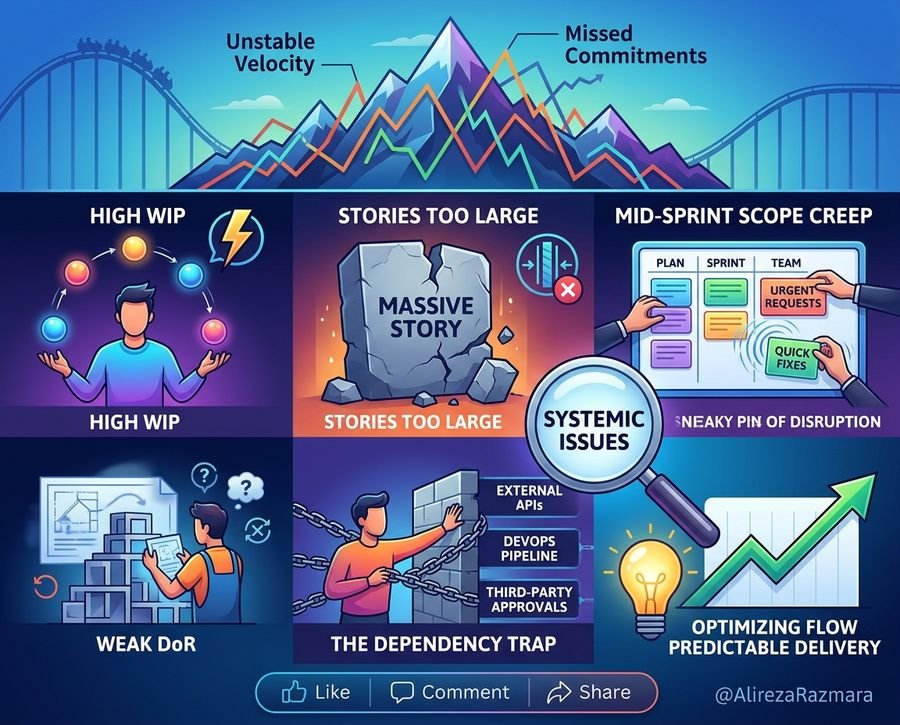
I have spent years coaching software delivery teams, and I can tell you this is almost never a motivation issue. It is a systemic issue. When commitments constantly fall through, your system is broken, not your developers. Bad systems beat good people every single time. If your delivery metrics look like a mountain range, you need to stop asking people to work weekends and start looking at how work flows through your team.
Let’s examine the five silent velocity killers hiding in plain sight on your Agile board, and look at exactly how to fix them.
What Causes Unstable Sprint Velocity?
Unstable sprint velocity is caused by systemic delivery bottlenecks like high Work In Progress (WIP), mid-sprint scope creep, unrefined backlog items, and external dependencies. When teams treat velocity as a target rather than a byproduct of a healthy workflow, these silent killers destroy focus and predictability. Fix the flow of work, and the velocity will stabilize itself.
Predictability does not come from estimating better. It comes from controlling the variables that introduce chaos into the sprint container. Let’s break down the specific culprits.
1. High Work In Progress (WIP) and Context Switching
High Work In Progress (WIP) destroys velocity by forcing developers into constant context switching, which stalls completed work while half-baked code piles up. When a team takes on too many tasks simultaneously, nothing crosses the finish line on time.
Walk into a daily stand-up and listen closely. If you hear developers saying, “I’m waiting on a code review for Ticket A, so I picked up Ticket B, and I’m investigating an issue on Ticket C,” you have a WIP problem. Human brains do not parallel process well. Every time a developer switches context between complex tasks, there is a cognitive penalty. Research consistently shows you lose about 20% of your effective capacity for every simultaneous project or context you juggle.
Furthermore, high WIP hides bottlenecks. If you have five developers and fifteen items “In Progress,” your QA process is going to get slammed on the last day of the sprint. It is a mathematical certainty.
How to Fix High WIP
- Implement Strict WIP Limits: Set a rule on your Kanban or Scrum board. For a team of five, limit the “In Progress” column to no more than three or four items.
- Stop Starting, Start Finishing: If a developer hits a blocker, they should not automatically pull new work from the backlog. They should swarm on existing open items, pair program, or review code to push existing work to “Done.”
2. Monolithic User Stories (Lack of Vertical Slicing)
Stories that are too large carry massive, hidden execution risks that only surface late in the sprint. Without vertical slicing, a single unexpected blocker on day nine can sink 40% of your planned sprint payload.
We all know the infamous 8-point story that rolls over from sprint to sprint. It usually represents a massive chunk of functionality. The problem with monolithic stories is that they give you zero early feedback. A developer might work on a massive feature for a week, confidently stating “it’s on track” during every stand-up, only to discover a fundamental architectural flaw the day before the sprint review.
Large stories also create testing bottlenecks. If QA only gets their hands on the feature 24 hours before the sprint ends, any bug found will result in a missed commitment. You end up with the “90% Done Syndrome,” where tasks sit just inches from the finish line but yield zero business value.
How to Fix Large Stories
- Slice by Value, Not Layer: Do not create one story for the database, one for the API, and one for the UI. Slice vertically. A story should deliver a thin, fully functional slice of user value from the back-end to the front-end.
- The 3-Day Rule: If a team cannot confidently design, code, test, and deploy a user story within two to three days, it is too big. Break it down further during refinement.
3. Mid-Sprint Scope Creep and “Quick Fixes”
Mid-sprint scope creep guts a team’s planned capacity when stakeholders introduce urgent requests or tiny fixes after the sprint backlog is locked. These tiny additions secretly bleed away the hours needed to deliver on the original sprint goal.
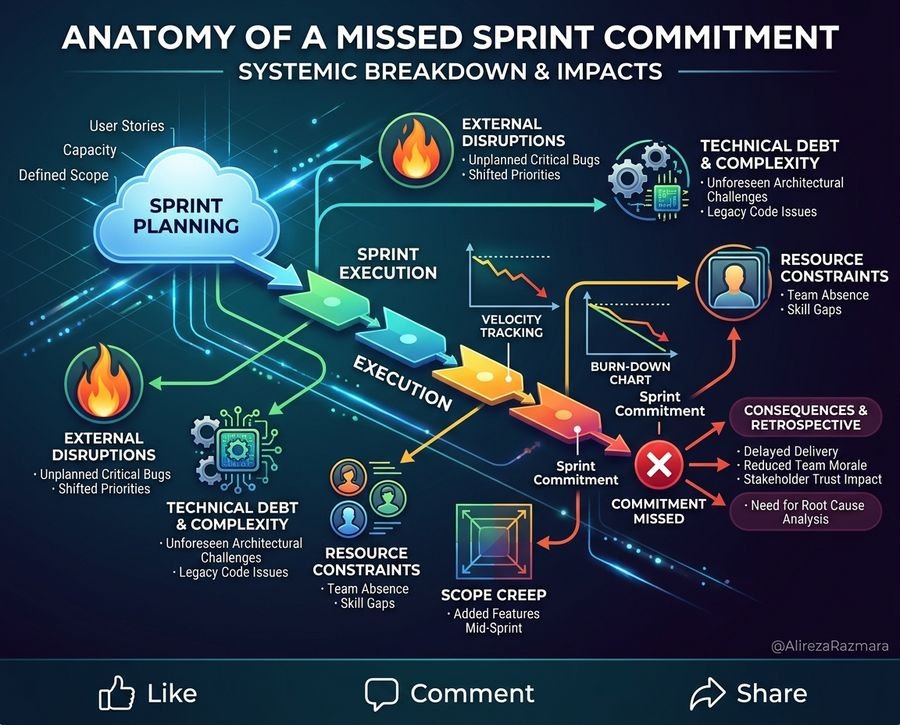
It usually starts innocently enough. A product manager asks for “just a quick text change,” or a stakeholder sends a direct message to a developer asking them to look into a minor bug. The developer wants to be helpful, so they oblige. The problem? That “one hour fix” takes an hour to code, an hour to review, an hour to test, and an hour to deploy. Multiply that by three interruptions a week, and your team just lost an entire day of capacity.
When this happens, the team misses their original sprint commitments, but nobody remembers the invisible favors they did mid-sprint. They just look at the failed burn-down chart and assume the team underperformed.
How to Fix Scope Creep
- Protect the Sprint Container: The Scrum Master and Product Owner must act as a shield. All requests must go through the PO, not directly to the engineers.
- The Zero-Sum Rule: If an urgent request truly must enter the active sprint, something of equal or greater size must be removed from the sprint backlog immediately.
- Plan for Support: If your team handles production support, leave a 15% to 20% capacity buffer empty during sprint planning. Never plan for 100% utilization.
4. A Weak Definition of Ready (DoR)
Pulling work into a sprint with vague requirements leads to constant rework, mid-sprint discovery, and missed acceptance criteria. A weak Definition of Ready forces developers to do product analysis instead of writing code.
“We’ll figure the details out during the sprint.” These are famous last words for an Agile team. When stories enter a sprint lacking clear acceptance criteria, UI mockups, or API contracts, developers are forced to make assumptions. Midway through the sprint, they finally get time with the Product Owner, only to realize what they built isn’t what the business wanted.
The result is massive rework. Time is wasted tearing down code and rewriting it, which pushes the delivery date past the end of the sprint. Vague requirements are a tax on your team’s velocity.
How to Fix a Weak DoR
- Create a DoR Checklist: Establish a strict agreement between the Product Owner and the Development Team. Before a ticket can be pulled into a sprint, it must meet specific criteria (e.g., acceptance criteria written, dependencies identified, designs attached).
- Refine Aggressively: Spend 10% of your sprint capacity refining the backlog for the next sprint. Planning should be a formality, not a discovery session. If a story isn’t ready, it does not enter the sprint. Period.
5. The Dependency Trap (External Blockers)
Teams trapped waiting on external APIs, DevOps pipelines, or third-party approvals will never close stories on time, regardless of how fast they write code. Dependencies paralyze execution and strip the team of their autonomy.
You cannot code your way out of a waiting state. If your team finishes their part of a feature on Tuesday, but they need the platform team to provision a server, and that platform team has a two-week SLA, your sprint commitment is already dead. Cross-team handoffs are the ultimate flow killer.
When a team is bogged down by external dependencies, their velocity becomes a reflection of the organization’s bureaucracy, not the team’s engineering capability.
How to Fix The Dependency Trap
- Map Dependencies Early: Identify external blockers during backlog refinement. Never pull a story into a sprint if its external dependency isn’t already resolved. Have the other team build their API endpoint first, then bring the integration story into your sprint.
- Move Toward Cross-Functional Teams: The long-term fix is organizational. Equip your team with the skills and permissions they need to deliver end-to-end. If they constantly wait on DevOps, embed a DevOps engineer into the team.
Stop Managing Velocity as a Target
Predictable delivery is a byproduct of a healthy system, not a metric you can mandate from the top down. As Goodhart’s Law states, when a measure becomes a target, it ceases to be a good measure.
If leadership demands a higher, more stable velocity without fixing the underlying system, teams will naturally adapt by inflating their estimates. A 3-point story suddenly becomes an 8-point story, the velocity chart goes up, executives are happy, but actual software delivery remains exactly the same.
To stop the roller coaster and start hitting sprint commitments consistently, shift your focus away from the numbers. Optimize for flow. Limit your WIP. Slice your stories thin. Protect your team from rogue interruptions. Build a robust Definition of Ready, and ruthlessly eliminate dependencies. Do these things, and you will find that a stable, predictable velocity takes care of itself.