The Problem with Over-Engineered Jira Tickets
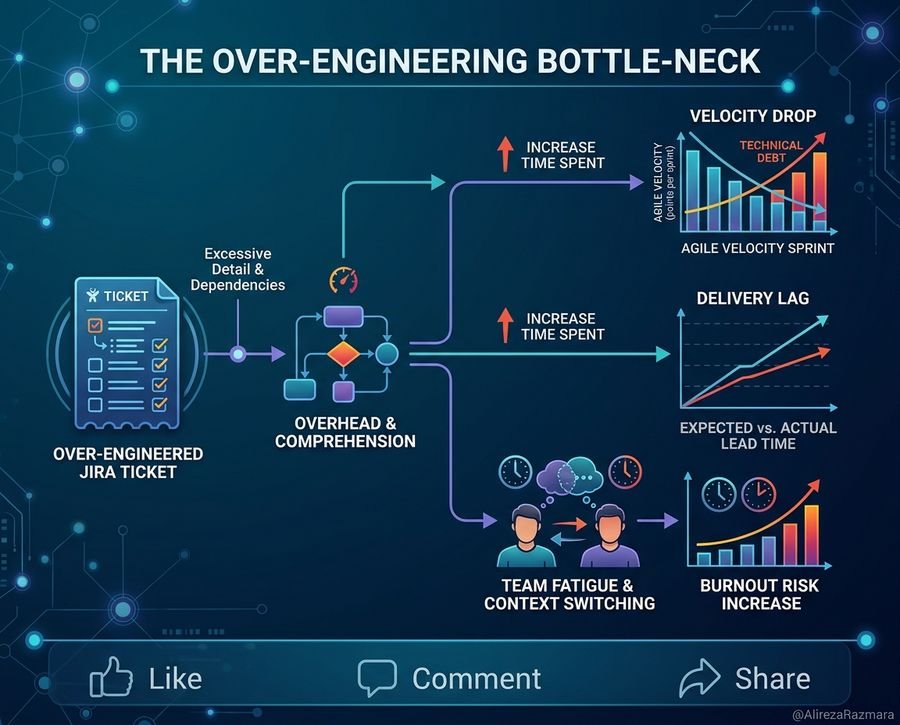
Writing overly detailed, multi-page technical documents inside user stories directly leads to reduced team velocity, lower engineering morale, and products that fail to solve actual customer problems. When Product Owners dictate the exact technical architecture within a ticket, they strip the engineering team of their problem-solving autonomy and create rigid bottlenecks.
We have all seen it. You open a Jira ticket expecting a clear articulation of a user’s need, and instead, you are hit with a 50-point list of unyielding technical specifications. There is zero user context. There is no room for engineering flexibility. The ticket reads more like a relic from a 1990s waterfall requirements document than an Agile artifact.
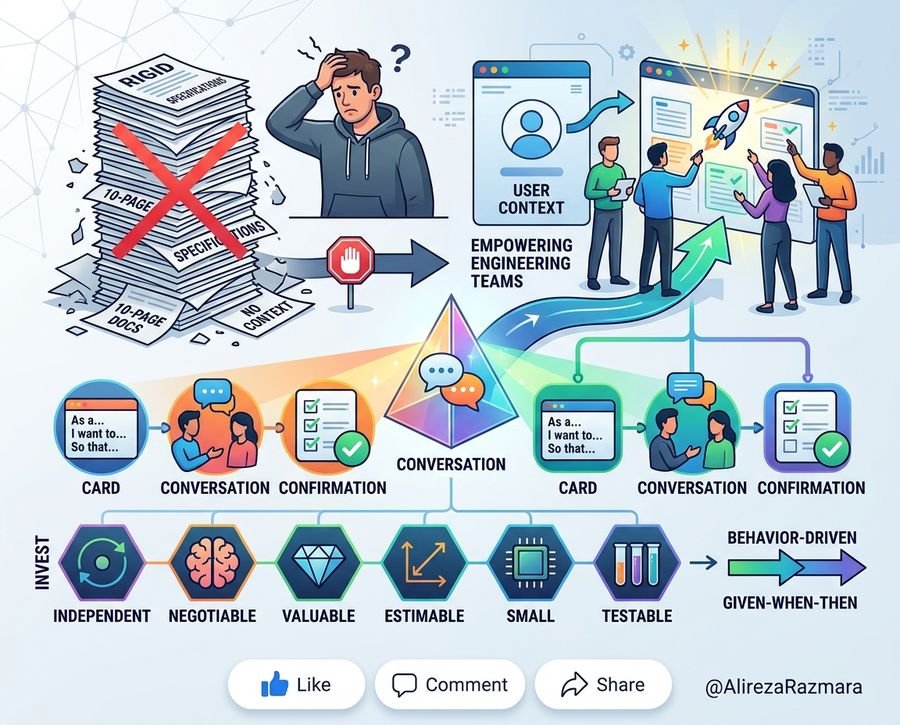
The result is always the same: frustrated developers, missed sprint goals, and features that completely miss the mark for the actual customer. A great User Story is not a detailed technical blueprint. It is an invitation to a high-value conversation. It outlines a clear problem and sets the boundaries for success, leaving the actual technical execution entirely up to the professionals hired to write the code.
What Makes a Good Agile User Story? The 3 Cs Explained
A highly effective Agile user story clearly articulates who the user is, what they need, and why they need it, while leaving the technical implementation to the development team. The most reliable way to structure this is by applying Ron Jeffries’ foundational 3 Cs concept: Card, Conversation, and Confirmation.
Understanding this triad shifts your backlog from a list of demands into a catalyst for collaboration.
- Card: This is the physical or digital token representing the requirement. It intentionally forces brevity. The classic format is: As a [persona], I want to [action] so that [value/benefit]. It keeps the focus squarely on the human problem rather than system architecture. If you find yourself writing, “As a database, I want to store data…” you have completely missed the point.
- Conversation: A user story is incomplete without the collaboration phase. This represents the continuous dialogue between Product, QA, and Engineering to uncover nuances, edge cases, and technical constraints. If a story does not trigger a conversation, it is a mandate. Refinement sessions are where the real work of the “Conversation” happens.
- Confirmation: This defines the explicit Acceptance Criteria. It establishes the exact boundaries of the work and clearly defines what “Done” means. Without confirmation, teams will endlessly argue about whether a feature is complete.
How to Validate Your User Stories: The INVEST Framework
You can objectively validate the quality and readiness of a user story by applying the INVEST framework, ensuring the ticket is Independent, Negotiable, Valuable, Estimable, Small, and Testable. If a user story fails to meet any of these criteria, it needs further refinement before a team commits to it in sprint planning.
Let’s break down why this checklist is mandatory for maintaining a healthy, actionable product backlog.
Independent
Dependencies kill sprint flow. Try to structure stories so they can be completed in any order. If Ticket A absolutely requires Ticket B to be finished first, see if they can be combined or sliced differently. High dependencies mean blocked developers and stalled velocity.
Negotiable
This is where rigid technical specs fail miserably. The ticket should state the problem clearly, leaving the solution highly negotiable. Give your engineers the space to be creative. A developer might know a way to solve the user’s problem with three lines of existing code rather than building the massive new service you assumed was necessary.
Valuable
Who actually cares if we build this? Every single story must deliver measurable customer or business value. If you cannot articulate the “so that” portion of your user story card, drop the ticket entirely. Tech debt and refactoring are important, but even they should be framed around the value they bring (e.g., faster load times, reduced system downtime).
Estimable
If the engineering team cannot size the story, they do not truly understand it. Ambiguity is the enemy of estimation. A story is estimable when the team has enough domain knowledge and clear acceptance criteria to gauge the effort required confidently.
Small
A story must fit comfortably within a single Sprint. If a team estimates that a piece of work will take three weeks to build, it is not a user story—it is an Epic. Slice it down vertically into smaller, deployable chunks that still deliver incremental value.
Testable
If you cannot test it, you cannot ship it. You need crystal clear criteria to verify the execution. Ambiguous criteria like “make the page load fast” are useless. Testable criteria look like, “the page must fully render in under 2 seconds on a 4G mobile connection.”
Writing Better Acceptance Criteria with Behavior-Driven Design
Behavior-Driven Acceptance Criteria use a Given-When-Then format to bridge the communication gap between business intent and technical validation. This specific structure forces Product Owners to shift their focus away from how developers should write the code, toward how stakeholders will actually validate the success of the feature.
Stop writing acceptance criteria that sound like database schemas or UI hex-code mandates. Frame your success metrics around actual user behavior. The Given-When-Then syntax works beautifully for this:
- Given: The context or starting state. (e.g., Given a premium user is logged into their dashboard…)
- When: The specific action taken by the user. (e.g., …When they click the ‘Download Annual Report’ button…)
- Then: The expected, observable outcome. (e.g., …Then the system generates a PDF payload in under 5 seconds, and the user receives an on-screen success notification.)
This format is incredibly powerful because it explicitly defines boundaries without dictating code. QA engineers know exactly what test scripts to automate. Developers know exactly what end-state to build toward. Product Owners know exactly what to demo to stakeholders. It completely eliminates the gray area that plagues end-of-sprint reviews.
The Bottom Line: Aligning Purpose with Engineering Excellence
Transitioning from writing rigid technical specifications to highly collaborative user stories requires holding refinement sessions focused entirely on the user’s problem rather than a pre-determined technical solution. You must actively encourage your engineers to ask “why” until the underlying business value is completely transparent.
It usually happens slowly. A Product Owner gets burned by a missed requirement, so they start adding highly technical constraints to the next story. Soon, every ticket includes mandated API endpoints, specific UI layouts, and explicit database queries. Before you know it, you are not writing user stories anymore. You are doing Waterfall delivery inside Jira.
When you refine your stories to focus purely on business purpose rather than technical execution, your entire delivery pipeline changes. You reduce rework because the team genuinely understands the “why” behind the feature. You accelerate sprint velocity because engineers are not stumbling over contradictory, non-sensical technical mandates written by non-technical stakeholders. Most importantly, you unleash the full problem-solving potential of the smart people you hired to build great software.
A Question for Agile Leaders
Take a hard look at your current backlog. Are you inviting your team to solve a problem, or are you just handing them a list of exhausting technical demands? The transition to true agility starts with how you frame the work.
What is the absolute biggest red flag you see in poorly written user stories? Identifying these anti-patterns in your own organization is the crucial first step toward building a healthier, faster, and much happier Agile team.