
The Trap of the Agile Blood Oath
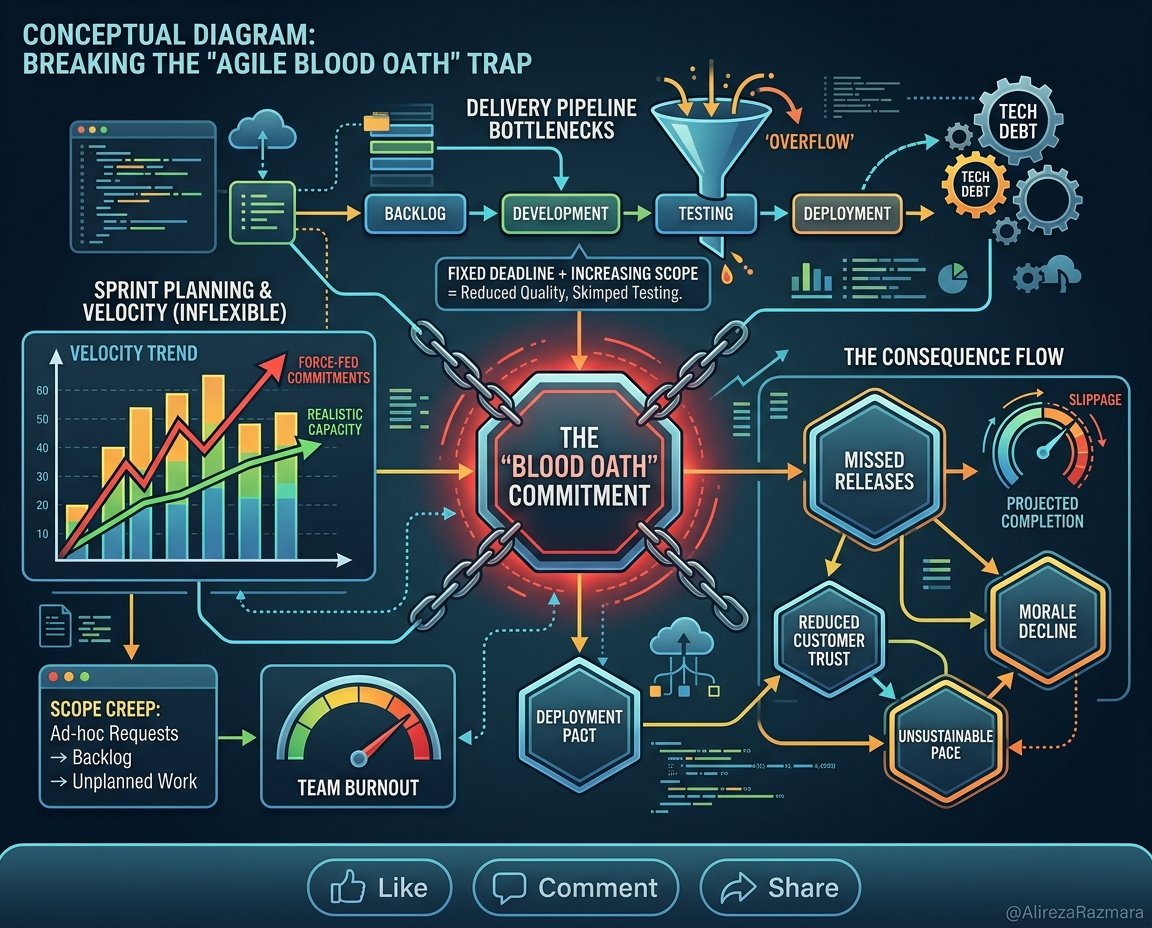
Let’s get something straight right out of the gate. An estimate is a guess. An educated, professionally informed guess based on current knowledge, but still a guess. Yet, in sprint planning rooms across the globe, teams routinely fall into the exact same trap. They confuse estimates with blood oaths. As soon as a lead developer mutters “this feels like an eight,” stakeholders instantly translate that number into a hard Friday delivery deadline.
This fundamentally breaks the Agile mindset. The real goal of estimation in Scrum isn’t pinpoint accuracy or creating rigid timelines. The goal is alignment, uncovering hidden technical risks, and sparking conversations that prevent mid-sprint disasters. If your team is stuck in endless, exhausting debates over whether a specific backend ticket is a 5 or an 8, you are entirely missing the point.
Why Do Agile Teams Confuse Estimates With Deadlines?
Teams confuse estimates with deadlines because leadership often views velocity as a productivity metric rather than a capacity planning tool. When management demands absolute certainty in a complex, shifting environment, developers naturally resort to defensive padding or panic-driven commitments. This pressure strips the actual value out of the estimation process.
I have sat in countless retrospectives where developers admit they inflated their story points just to avoid getting chewed out by a Product Owner during the sprint review. When estimates become weapons used against the engineering team, you lose psychological safety. Without psychological safety, you lose honesty. And without honesty, your roadmap is built on absolute fiction.
We have to shift the narrative. Estimation is a team-building and alignment exercise, not an accounting drill. To stop the arguing and start aligning, you need the right tool for the specific type of work you are sizing. Here are four powerful estimation techniques every tech leader needs in their toolbox.
4 Powerful Agile Estimation Techniques You Should Master
1. Planning Poker (Fibonacci Sequence)
Planning Poker is a consensus-based technique where team members simultaneously reveal Fibonacci-numbered cards to estimate the relative effort of a backlog item. This method works best for sprint backlog refinement because it prevents anchoring bias and forces the team to immediately confront differing assumptions.
The Fibonacci sequence (1, 2, 3, 5, 8, 13, 21…) is intentionally non-linear. The bigger the number, the larger the gap between options. This reflects the reality of software development: the larger the task, the greater the uncertainty.
Why it works: Planning poker forces divergence before convergence. The magic does not happen when everyone agrees; the magic happens when a junior developer votes an 8 and a senior developer votes a 2. What did one see that the other missed? Did the senior dev know about a pre-existing library that cuts the work in half? Did the junior dev realize there is a missing database migration that will block the entire feature? That five-minute conversation is the true deliverable of Planning Poker.
2. T-Shirt Sizing (XS, S, M, L, XL)
T-Shirt Sizing replaces numerical values with standard apparel sizes to quickly estimate large-scale epics and complex features. This technique is highly effective for early-stage roadmapping and epic grooming because it completely removes the false precision of numbers, helping stakeholders understand relative effort without anchoring on hours or days.
When executives see a “13” next to a project, their brains naturally try to calculate exactly how many days that translates to. When they see “Large,” they accept it as a broad conceptual bucket.
Why it works: It changes the vocabulary of the planning session. You stop asking, “How many days will this take?” and start asking, “Is this payment gateway integration larger or smaller than the user profile overhaul we did last month?” It trains the business side of the house to think in terms of relative complexity rather than fixed calendars.
3. Affinity Estimation (Silent Sorting)
Affinity Estimation is a rapid, silent sorting exercise where a team categorizes dozens of user stories into relative size buckets on a physical or virtual board. This method is incredibly powerful for sizing 50 or more backlog items at once, as it entirely eliminates the loudest-voice-in-the-room bias and relies on rapid group consensus.
To run it, simply lay out columns from Extra Small to Extra Large (or 1 to 21). Ask the team to silently drag tickets into the columns they feel are appropriate. If a team member disagrees with a placement, they silently move it to another column. Items that continuously bounce back and forth between columns are flagged for a brief discussion.
Why it works: It removes the exhausting debate over minor details. By removing the talking phase initially, you prevent the dominant senior architect from unintentionally swaying the entire room’s opinion. It is fast, highly collaborative, and gets a massive amount of sizing done in under an hour.
4. The Bucket System
The Bucket System is a scalable estimation framework where teams place backlog items into sequentially numbered buckets (typically 0, 1, 2, 3, 4, 5, 8, 13, 20, 30, 50, 100, 200). It is ideal for large teams facing high-volume backlogs, offering a blend of rapid sorting speed while maintaining a structured relative complexity score.
Similar to Affinity Estimation, the team picks a random item from the backlog and places it in the middle bucket (usually an 8). Every subsequent item is then discussed briefly and placed in a bucket relative to that anchor item.
Why it works: It scales much better than Planning Poker. If you have a newly formed backlog with 150 items, playing Planning Poker will take weeks and drain the life out of your engineering team. The Bucket System provides enough numerical structure to track velocity later, but moves with the speed of an affinity mapping session.
Leadership Takeaway: Shielding the Team from Fixed Commitments
To stop estimates from turning into fixed deadlines, tech leaders must strictly enforce velocity as an internal team capacity metric, not an external reporting KPI for management. You achieve this by constantly communicating the concept of relative effort, embracing project uncertainty, and actively pushing back when stakeholders ask for guaranteed delivery dates based on story points.
If you are a Scrum Master, Agile Coach, or Tech Lead, it is your job to protect the integrity of the estimation process. Here are three practical ways to do that:
- Burn the translation tables. Never let anyone create a spreadsheet that equals 1 story point to 8 hours of work. The moment you do this, you are no longer estimating complexity; you are just doing traditional waterfall time-tracking with extra steps.
- Focus on the slice, not the size. If a ticket is consistently debated or lands on a 13 or 21, stop estimating and start slicing. Ask the team: “How can we break this down so that the riskiest part is an independent 3?”
- Educate your stakeholders. Consistently remind product owners and business sponsors that Agile planning is about forecasting weather, not scheduling trains. We know the general direction and intensity, but we expect conditions to change once we actually start writing code.
Velocity is a capacity planning metric for the team. Full stop. The absolute value of your estimation sessions lies in the alignment achieved by the people doing the work, not the numbers printed on a Jira dashboard. Master the techniques above, trust your developers, and remember to protect the conversation over the commitment.