
Listen In: Agile Mindset versus Automated Guardrails (17 min)
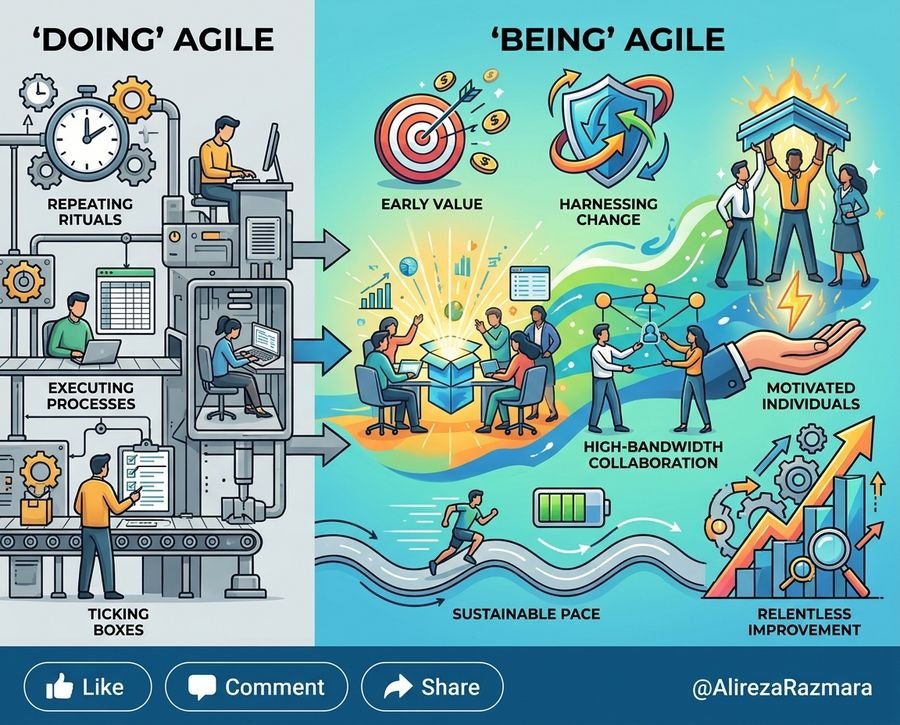
Most tech organizations adopt Jira, mandate daily standups, and call it a day. That is not agility. True agility is a high-performing mindset focused on outcomes, not a mechanical checklist of framework rituals.
As an Agile Coach and Technical Project Delivery Consultant, I see this pattern constantly. Teams execute Scrum events flawlessly but still struggle to ship valuable software to their users. If you strip away the framework buzzwords, real business impact relies on mastering a few non-negotiable principles. Transitioning from doing Agile to being Agile requires tearing down bloated processes and returning to the foundations of software delivery.
1. Early and Continuous Value Delivery
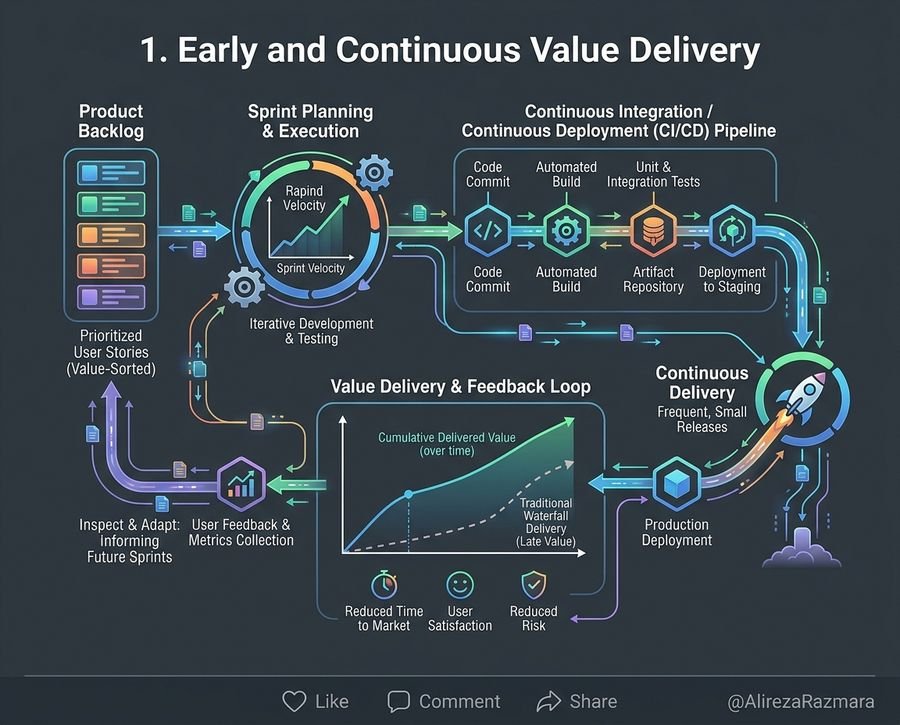
Early and continuous value delivery means shipping functional, usable software to customers in short cycles to validate assumptions. If your product takes six months to reach users, your organization is operating in a waterfall methodology, regardless of what you call your meetings.
We build software in a world of profound uncertainty. The only way to know if you are building the right thing is to put it in the hands of real people. Frequent releases generate immediate market feedback, allowing you to iterate rapidly based on data rather than executive intuition.
The Reality Check
Many teams conflate “delivering story points” with “delivering value.” You can burn through 100 points in a sprint, but if those features sit unreleased behind a massive integration phase, zero value has been delivered. Velocity is a vanity metric if the software isn’t in production.
The Fix
Shift your engineering focus to continuous integration and continuous deployment (CI/CD). Break massive initiatives into thin vertical slices that provide immediate utility. Your goal should be shrinking the lead time from a developer’s local machine to a live production environment. When you reduce batch sizes, you drastically lower deployment risk.
2. Embrace Change as a Competitive Advantage
Embracing change means viewing scope adjustments not as annoying distractions, but as strategic pivots that keep your product relevant. Great tech leaders build architectures and team processes that absorb shifting priorities effortlessly.
Rigid roadmaps give us a false sense of security. The market changes, competitor landscapes shift, and user needs evolve. An organization that resists change because it “disrupts the sprint plan” is optimizing for predictability at the expense of market relevance.
The Reality Check
Teams stuck in the “doing” Agile phase panic when requirements change. They point to locked scope documents and complain about scope creep. While protecting the current iteration is important, fiercely guarding a six-month roadmap against vital market data is a recipe for building a perfectly executed product that nobody wants.
The Fix
Adopt rolling-wave planning. Keep near-term backlog items highly detailed while leaving future work intentionally vague. On the technical side, invest in modular architectures and robust automated testing. Codebases that are easy to refactor allow engineers to pivot direction safely without breaking existing functionality.
3. Build Around Motivated Individuals (and Trust Them)
Servant leadership is the absolute bedrock of agility. You must provide your engineering teams with clear business context, the right tools, and unwavering support—then you must get out of their way.
Software engineering is highly complex, creative work. It cannot be managed like an assembly line. When leaders dictate exactly how a problem should be solved, they strip away the autonomy that drives deep engagement and innovation.
The Reality Check
Micromanagement kills velocity. I frequently observe organizations where developers must ask for permission to refactor code or update a library. This top-down control slows delivery to a crawl and turns brilliant engineers into mindless order-takers. Burnout spikes not just from long hours, but from a profound lack of agency.
The Fix
Shift from assigning tasks to assigning problems. Present the team with a clear customer pain point and let the engineers figure out the technical solution. Cultivate psychological safety where developers feel comfortable experimenting, failing, and learning without fear of punitive action.
4. High-Bandwidth Collaboration
High-bandwidth collaboration requires direct, real-time communication between developers, product managers, and business leaders to resolve blockers immediately. You must ditch the endless 20-comment ticket threads that stretch problem-solving across days.
Asynchronous communication is excellent for deep work, but it is terrible for resolving complex ambiguity. When teams rely solely on Jira comments to clarify requirements, nuance is lost, assumptions are made, and defects are written into the codebase.
The Reality Check
Ticket ping-pong is a massive drain on productivity. A developer leaves a comment, a product owner replies eight hours later, the developer misinterprets it, and two days are wasted on a conversation that would have taken three minutes over a quick video call or face-to-face chat.
The Fix
Encourage synchronous huddles for anything requiring debate or complex clarification. Co-locate teams when possible, or establish virtual “bullpen” hours where team members can work silently but ask questions in real-time. Make “talk to each other” the default process over “update the ticket.”
5. Sustainable Pace Over Heroics
A truly Agile team maintains a steady, predictable rhythm that keeps engineers energized sprint after sprint. High velocity should never be purchased at the cost of high burnout.
We have deeply ingrained cultural habits that celebrate the weekend coding marathon and the all-nighter deployment. While these heroic efforts might save a specific release, they incur massive technical and human debt. Exhausted developers write buggy code, skip writing tests, and eventually quit.
The Reality Check
If your team requires heroics to meet their sprint commitments, your planning process is broken. Chronic over-commitment usually stems from external pressure to hit arbitrary deadlines, rather than a realistic assessment of the team’s actual capacity.
The Fix
Track team capacity realistically, accounting for meetings, vacations, and inevitable operational interruptions. Stop rewarding the “hero” who fixed a critical bug at 3 AM, and start rewarding the team that built an automated pipeline so the bug never reached production in the first place. Predictability scales; heroics do not.
6. Relentless Continuous Improvement
Continuous improvement means regularly reflecting on your processes, adapting your workflows, and refining your execution based on real data. A retrospective without actionable experimentation is just a complaint session.
No process is perfect out of the box. What works for a team of five will break for a team of fifty. Agility requires an organizational muscle memory of constant, iterative self-correction. If your team operates exactly the same way today as they did a year ago, they have stopped improving.
The Reality Check
Many Scrum Masters run retrospectives as a mere administrative chore. The team vents about the same blockers—flaky staging environments, vague requirements, too many meetings—but nothing ever changes. Eventually, team members disengage, realizing that speaking up is a waste of breath.
The Fix
Limit your retrospective output to one or two concrete, actionable experiments for the next sprint. Assign clear ownership to these action items. In the following retrospective, review the results of the experiment before discussing new problems. Treat process improvement with the same rigor you apply to product development.
The Bottom Line: Agility as a Strategic Capability
Agile is not a rigid methodology you execute mechanically; it is a strategic capability to adapt, empower teams, and deliver maximum customer value. If your daily practices are not directly resulting in faster feedback loops, happier engineers, and better software, it is time to stop going through the motions.
Take a hard look at how your team operates this week. Look past the Kanban boards and the burndown charts. Are you truly adapting to change, or are you just efficiently marching toward a predetermined failure? Stop doing Agile. It is time to start being Agile.