
What is Servant Leadership in Agile?
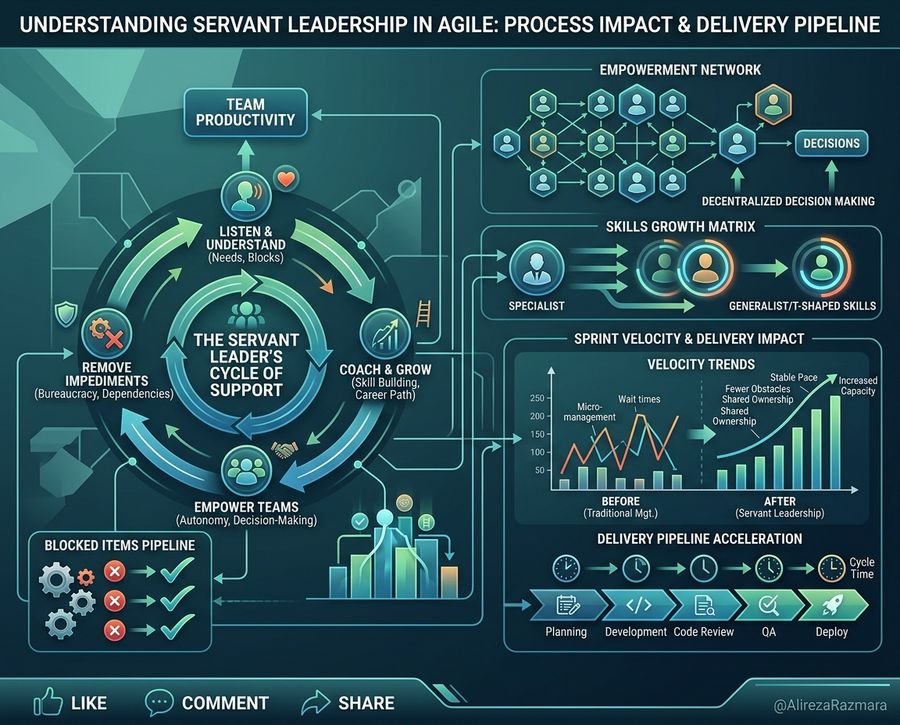
Servant leadership in Agile is the practice of acting as an active catalyst who removes systemic friction, empowers team autonomy, and optimizes delivery flow. It is not about being a passive administrator, a team secretary, or someone who simply updates Jira tickets and schedules meetings.
Let us kill the most pervasive myth in modern software development right now: servant leadership does not mean servitude. If you are running around acting like an administrative assistant for your development team, you are doing them a disservice. True servant leaders operate with a high degree of authority and influence, but they apply that influence toward dismantling obstacles rather than micromanaging people.
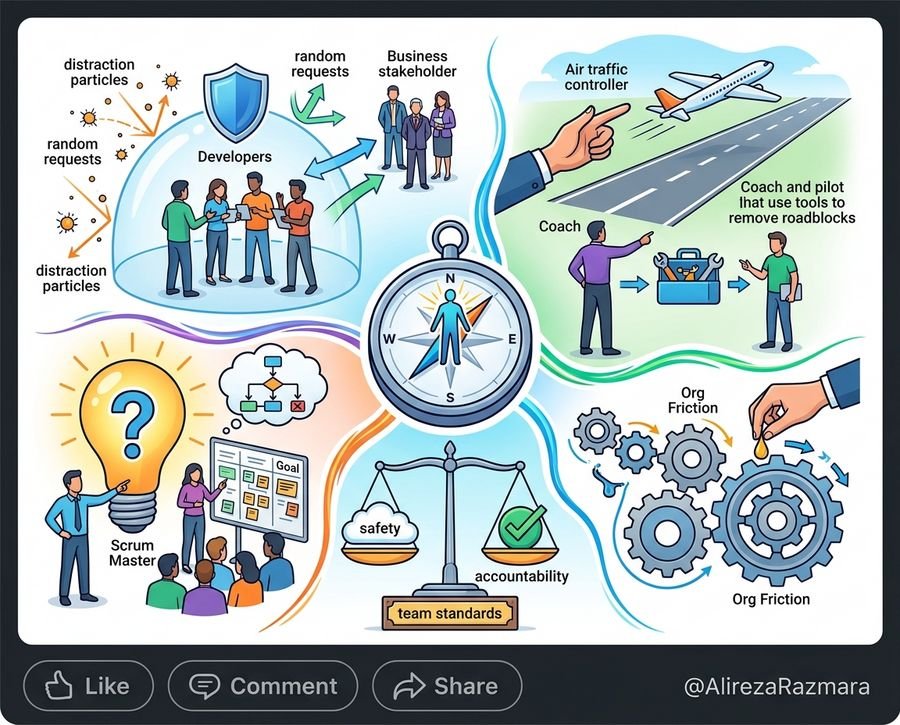
If you want to truly demonstrate servant leadership as a Scrum Master, Agile Coach, or Technical Project Manager, you must pivot away from administrative busywork. Great Agile leaders focus heavily on these five practical shifts to build operational flow and high performance.
1. Shield the Flow, Don’t Block the Signal
To protect flow without blocking the signal, a Scrum Master deflects distracting corporate noise while enabling direct, necessary communication between developers and business stakeholders. You must act as a contextual filter for your team, not a solid brick wall.
Developers require deep, uninterrupted focus to write maintainable code and solve complex architectural problems. Constant tap-on-the-shoulder requests, random Slack messages from sales, and mid-sprint scope changes destroy productivity through context switching. Your job is to intercept these distractions.
However, over-shielding creates a dangerous vacuum where critical business context dies. If you act as a proxy for every single conversation, you become a bottleneck. You end up playing a giant game of corporate telephone, passing requirements back and forth between engineering and product.
- The Anti-Pattern: Telling stakeholders they are never allowed to speak to developers and demanding all communication goes through you.
- The Practical Shift: Facilitate healthy, structured collisions. If a stakeholder has a complex feature question, do not try to answer the technical details yourself. Instead, facilitate a 15-minute timeboxed discovery session directly between the lead engineer and the stakeholder. Coach them both on how to communicate effectively.
2. Clear the Runway, Don’t Drive the Plane
Handling impediments as a servant leader means teaching the team how to navigate systemic roadblocks themselves rather than immediately solving every problem for them. This builds self-organizing resilience and prevents the team from developing a dependency on you.
It feels incredibly rewarding to be the hero. A build server goes down, and you immediately jump on the phone with DevOps. A cross-functional dependency blocks a critical user story, and you spend three hours chasing down the external team’s product owner. Stop doing this. When you rush in to solve every single problem, you unintentionally train your team in learned helplessness.
You want your team to build the muscle memory required to clear their own runway. Next time an impediment hits the board during the Daily Scrum, resist the urge to assign it to yourself.
- The Anti-Pattern: Acting as the sole impediment remover, ensuring the team cannot function if you take a week of PTO.
- The Practical Shift: Use coaching stances to guide the resolution. Ask the team, “Who is the best person equipped to talk to the infrastructure team about this?” or “What do you need from me to help you escalate this?” Give them the tools and the organizational air cover to fix their own problems.
3. Ask Powerful Questions Over Giving Answers
Agile coaches ask questions instead of providing direct solutions because guided discovery forces teams to take ownership of their processes and technical decisions. Telling teams what to do creates basic compliance; asking them what they should do cultivates mastery and true ownership.
Organizations frequently hire incredibly smart, capable engineers and then dictate exactly how they should work. This is a massive waste of human potential. As an Agile leader, you need to shift your default stance from giving advice to sparking discovery. Even if you know the answer to a process issue, handing the team the solution rarely results in long-term behavioral change.
If the team keeps failing to meet their Sprint Goal, do not walk into the Retrospective and say, “We are taking on too much work, we need to reduce our velocity.” They will nod, comply, and learn nothing.
- The Anti-Pattern: Diagnosing the team’s problems and prescribing the exact workflow adjustments they need to make.
- The Practical Shift: Leverage powerful, open-ended questions. Try asking: “What is actually stopping us from deploying to production with confidence right now?” or “If we could only change one thing about how we refine our backlog, what would give us the highest return?” Let the uncomfortable silence hang in the room. Someone will eventually speak up, and the solution they design will be one they actually respect.
4. Balance Psychological Safety with Accountability
Psychological safety gives teams the cover to fail fast and learn openly, while accountability ensures those learnings translate into high-quality delivery. Safety without accountability breeds complacency, just as accountability without safety breeds fear and hidden mistakes.
Psychological safety is currently a heavily misused buzzword. Many organizations misinterpret it as “an environment where no one ever gets criticized and all ideas are perfect.” That is fundamentally incorrect. Psychological safety simply means team members can speak hard truths, admit mistakes, and pitch wild ideas without fear of punitive retaliation.
When a sprint crashes and burns, a servant leader ensures there is no witch hunt for a scapegoat. You look at the systemic data. However, you must also hold the team accountable to their own Definition of Done. Failing to challenge poor quality or lazy engineering practices is just ruinous empathy. High-performing teams actually want to be held to an exceptionally high standard.
- The Anti-Pattern: Letting missed commitments and dropping code quality slide continuously under the guise of “protecting the team’s feelings.”
- The Practical Shift: Frame accountability around the team’s own agreed-upon working agreements. “We agreed as a team that no code merges without two peer reviews. I’m noticing we bypassed that twice this sprint. What is driving that behavior, and how do we correct it?” Challenge the behavior, never the individual’s character.
5. Optimize the System, Not Just the Sprint
A Scrum Master optimizes the system by looking beyond the immediate team boundaries to fix organizational friction, cross-functional dependencies, and leadership misalignment. True servant leadership scales outward to improve the entire enterprise value stream.
You can run the perfect Daily Scrum, facilitate engaging retrospectives, maintain flawless burndown charts, and still entirely fail to deliver value to the customer. Why? Because if the deployment process requires manual sign-offs from three different vice presidents and takes a month to complete, your two-week sprint efficiency is entirely irrelevant.
Great Agile practitioners act as systems thinkers. They map out the entire value stream from idea conception to production deployment. If the friction slowing your team down lives outside your team, that is exactly where you need to go to work.
- The Anti-Pattern: Focusing 100% of your energy purely on Scrum events and internal team dynamics while ignoring glaring enterprise bottlenecks.
- The Practical Shift: Start tracking Lead Time alongside your sprint metrics. Take the data to middle management and leadership. Say, “My team can build this feature in five days, but our current staging environment constraints force it to sit idle for fifteen days. Let’s talk about fixing the staging environments.” Fix the system, and the sprint often fixes itself.
Transforming from Administrator to Catalyst
Ultimately, great Scrum Masters and Agile leaders do not manage people, and they certainly do not manage tasks. They optimize delivery systems and liberate human potential to deliver real user value.
Servant leadership requires courage. It requires the willingness to step back and let the team stumble, the bravery to push back against overbearing stakeholders, and the analytical mind to troubleshoot broken organizational processes.
Take a hard look at your calendar and your daily habits. Which of these five practices requires your biggest focus this sprint? Start small. Pick one area—whether it is asking better questions or tracking down a systemic bottleneck—and begin practicing true servant leadership today.