
🎧 Listen In: Why Senior Developers Go Rogue (19 min )
The Call to Arms: Dealing with the Rogue Developer
You check your project dashboard and see it. Your most senior developer just pushed code straight to the main branch, bypassed the testing gate, and marked a critical user story as complete without a peer review. As an Agile Coach, Scrum Master, or Technical Lead, your blood pressure spikes. The immediate temptation is to grab the Scrum Guide, call a mandatory meeting, and play the role of the Agile Police.
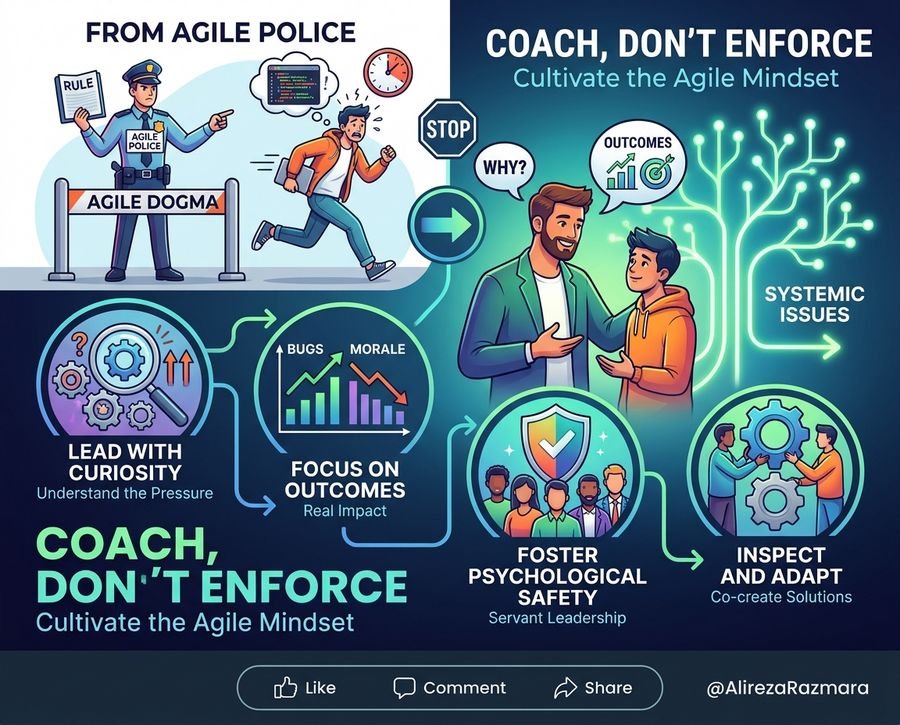
Stop right there. Taking a punitive approach is the fastest way to lose the respect of your engineering team. When a veteran team member goes rogue and bypasses core principles, it is almost never about malice or arrogance. It is a massive, flashing warning light pointing to a deeper systemic issue. Enforcing compliance will not fix the root cause. Effective coaching will. Here is a battle-tested framework for turning a rule-breaker into a catalyst for genuine team improvement.
Why Do Senior Developers Ignore Agile Practices?
Senior developers usually ignore Agile principles because they are reacting to severe systemic pressures, such as unrealistic management deadlines, bloated internal processes, or misaligned product incentives. They cut corners because the surrounding business environment makes doing the right thing too difficult or too slow.
When a highly experienced engineer skips code reviews, bypasses quality assurance limits, or ignores Work in Progress (WIP) constraints, they are making a calculated trade-off. They are trying to survive a broken delivery system. Perhaps the Product Owner promised a feature delivery date to a massive client without consulting the engineering team. Maybe your CI/CD pipeline takes forty-five minutes to run, and the developer just wanted to unblock a junior teammate before the weekend.
Before you assume you have a behavioral issue on your hands, look at the ecosystem surrounding the developer. Punishing the individual while ignoring the environment guarantees the behavior will repeat. You must fix the habitat before you blame the resident.
The Danger of the “Agile Police” Mentality
Playing the Agile police means enforcing framework rules through authority and reprimand rather than understanding the root cause of a deviation. This mentality destroys team trust and forces developers to hide their shortcuts rather than openly address the underlying workflow issues.
If you approach a senior engineer with a clipboard-checker attitude, you immediately create an adversarial relationship. Developers are pragmatists. They value working software over comprehensive documentation and rigid rules. If they perceive Agile as just another layer of middle-management bureaucracy designed to micromanage their output, they will actively subvert it. Your job is not to ensure 100% compliance with a theoretical framework. Your job is to facilitate the delivery of high-quality software at a sustainable pace.
Step 1: Lead with Curiosity, Not Condemnation
Leading with curiosity means asking exactly why a shortcut was taken before assigning blame, treating the deviation as a valuable clue about a process bottleneck rather than a behavioral flaw. You start the conversation seeking context, not a confession.
The next time you see a bypassed standard, pull the developer into a quick, informal one-on-one. Keep your tone entirely neutral. Say something like, “I noticed we shipped the payment module today without the usual integration test coverage. Can you walk me through what happened there?”
Listen closely to their answer without interrupting. You are looking for the hidden constraints in their daily workflow:
- Are they under extreme, unspoken pressure from stakeholders?
- Is the testing environment constantly down or unreliable?
- Are they drowning in technical debt that makes proper implementation impossible?
By asking open-ended questions, you transform a tense confrontation into a collaborative problem-solving session. You stop being an enforcer and become an ally. The vast majority of engineers want to write quality code. If they aren’t doing so, you need to find out what is standing in their way.
Step 2: Ditch the Jargon and Focus on Tangible Outcomes
You resolve Agile compliance issues by connecting the broken practice directly to its technical or business impact, avoiding framework jargon entirely. Nobody cares about violating the theoretical values of a manifesto, but every engineer cares about breaking the production build.
Walking up to a senior developer and saying, “You aren’t respecting our Scrum values,” is a surefire way to get ignored. It sounds academic and detached from the physical reality of shipping software. Instead, ground your feedback in the actual pain caused by the shortcut.

Frame the conversation around cause and effect. Try phrasing it like this: “When we skip the peer review process, our bug rate in production doubles. That leads to weekend hotfixes, which burns out the whole team and delays our actual roadmap.”
Notice the subtle difference? You are not policing a framework. You are protecting the team’s sanity and the product’s stability. Engineers respect data, logic, and systems thinking. Speak their language. Connect the specific action to the direct consequence, and leave the buzzwords at the door.
Step 3: Foster Psychological Safety to Shield the Team
Psychological safety is built when leaders actively protect their teams from toxic external pressures, allowing developers to admit when aggressive timelines force them to cut corners. It is the absolute foundation of any high-performing engineering culture.
If your senior dev feels forced to rush features out the door to satisfy a demanding stakeholder, you need to look in the mirror. Are you doing your job as a Servant Leader? It is your responsibility to act as a heat shield for your team. When executives demand the impossible, you must push back. You must make the technical trade-offs highly visible to the business.
Create a genuinely safe space during your retrospectives. Ask point-blank, “Are we committing to too much this sprint?” If the team says yes, you have to back them up immediately. If an engineer knows you will defend them when they say a feature needs two more days to be built correctly, they will stop taking reckless shortcuts. Developers rush because they are afraid of the consequences of being late. Remove that fear, and architectural quality will naturally return.
Step 4: Inspect, Adapt, and Challenge the Process
When an Agile practice consistently slows a team down without adding clear value, you must adapt or discard that practice rather than forcing strict compliance. Agile is a living mechanism meant to serve the team, not a rigid dogma the team must blindly serve.
Sometimes, the rogue developer is actually right. Take a hard, objective look at the rule they broke. Is your “Definition of Done” bloated with unnecessary red tape? Do you require three different managerial approvals just to merge a minor CSS fix? If a highly capable engineer is bypassing a process, it might be because the process itself is fundamentally broken.
Use this as a prime opportunity to inspect and adapt. Bring the issue to the wider team. Ask them: “We’ve been struggling to stick to this specific code review policy. Is it actually catching bugs, or is it just acting as a bottleneck?”
If the team agrees the practice is useless, kill it immediately. If the practice is actually critical—like security vulnerability scanning—co-create a more sustainable, frictionless way to follow it. Pair programming might replace asynchronous pull requests. Automated testing might replace manual QA gates. Fix the system.
Engineering the Path of Least Resistance
The most effective way to ensure Agile practices are followed is to design workflows where the correct behavior is the absolute easiest action to take. Great technical leaders do not demand compliance; they engineer environments of least resistance.
If writing a unit test takes ten seconds and runs instantly, people will write tests. If deploying to a staging environment is a single click, people will use it. When you rely entirely on discipline, nagging, and process enforcement to maintain Agile principles, you have already lost the battle.
Your ultimate goal is to build a culture of shared ownership. When developers deeply understand the “why” behind a process, and when that process is explicitly designed to support rather than hinder them, enforcement becomes completely obsolete. Shift your daily energy from policing human behavior to removing technical friction.
The next time your senior developer ignores an Agile principle to rush a feature out, take a breath. Put away the rulebook. Get genuinely curious. Protect your team from external chaos. Adapt your workflow to reality. That is what true Agile leadership looks like in the real world.