
The Anatomy of a Broken Standup
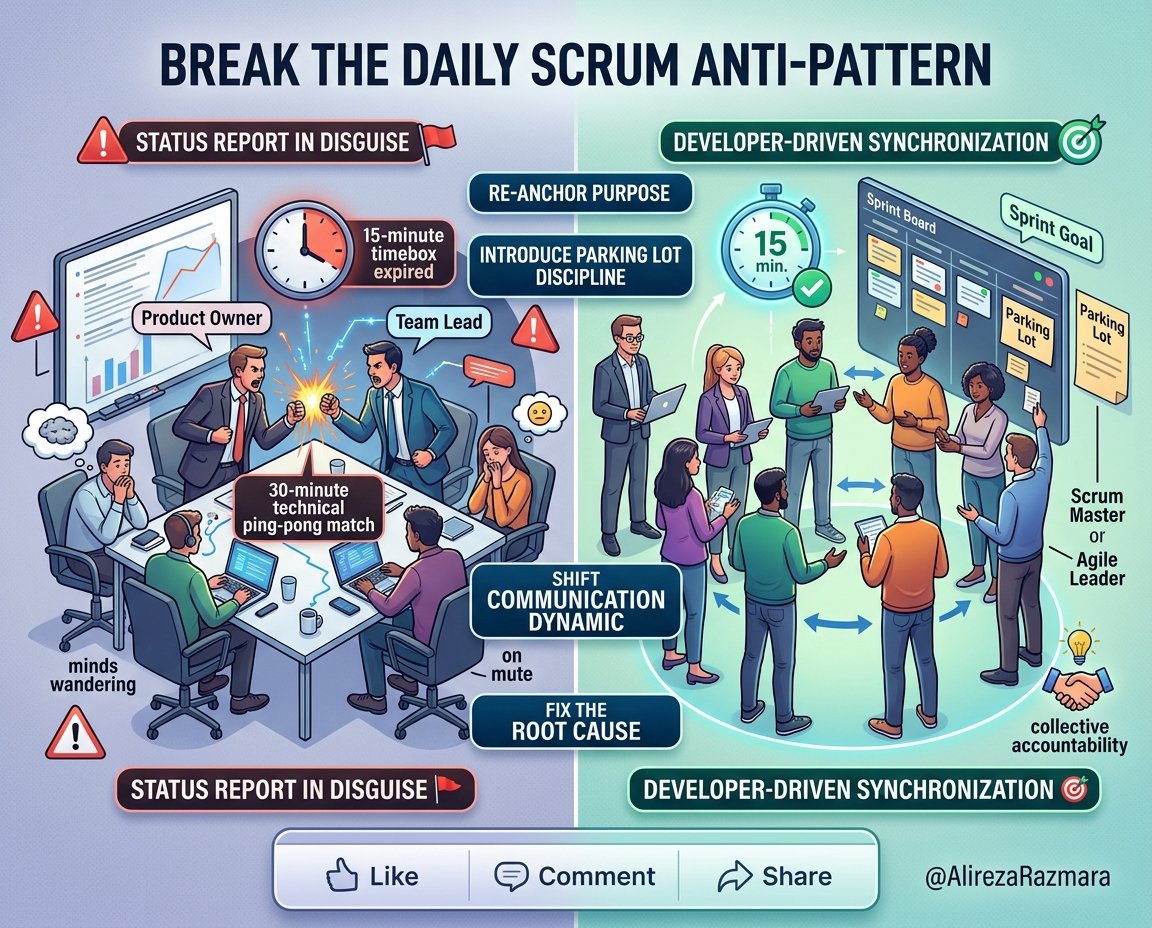
Picture this scenario. The 15-minute timebox expired five minutes ago. The development team is staring at their screens on mute, minds wandering toward their morning coffee. Meanwhile, the Product Owner and the Tech Lead are locked in a relentless 30-minute technical ping-pong match about an architectural nuance that only affects two people.
Sound familiar? It happens everywhere.
This is one of the most toxic Daily Scrum anti-patterns in modern software delivery. When the standup shifts from developer-driven synchronization to a two-person status report, psychological safety drops. Collective accountability vanishes entirely. Agile relies heavily on self-organization, but if your morning sync feels like a roll-call, you are accidentally running an executive reporting briefing.
Let’s fix it. Here is a field-tested guide to rescuing your Daily Scrum from the micro-management trap and giving it back to the people doing the work.
What is the True Purpose of the Daily Scrum?
The Daily Scrum is a 15-minute daily planning event created strictly for the Developers to inspect progress toward the Sprint Goal and adapt their plan for the next 24 hours. It is not a status update for management, a general problem-solving session, or a platform for backlog negotiation.
If you look at the core Agile frameworks, the mandate is clear. It exists to reduce complexity and keep the engineering team aligned. When developers use this time to synchronize their work, identify blockers, and adjust the Sprint Backlog, the team moves faster and delivers more predictable increments.
Unfortunately, many teams drift. They default to the easiest, lowest-value communication model: reciting what they did yesterday to a person in authority. This turns a highly strategic planning huddle into a tedious, low-energy ritual where everyone simply waits for their turn to speak.
4 Warning Signs Your Standup is a Status Meeting
You can spot a status meeting disguised as a Daily Scrum by looking closely at who speaks, who they look at, and what they discuss. If team members only make eye contact with the Scrum Master or Product Owner, you have a status meeting.
Here are the specific red flags you should look for as an Agile leader:
- The Manager Update Dynamic: Developers direct their updates exclusively to the Team Lead, Scrum Master, or Product Owner, rather than addressing their peers.
- Hyper-Fixation on Metrics over Goals: The conversation focuses on logging hours, closing sub-tasks, or justifying time spent, rather than asking, Are we on track to hit the Sprint Goal?
- The Technical Rabbit Hole: Two people hijack the conversation to debate database schemas or API architecture while the rest of the team tunes out.
- Live Problem Solving: Instead of flagging a blocker to address immediately after the standup, the team tries to solve the bug live on the call.
- Lopsided Talk Time: The Product Owner and Tech Lead account for 80% of the talking time in a team of eight engineers.
How to Break the Status Meeting Anti-Pattern
Fixing a broken Daily Scrum requires active facilitation and a willingness to interrupt bad habits. You must protect the team’s focus and gently coach leadership out of the spotlight.
Here is exactly how you break the cycle and rebuild a healthy Agile routine.
1. Re-anchor the Core Purpose
Reset the baseline expectations immediately. You must reiterate that the Daily Scrum is for the Developers, by the Developers. It exists to inspect progress toward the Sprint Goal, not to give leadership a warm feeling of control.
Start your next Sprint with a quick alignment exercise. Remind the team that they do not owe the Scrum Master a status report. They owe each other a plan for the day. If a developer says, Yesterday I worked on ticket 402, challenge them to reframe it contextually: I finished the authentication module, so Sarah, you can start integrating the front end today.
2. Introduce the Strict Parking Lot Discipline
The moment a topic involves only two people or dives into architectural nuance, you must step in. Do not wait for a polite pause.
Interrupt politely but firmly: “This sounds critical. Let’s park it for a dedicated follow-up right after the 15-minute mark.”
Maintain a visual or digital Parking Lot board during the meeting. When a tangent begins, write it down. This acknowledges the importance of the conversation without letting it hold the entire engineering team hostage. Once the 15 minutes are up, officially close the Daily Scrum and dismiss anyone who isn’t needed for the parked items.
3. Shift the Communication Dynamic
Coach the Team Lead and Product Owner to physically or virtually step back. If developers naturally direct their updates to the Lead, you have to break the visual or conversational loop.
In remote environments, encourage the team to look at the shared Sprint Board and address their peers. If a developer gives an update and asks the Product Owner if it sounds good, the PO should seamlessly redirect the question to the team. A simple, Don’t ask me, ask the developers building it with you, works wonders to rebuild peer-to-peer accountability.
4. Fix the Root Cause Outside the Standup
People hijack the Daily Scrum because it is often the only time they have everyone in one room. If the Product Owner and Tech Lead genuinely need 30 minutes of daily alignment, give them that space separately.
Schedule a daily 15-minute sync specifically for the Product Owner and Tech Lead right before the Daily Scrum. Let them hash out priority shifts, backlog debates, and stakeholder pressures there. By the time they enter the team’s standup, they are aligned and far less likely to use the event for their own negotiations.
Coaching Leadership Out of the Micro-Management Trap
Managers and leaders often crash the Daily Scrum with the best of intentions. They want visibility. They want to unblock the team. They want to ensure the investment is tracking well. But their over-involvement kills the very autonomy that drives high performance.
To fix this, you need to provide leaders with alternative visibility mechanisms. Show them how to read the Sprint Board effectively. Walk them through burn-down charts, cycle time metrics, or cumulative flow diagrams. Prove to them that the data they crave is already available asynchronously, without needing to interrogate developers every morning.
If a leader insists on attending the Daily Scrum, set strict rules of engagement. They attend as silent observers. They do not ask probing questions during the 15-minute timebox. If they see a risk, they take it to the Scrum Master or follow up with specific individuals after the standup closes.
Measuring the Success of a Healthy Daily Scrum
You know your Daily Scrum is functioning correctly when the event naturally ends in under 15 minutes and the team walks away with a clear, shared plan for the day. Energy levels remain high. Developers immediately break off into small pairs to tackle the parked items.
Track this cultural shift by observing the team’s language. A healthy team routinely uses phrases like I need help with this, I will pass this to you this afternoon, and Are we going to miss the Sprint Goal if we ignore this bug? This indicates active collaboration and high psychological safety. You will also notice a steep drop in the time it takes to resolve daily blockers, simply because developers are actually listening to each other instead of zoning out while management talks.
Standups should empower your team, not drain them. Stop running micro-management briefings. Give the Daily Scrum back to the developers, protect the timebox aggressively, and watch your team’s autonomy and delivery speed thrive.