
Listen In: Fixing the Broken Daily Stand-Up (18 min)
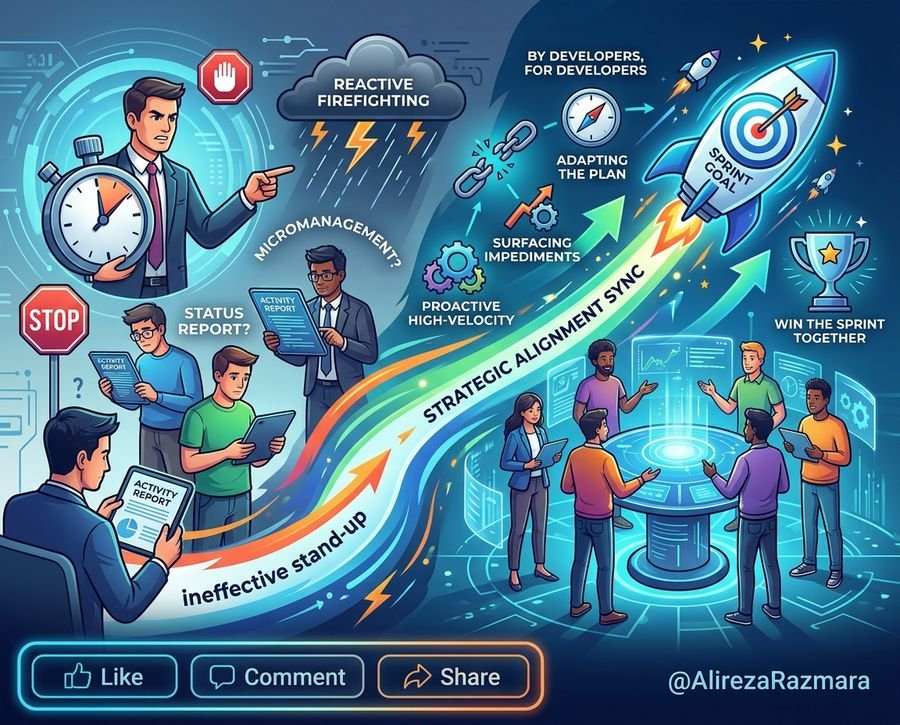
If your Daily Stand-Up feels like a 15-minute micromanagement interrogation, stop immediately. You are doing it wrong. The Daily Scrum is absolutely not a status report for managers, stakeholders, or even the Scrum Master. It is a fast-paced, strategic alignment event built specifically by the developers, for the developers.
Far too many teams treat their morning sync like a confessional. Engineers stand in a circle (or stare at a grid of Zoom squares) and justify their paychecks by listing everything they did yesterday. This reactive routine drains team energy and completely misses the point of agile frameworks.
When executed correctly, this strict 15-minute daily ritual transforms reactive firefighting into proactive, high-velocity execution. It creates a shared cadence where the team collectively looks at the board, assesses reality, and makes tactical decisions for the day ahead. Let us unpack exactly how to rebuild a high-performing Daily Stand-Up.
What is the True Purpose of the Daily Stand-Up?
The true purpose of the Daily Stand-Up is to inspect progress toward the Sprint Goal and adapt the sprint backlog for the next 24 hours. It is a strategic planning session where the development team identifies immediate priorities, coordinates dependencies, and surfaces blockers. It is not an update on individual task hours or a venue for management oversight.
Agile is built on the concept of empirical process control: transparency, inspection, and adaptation. If your team only uses the daily sync for transparency (saying what they did) but fails to inspect the actual progress and adapt the plan, they are only doing one-third of the job.
Great teams do not use the Daily Scrum to track work. They use it to win the Sprint together.
Clear Signs Your Daily Sync is Broken
Before you can fix the problem, you have to diagnose it. Most broken stand-ups share identical anti-patterns. If any of the following behaviors are common on your team, your process needs an immediate overhaul.
- The Manager’s Q&A: The Scrum Master, Product Manager, or Tech Lead stands at the center of the conversation, and every developer directs their update solely to that person. This destroys self-organization.
- The Jira Reading Session: Developers literally read the titles of Jira tickets out loud. “Yesterday I worked on PRJ-402, today I am still working on PRJ-402.” This provides zero context, zero value, and wastes everyone’s time.
- Problem-Solving Rabbit Holes: Two engineers start debating the nuances of a specific API payload or a database schema design, holding the rest of the team hostage for twenty minutes.
- Ignoring the Sprint Goal: The team talks endlessly about individual side-tasks, operational support, or administrative duties, without ever mentioning whether the core commitment of the sprint is at risk.
How to Run a High-Performing Daily Stand-Up
A high-functioning team operates differently. They do not talk about themselves; they talk about the work. Here are the three critical pillars of a value-driven daily sync.
1. Inspecting Progress Toward the Sprint Goal
The primary focus of the meeting is not individual activity, but collective outcomes. Every conversation should anchor back to a single question: Are our daily efforts moving us closer to fulfilling our Sprint commitment?
To achieve this, ditch the traditional “round-robin” format where you go person-by-person. Instead, adopt a practice called “Walking the Board.” Open your Kanban or Scrum board, start at the far-right column (the items closest to being ‘Done’), and work your way left.
Ask the team: “What do we need to do collectively to get this specific ticket into production today?” This subtle shift changes the psychology of the room. It prevents engineers from hoarding their own tasks and encourages them to swarm on work that is nearly finished, ultimately accelerating delivery.
2. Surfacing Impediments Early
This is where psychological safety shines. A successful stand-up requires an environment where developers feel entirely comfortable raising a red flag. Team members must highlight blockers immediately, whether they are facing crippling technical debt, delayed cross-team dependencies, or ambiguous product specifications.
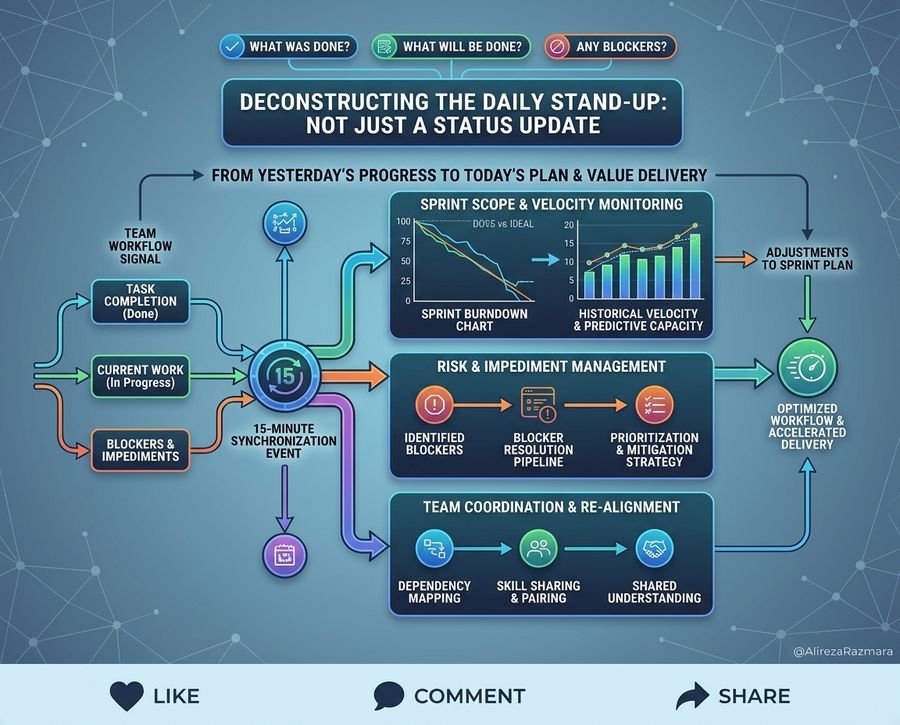
If a developer is stuck, they should not suffer in silence to avoid looking incompetent. The phrase “I am blocked” should be celebrated as a proactive measure, not penalized as a failure. Once a blocker is surfaced, the Scrum Master and Tech Lead can clear the runway, allowing the developer to get back to writing code rather than chasing down permissions from the infrastructure team.
3. Adapting the Plan for the Next 24 Hours
Agile is fundamentally about responsiveness. The daily sync is where the team actively re-evaluates priorities, reallocates pairings, and adapts their strategy based on the discoveries made yesterday.
Software engineering is unpredictable. You might uncover a nasty edge case that turns a 2-point story into an 8-point nightmare. The stand-up is the moment to pivot. If a specific feature is dragging, an engineer should say, “This authentication bug is much deeper than we thought. Can someone pair with me right after this call?” This real-time resource reallocation is the hallmark of a mature agile team.
Mastering the “Parking Lot”
How do you keep the meeting strictly under 15 minutes when complex technical issues arise? You use a Parking Lot. A Parking Lot is a designated space at the end of the stand-up for deep-dive discussions that only involve a subset of the team.
When those two engineers start debating the database schema on minute four of the stand-up, a strong Scrum Master or peer steps in and says, “Great topic. Let’s put that in the Parking Lot.”
Once the 15-minute timebox expires and the broader team is aligned on the daily plan, the core meeting ends. Anyone who does not need to be involved in the database debate drops off the call or leaves the room to start coding. Only the relevant engineers remain to solve the problem. This respects everyone’s time while still ensuring critical technical conversations happen.
The Pro-Tip for Tech Leaders and Project Managers
If you hold a leadership title—Engineering Manager, Product Owner, or Senior PM—your presence at the Daily Scrum can inadvertently break it. Your team might default to treating you as an authority figure, shifting their body language and updates toward you.
Step back. Resist the urge to turn the Stand-Up into a status gathering session. Your engineering team needs to self-organize and take ownership of their delivery. If you ask probing questions about task statuses, you are training them to be reactive subordinates rather than proactive problem solvers.
Your primary role at this event is to listen silently, identify systemic issues, and unblock the team when they request help. You are a facilitator of their success, not a monitor of their hours. Empower them to hold each other accountable.
Transforming the Routine
Moving away from a micromanagement-heavy stand-up requires deliberate effort. It requires breaking years of corporate conditioning where developers were taught that “looking busy” was more important than “delivering value.”
Start tomorrow. Ask your team to try walking the board. Stop asking “What did you do yesterday?” and start asking “How do we cross the finish line on this feature today?” Enforce the Parking Lot mercilessly to protect the team’s time. When you shift the focus from individual status to collective strategy, the Daily Scrum transforms from a dreaded morning obligation into the most valuable 15 minutes of your team’s day.