
Too many engineering organizations fall into the trap of “mechanical Scrum.” You know exactly what this looks like. Teams robotically go through the motions, execute the ceremonies, and check the boxes, yet entirely miss the value. The result? Exhausted developers, frustrated product owners, and Sprints that feel like a relentless feature factory.
If your team is constantly rolling over tickets, dreading the daily standup, or viewing the retrospective as a pointless venting session, you have a fundamental problem. Your tech team isn’t running Sprints. Your Sprints are running you.
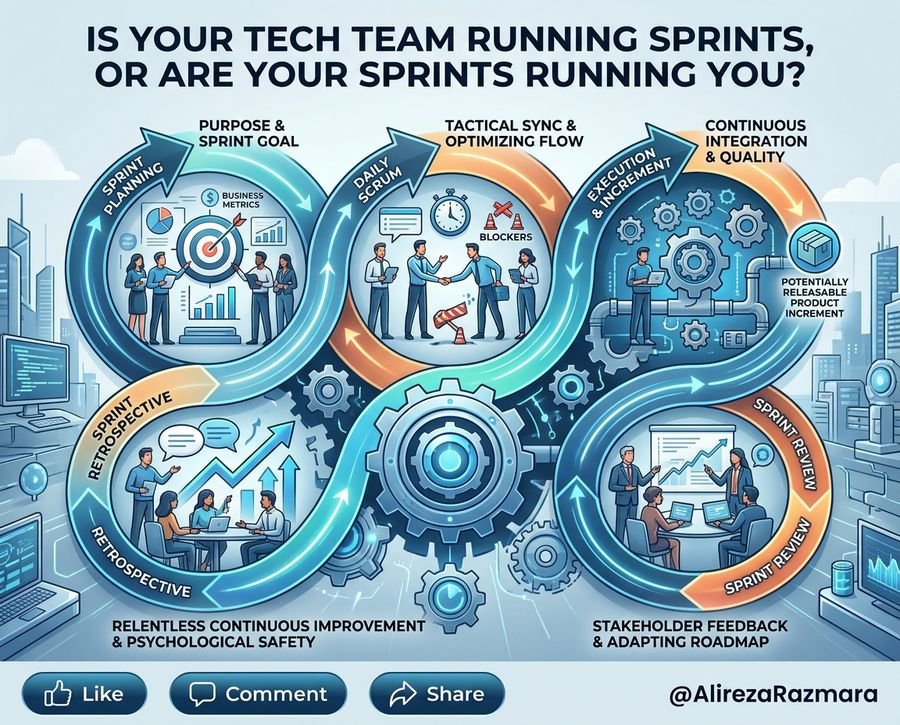
The secret to high-performing teams isn’t memorizing Scrum steps. It is mastering the Sprint Lifecycle as a synchronized engine for predictable value delivery and team empowerment. Let’s break down how elite software teams elevate these core events from tedious calendar invites into a distinct competitive advantage.
What is the Sprint Lifecycle and Why Does It Matter?
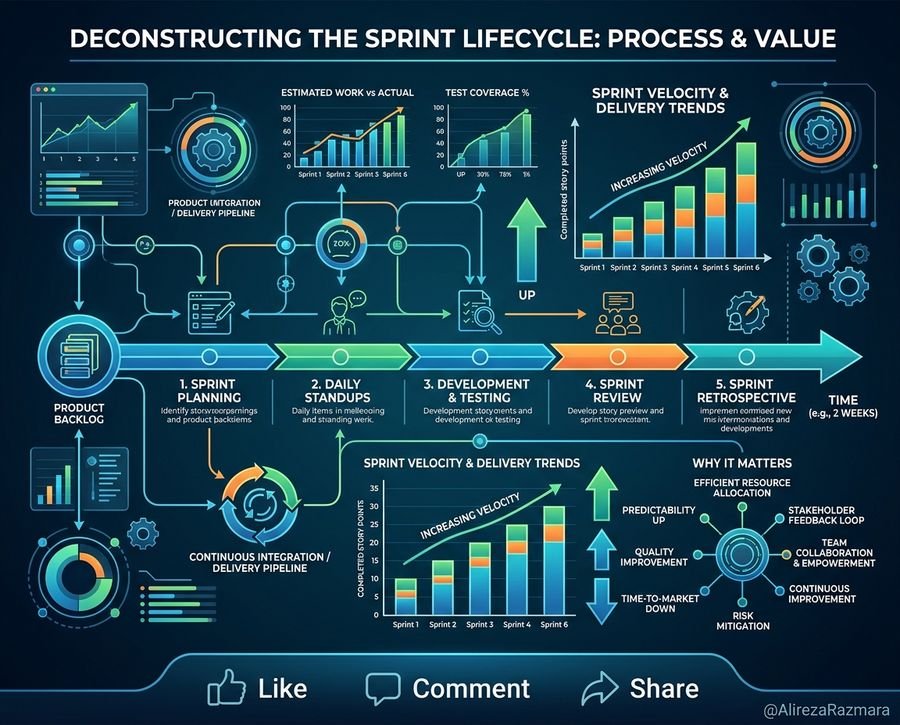
The Sprint Lifecycle is the continuous, time-boxed sequence of Agile events—Planning, Daily Scrum, Execution, Review, and Retrospective—designed to deliver working software iteratively. It matters because when executed with intent, this cycle transforms unpredictable software development into a reliable, feedback-driven value engine.
Agile leadership isn’t about enforcing rules blindly. It requires creating an environment where this dynamic cycle breeds trust, speed, and continuous improvement. Moving from a beginner team to an elite one requires shifting your focus from compliance to intent. Here is how you optimize each phase of the lifecycle.
1. Sprint Planning: From Ticket Packing to Purpose
Sprint Planning is the critical starting point where the team defines the exact business value they will deliver over the upcoming iteration and how they will achieve it. The goal is to establish a clear, unified Sprint Goal rather than simply cramming a backlog with random, disconnected tickets.
The Mechanical Trap
In low-maturity teams, planning looks like a prolonged negotiation over story points. The Product Owner reads off a list of tickets, the developers try to guess how much they can squeeze into two weeks based on historical velocity, and everyone leaves feeling overwhelmed. There is no narrative. There is just a bucket of tasks.
The Coach’s Fix
Elite teams start with the Sprint Goal. This is a single, compelling objective that connects engineering work directly to business outcomes. For example, instead of “complete 40 story points,” the goal becomes “enable users to securely reset their passwords via SMS.”
- Define the “Why” first: What is the most important problem we need to solve in the next two weeks?
- Pull, don’t push: Developers must pull work into the Sprint based on their actual capacity, not have it pushed onto them by aggressive deadlines.
- Leave slack in the system: Aim for 80% utilization. If you plan for 100% capacity, a single production bug will derail the entire iteration.
2. The Daily Scrum: Tactical Alignment, Not a Status Report
The Daily Scrum is a 15-minute tactical synchronization meeting held by and for the developers to inspect progress toward the Sprint Goal and adapt their plan for the next 24 hours. It is an alignment tool to optimize flow, pivot quickly, and eliminate blockers.
The Mechanical Trap
We have all attended painful standups. The Scrum Master acts like a project manager, calling on team members one by one. Developers mumble through the three standard questions (“Yesterday I wrote code, today I will write code, no blockers”) while everyone else zones out. It is a micromanaged status report that adds zero value.
The Coach’s Fix
Ditch the rigid three-question format. Turn the Daily Scrum into a strategy session.
- Walk the board: Start from the right side of your Jira (or equivalent) board—the items closest to “Done”—and work backward. Ask: “What do we need to do together to get this specific ticket across the finish line today?”
- Focus on flow, not busyness: It does not matter if a developer is busy. What matters is if the work is moving.
- Take it offline: If a technical discussion starts dragging on past two minutes, call a “parking lot” and move it to a post-sync huddle with only the necessary people.
3. Execution & Increment: Building Quality In
Sprint Execution is the active building phase where the team writes, tests, and integrates code to create a potentially releasable product increment. The primary focus here must be on continuous integration and maintaining high quality from day one, avoiding late-stage technical debt.
The Mechanical Trap
In mechanical Scrum, developers code in silos for eight days. On day nine, they throw everything over the wall to QA. Integration conflicts explode. Bugs pile up. The Sprint ends with five tickets sitting in the “In Review” or “Testing” columns, leading to a massive carryover into the next Sprint.
The Coach’s Fix
You cannot bolt quality onto a product at the end of a Sprint. You have to build it in.
- Swarm on tickets: Stop having five developers working on five separate features. Encourage pair programming and mobbing to finish one feature before starting the next. Limit your Work In Progress (WIP).
- Shift testing left: Quality assurance isn’t a final phase; it is a continuous activity. Write automated tests alongside the code.
- Strict Definition of Done (DoD): Done doesn’t mean “it works on my machine.” Done means code is reviewed, tested, integrated, documented, and fully ready to deploy to users.
4. The Sprint Review: Closing the Feedback Loop
The Sprint Review is a collaborative working session held at the end of the Sprint to inspect the working software with stakeholders and adapt the product roadmap based on real data and feedback. It is a strategic pivot point, not just a one-way presentation.
The Mechanical Trap
Many teams treat the Review as a passive “demo theater.” The team shows off a few features to stakeholders who nod silently, applaud politely, and log off. There is no discussion about market changes, user feedback, or roadmap adjustments. Worse, teams sometimes present slides instead of actual working software.
The Coach’s Fix
Treat this event as a vital feedback loop. You want stakeholders to actively engage with the product.
- Show real software: Never demo from a PowerPoint or a staging environment that isn’t representative of production. Inspect the actual increment.
- Discuss the misses: Be transparent about what you didn’t achieve. If you missed the Sprint Goal, explain why and what you learned. This builds immense trust with the business.
- Adapt the backlog: Spend the last 15 minutes discussing what comes next. Did a stakeholder’s feedback just invalidate an upcoming feature? Great. Adjust the product backlog right there.
5. The Sprint Retrospective: The Engine of Continuous Improvement
The Sprint Retrospective is the most critical event in the Agile framework, designed for the team to inspect how they worked together and identify actionable ways to improve their process, tools, and relationships. It requires psychological safety and a commitment to incremental upgrades.
The Mechanical Trap
Teams run out of time and skip the Retrospective, or it devolves into a superficial “Start, Stop, Continue” exercise where the same minor complaints (e.g., “too many meetings”) are raised Sprint after Sprint without anything ever changing. It becomes an empty ritual.
The Coach’s Fix
If you only have time for one Agile event, make it the Retrospective. This is where your team upgrades its own process engine.
- Establish psychological safety: Start with the Prime Directive. Everyone must believe that regardless of what was discovered, everyone did the best job they could given what they knew at the time. No blame games.
- Focus on one clear action item: Do not try to fix ten things at once. Identify the single biggest bottleneck impacting the team right now.
- Assign accountability: An action item without an owner is just a wish. Assign a specific person to drive the process change in the very next Sprint, and put that action item physically on the Sprint backlog.
Shifting from Rules to Rhythm
Scrum is not a rigid rulebook meant to micromanage developers. It is a continuous rhythm. When you shift your perspective from just checking off calendar events to genuinely mastering the Sprint Lifecycle, everything changes.
Planning becomes purposeful. Standups become tactical. Execution drives quality. Reviews generate crucial business pivots. Retrospectives build unstoppable teams.
Take a hard look at your current iteration. Which phase of the Sprint Lifecycle is currently your team’s biggest bottleneck? Stop going through the motions. Identify the mechanical traps in your current process, apply these tactical fixes, and watch your tech team evolve from a stressed-out feature factory into a highly predictable, high-performing value engine.