
Listen In: A high-stakes debate on translating Agile bottlenecks into executive-level financial metrics, the hidden cost of the Context Switching Tax, and calculating your true Cost of Delay (17 Min).
When executives ask, “Why is velocity dropping?” or “Why are we missing product launch dates?”, the room usually gets quiet. Standard agile burn-down charts are pulled up on the screen, showing the symptom. They do not show the financial leak. Engineering managers point to a spike in bugs. Product owners talk about shifting priorities. The CFO just sees money burning.
Here is the uncomfortable truth. The hidden budget killer in your engineering organization is not failed releases, poor architecture, or bad estimates. It is Unplanned Work.
To drive real alignment with leadership, agile practitioners must stop using insular metrics like story points to explain business problems. We have to translate “firefighting” into executive-level financial and opportunity metrics.
What is the True Cost of Unplanned Work?
The true cost of unplanned work is the combined financial loss of direct labor spent on emergencies, the revenue lost from delayed strategic features, and the cognitive tax of context switching. To quantify this effectively, organizations must track direct labor burn rates, Cost of Delay (CoD), and Unplanned Capacity Ratio (UCR).
Most organizations fail to measure this financial impact because their agile tools are configured to track output rather than disruption. Agile platforms are usually set up to burn down whatever work is thrown into the active sprint. Without specific tagging for unplanned injections, the business remains blind to the massive financial leak happening right under their noses.
1. The Direct Labor Burn Rate
We routinely talk about sprint capacity in terms of story points, t-shirt sizes, or developer hours. Executives talk in dollars. To bridge this communication gap, you must calculate the direct labor burn rate of your team’s firefighting efforts.
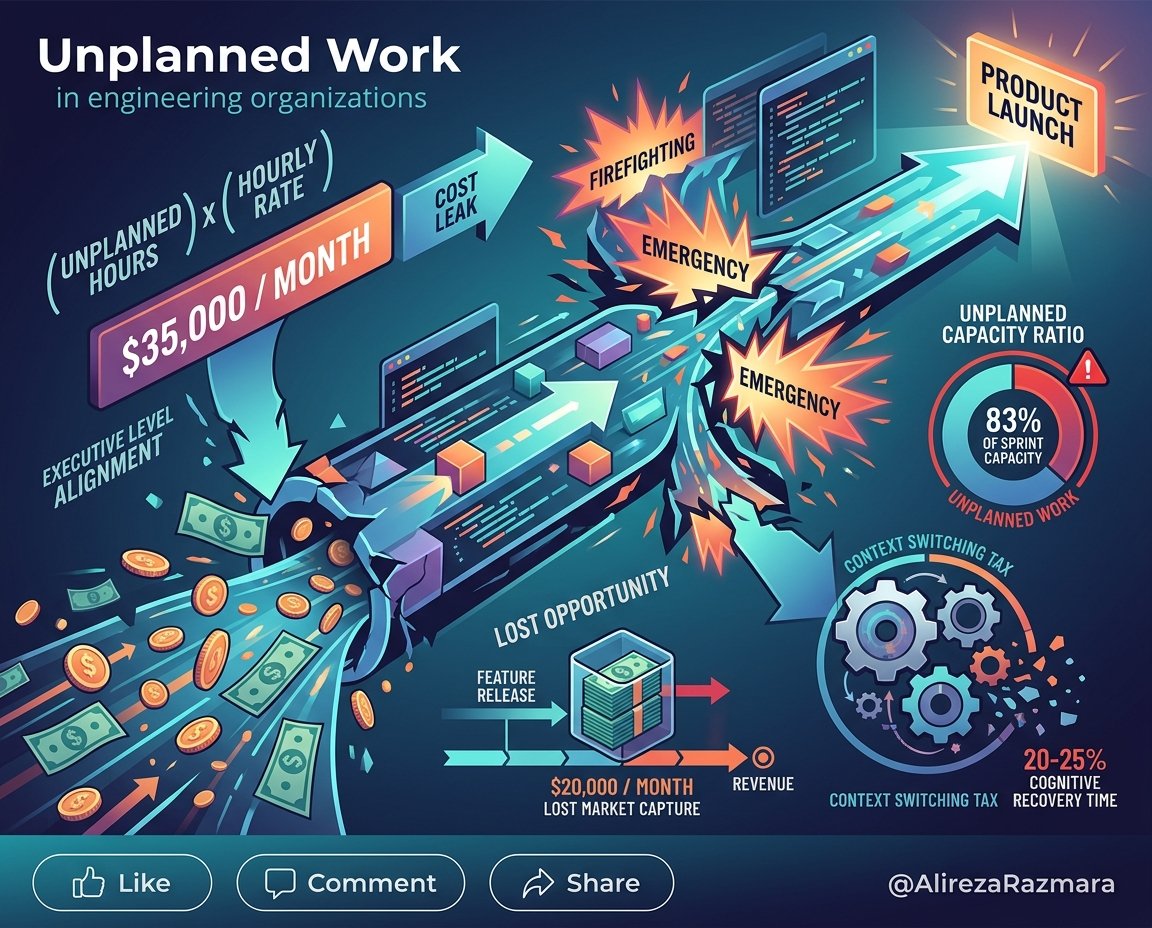
- The Formula: (Unplanned Hours Logged) × (Blended Team Hourly Rate)
Let’s examine the leadership impact. Telling a VP of Engineering that “the team is overwhelmed with bug fixes” rarely gets you additional headcount. It rarely stops the sales team from promising custom features. To an executive, “overwhelmed” sounds like a subjective complaint about workload.
However, when you demonstrate that ad-hoc requests, VIP customer escalations, and production firefights cost exactly $35,000 this month alone, the narrative flips. Reactive work suddenly triggers a high-priority architectural discussion. Put a strict price tag on the chaos. When you show the CFO that the company spent the equivalent of a senior engineer’s quarterly salary on fixing avoidable legacy code, watch how fast stakeholders suddenly care about prioritizing technical debt.
2. Cost of Delay (CoD) and Lost Opportunity
Every unplanned ticket displaces a strategic, revenue-generating feature. This is basic project physics. If your team is fixing a legacy database schema because it crashed again, they are definitively not building the new checkout flow. Cost of Delay measures that specific opportunity cost.
Imagine your upcoming strategic release is projected to generate $20,000 per month in new recurring revenue or operational savings. If rolling outages and internal pet-projects delay that release by four weeks, the unplanned work did not just cost developer hours. It cost your company $20,000 in lost market capture.
When prioritizing the backlog, use CoD to force tough, objective decisions. Stakeholders love to classify every request as “Urgent.” By attaching a dollar value to the delay, you shift the burden of proof. Ask the stakeholder: “Is implementing this quick fix worth delaying the $20,000 monthly return on our planned roadmap?” Most of the time, the urgent request can suddenly wait until the next sprint.
3. Unplanned Capacity Ratio (UCR)
Velocity tells you how fast you are going, but it completely ignores whether you are driving in the right direction. Unplanned Capacity Ratio exposes exactly how much of your engine is dedicated to simply keeping the lights on.
- The Formula: (Unplanned Story Points / Total Sprint Capacity) × 100
Track this metric over a rolling three-sprint average to spot the trend. If your UCR sits around 5 to 10 percent, that is normal operational noise. If your UCR consistently exceeds the 15 to 20 percent benchmark, you have a systemic, structural issue.
At that threshold, you are no longer running an Agile product team. You are operating an exceptionally expensive helpdesk. Catching this trend early lets you intervene before morale tanks. If the UCR hits 30 percent, the Scrum Master and Product Owner must halt new feature development. Allocate an entire sprint to stabilization, refactoring, and root-cause analysis before the team burns out entirely.
4. Flow Debt and the Context Switching Tax
Emergency work never takes just four hours. That is a dangerous myth based on idealized time-tracking. The actual cost is paid in flow debt.
Software engineering is deep cognitive work. Research consistently shows that interruptions consume an extra 20 to 25 percent in cognitive recovery time. When a senior engineer drops a complex algorithmic task to hotfix a broken API or answer a “quick question” from an account manager, they do not seamlessly resume their previous work. They have to completely rebuild their mental model of the code.
That initial four-hour emergency inevitably delays surrounding sprint commitments by days. Flow debt is the silent killer of sprint predictability. Start tracking context switching as a hidden tax on your sprint capacity. When planning your next iteration, do not assume 100 percent utilization. Build an explicit buffer based on your UCR. If you know historical unplanned work runs at 15 percent, cap your sprint commitments at 80 percent. Protect the flow state at all costs.
How to Track This Without Micromanaging
The immediate pushback from development teams will be, “You want us to track every single minute we spend on interruptions?” No. Micromanagement destroys agile culture.
Instead, create a standard “Unplanned Work” label or issue type in your tracking tool. When a developer is pulled off their sprint goal for more than 30 minutes, they create a quick ticket, tag it, and drop it into the current sprint. Do not ask them to estimate it meticulously. Just track the actual time or standard point value after the fact.
This provides enough data to calculate your UCR and labor burn rate at the end of the sprint. It keeps the process lightweight while generating massive executive visibility. The goal is not timesheet compliance; the goal is identifying the massive financial leaks in your value stream.
The Bottom Line: Changing the Agile Conversation
Agile metrics fail when they stay trapped inside the engineering department. Executives do not care about your burn-down chart, and they do not inherently understand story points. They understand risk, revenue, and cost.
Shifting the conversation from “our developers are overwhelmed” to “this specific set of emergencies cost us $45,000 in direct spend and delayed $20,000 in revenue” changes the entire dynamic of the organization. It moves delivery teams off the defensive. It forces strategic, executive-level decisions regarding technical debt, client management, and product roadmaps.
Stop absorbing the hit in silence. Start quantifying the disruption. Calculate your Unplanned Capacity Ratio during this current sprint, and present the exact dollar value of your firefighting at your next sprint review. You will be amazed at how quickly the business aligns with your need for better technical stability.