How to Answer “Tell Me About Yourself” in a Scrum Master Interview
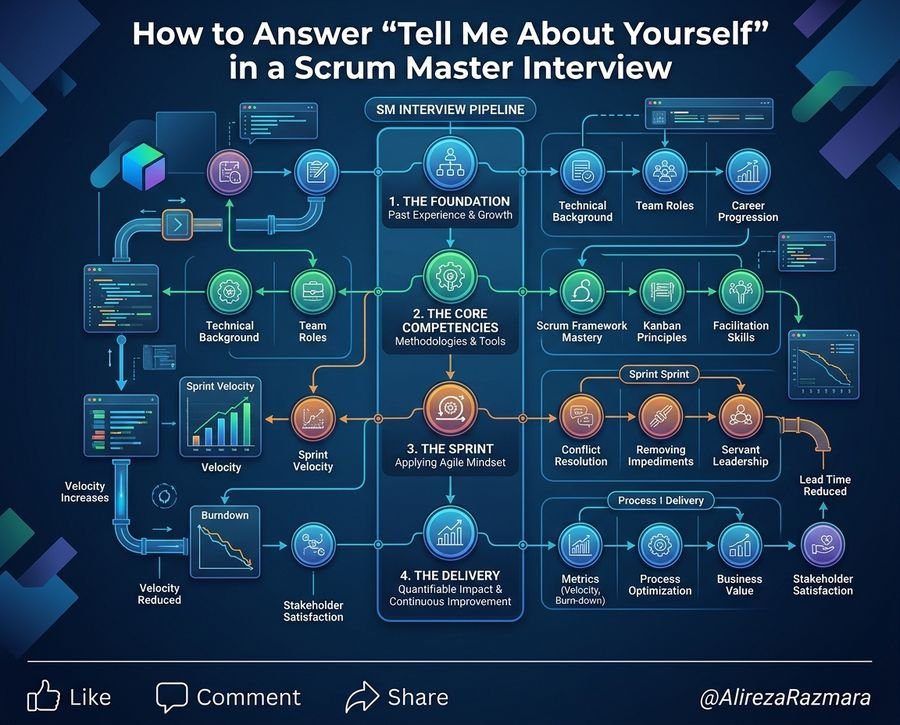
The best way to answer “Tell me about yourself” in a Scrum Master interview is to stop listing your certifications and start telling a story of team transformation. Hiring managers do not want a recitation of your resume; they want to know how you help technical teams build exceptional products while actually enjoying the process.
When you sit across from an interview panel, the instinct is often to validate your expertise. You mention your PSM I, your CSM, and your years of running daily standups. But tech leaders hear that exact same pitch from ten other candidates.
You need to position yourself as a catalyst for high-performing tech teams. Your passion cannot just be about enforcing Agile mechanics. It must be about helping organizations fundamentally change how they deliver value. Let’s break down exactly how you can frame your experience to show you are a Servant Leader capable of turning cross-functional friction into seamless execution.
Focusing on Flow, Not Just Frameworks
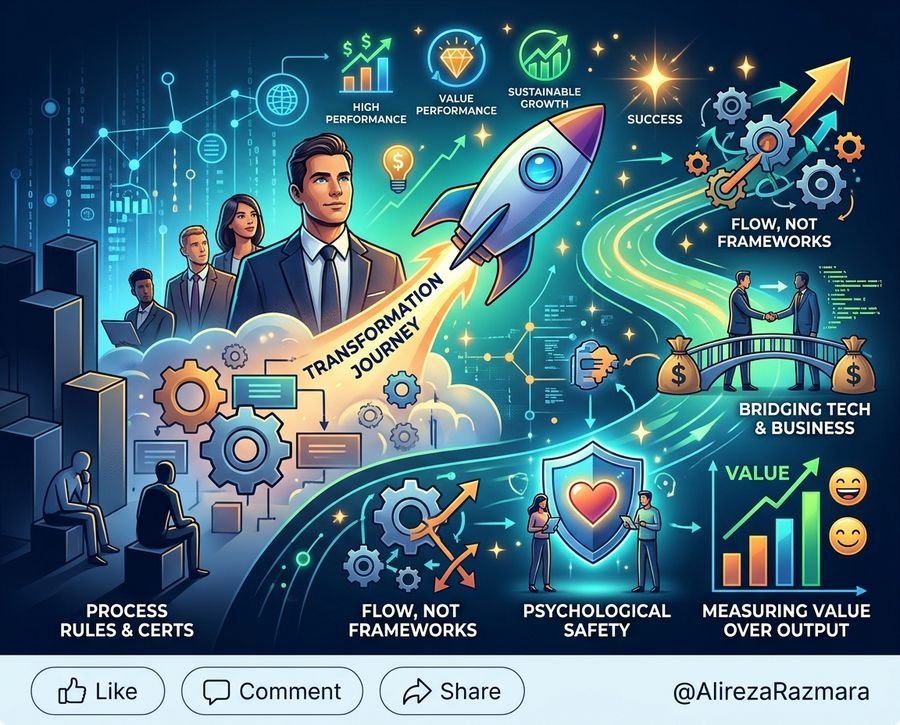
Great Scrum Masters optimize flow and reduce cognitive load, rather than just acting as Jira administrators. You answer this part of the interview by explaining how you actively dismantle systemic blockers and reduce cycle time so engineers can focus on innovation.
Many organizations treat the Scrum Master as a glorified project manager whose main job is to hound developers for status updates. If you talk about Agile as a rigid set of rules, you will immediately alienate engineering managers. Instead, focus the conversation on unblocking the system.
Talk about how you look at the entire value stream. When a developer pulls a ticket, how long does it sit in code review? Are environments ready for testing? Is the team drowning in technical debt that slows down feature delivery? By shifting the focus from “I ensure we do two-week sprints” to “I ensure work flows smoothly from idea to production,” you demonstrate a deep understanding of modern software engineering constraints.
Give them a tangible example. Explain a time you noticed the team was consistently missing sprint goals not because they were lazy, but because they were context-switching between unplanned support work and feature development. Show how you implemented WIP (Work in Progress) limits to stabilize the system.
Bridging the Gap Between Tech and Business
You add massive value as a Scrum Master by aligning business strategy with technical execution. Explain to the panel how you partner with Product Owners to turn complex, ambiguous roadmaps into clear, value-driven Sprints.
There is a historical tension between business stakeholders and development teams. Stakeholders want everything delivered yesterday. Developers want clear requirements and time to build things right. The Scrum Master sits right at this fault line.
When talking about your background, highlight your ability to speak both languages. You do not need to write code, but you must understand the technical realities your team faces. At the same time, you must understand the market pressures driving the Product Owner.
Share a scenario where you helped a Product Owner slice a massive, vague epic into distinct, testable user stories. Explain how you facilitated backlog refinement sessions that actually resulted in shared understanding, rather than just three hours of collective staring at a screen. When leaders see that you can protect the team from chaos while still delivering what the business actually needs, your value becomes obvious.
Building Psychological Safety for High-Velocity Teams
High velocity is impossible without high trust, meaning a Scrum Master must create environments where teams feel safe to experiment, fail fast, and improve without fear. You must explain how you cultivate this culture practically.
Agile teams cannot adapt if people are terrified of making mistakes. If a dropped database table or a failed deployment results in finger-pointing, the team will naturally become defensive. They will pad their estimates. They will avoid taking on complex work. Innovation dies in a blame culture.
In your interview, discuss your approach to Sprint Retrospectives. Are they just a box-checking exercise, or do you use them to uncover real systemic issues? Talk about how you handle failure. When a sprint goes completely off the rails, how do you guide the team to focus on the process rather than the person who made the error?
A strong answer highlights your emotional intelligence. You might mention how you noticed a quiet senior engineer who had brilliant ideas but was getting talked over by louder team members, and how you restructured your daily syncs to ensure equal voice. Psychological safety is not a soft skill; it is a hard prerequisite for engineering performance.
Measuring Value Over Output (Why Story Points Don’t Pay the Bills)
You must communicate that story points are a metric, not the mission, and that your ultimate goal is maximizing business value delivered to the end-user. Explain how you shift team focus from output (how much we did) to outcomes (what impact we made).
A common trap in Agile transformations is becoming obsessed with velocity. Organizations start equating a high number of story points with high productivity. As a seasoned practitioner, you know this is a dangerous game. Teams can easily inflate story points or ship 100 points of features that customers never actually use.
Tell the interview panel how you measure success. Yes, you track cycle time, sprint burndown, and lead time to spot bottlenecks. But the real victory is when the team releases a feature that actively solves a customer problem. Talk about how you encourage developers to care about product analytics and user feedback, not just moving a ticket to the “Done” column.
Answering “Why Do You Want to Be Our Scrum Master?”
You answer “Why do you want this role?” by directly connecting your servant leadership skills to the specific engineering challenges the organization is currently facing. You are not looking for a process management job; you are looking to guide a complex team through sustainable growth.
Before the interview, research the company’s engineering blog, recent product releases, or market shifts. Use that context to tailor your closing statement.
A powerful response sounds like this: “I want this role because your organization is tackling highly complex engineering challenges, particularly with your recent shift to a microservices architecture. You do not need someone to just schedule meetings. You need a Servant Leader who can manage the friction of cross-team dependencies, protect your engineers’ focus, and build a culture of continuous improvement. Agile is a mindset shift, and I want to guide your teams through that specific journey.”
By framing your answer this way, you stop being just another candidate. You become a strategic partner ready to help them build exceptional products.