
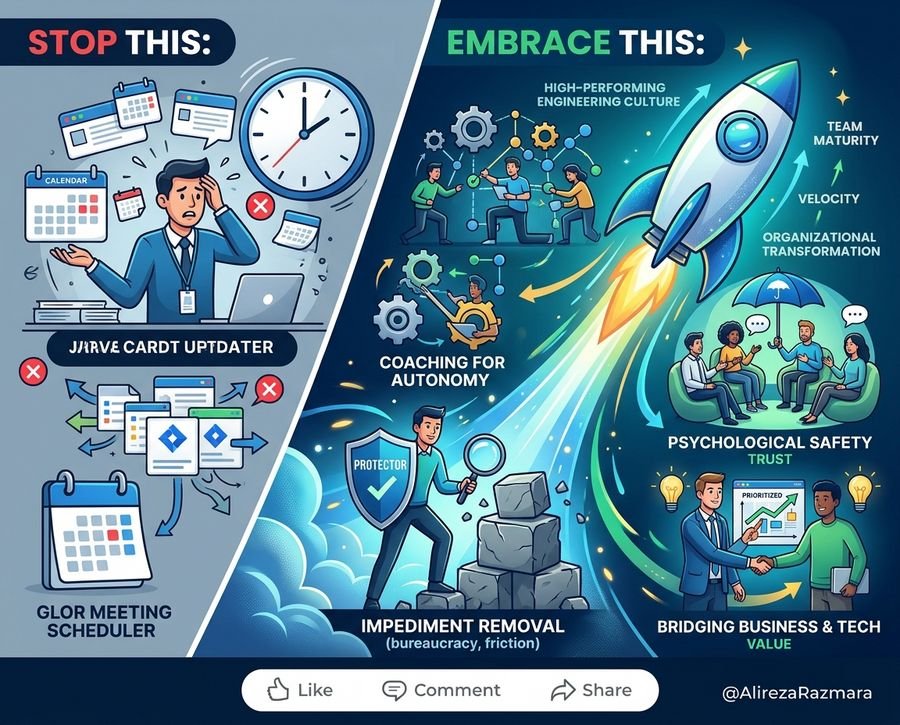
The Administrative Trap: Why We Misunderstand the Scrum Master Role
The Scrum Master role is frequently downgraded to an administrative function because updating Jira and scheduling meetings are highly visible, easily measurable tasks. True Agile leadership—focused on team maturity, conflict resolution, and systemic workflow improvements—is largely invisible until a team reaches high performance.
I see this in almost every enterprise I consult for. A company adopts Agile, assigns someone the title of Scrum Master, and immediately asks them to take meeting minutes. This is a massive waste of potential and budget. If your Scrum Master’s primary output is a well-organized Outlook calendar, you are paying a premium for an administrative assistant. An effective Scrum Master is an organizational change agent. They exist to optimize the system of delivery, not just the schedule. They observe team dynamics, identify communication gaps, and aggressively pursue operational excellence.
Systemic Impediment Removal: Beyond Daily Bug Fixes
Systemic impediment removal means proactively destroying cross-team dependencies, bureaucratic friction, and resource bottlenecks before they impact the Sprint. It is the shift from fixing isolated daily blockers to redesigning the environment so those blockers never appear again.
Listen to any daily standup. A developer says their environment is down or they are waiting on an API key from the security team. A junior Scrum Master pings the security team. A senior Scrum Master, however, recognizes a pattern. They see that environment provisioning is a recurring bottleneck slowing down velocity across three different squads. Instead of just sending a Slack message, they escalate the issue to engineering leadership, build a business case for self-service infrastructure, and work with DevOps to automate the provisioning process.
Great Scrum Masters hunt down macro-level blockers. They do not wait for the team to trip over a hurdle; they remove the hurdle entirely. This requires political capital, a deep understanding of organizational design, and the courage to challenge established workflows.
Fostering Psychological Safety for High-Performance
Psychological safety in Agile teams is an environment where developers can experiment, fail fast, and challenge leadership without fear of retaliation. It is the foundational requirement for true innovation, open communication, and effective retrospective events.
You cannot mandate psychological safety. You have to build it, interaction by interaction. When a sprint fails and executives are demanding answers, the Scrum Master must step up as a shield. They redirect the conversation from “who broke the build?” to “what gap in our CI/CD pipeline allowed this to happen?” This subtle shift from individual blame to systemic analysis transforms a culture.
True innovation only happens when fear is removed from the equation. If developers are afraid to speak truth to power or admit they underestimated a story, your Agile metrics are built on lies. A skilled Scrum Master observes body language, invites quiet voices into the conversation, and actively normalizes failure as a step toward discovery.
Bridging the Gap Between Business Value and Technical Execution
A great Scrum Master partners directly with the Product Owner to ensure engineers understand the “why” behind the backlog, translating business goals into actionable technical context. They align the team’s daily output with the strategic vision of the company.
Many tech teams fall into the “feature factory” trap. They churn out code, close tickets, and merge pull requests without any real understanding of how their work impacts the end user. When a Scrum Master acts as a bridge, they stop this mechanical workflow. They ensure backlog refinement sessions are not just about sizing stories with Fibonacci numbers, but about debating value.
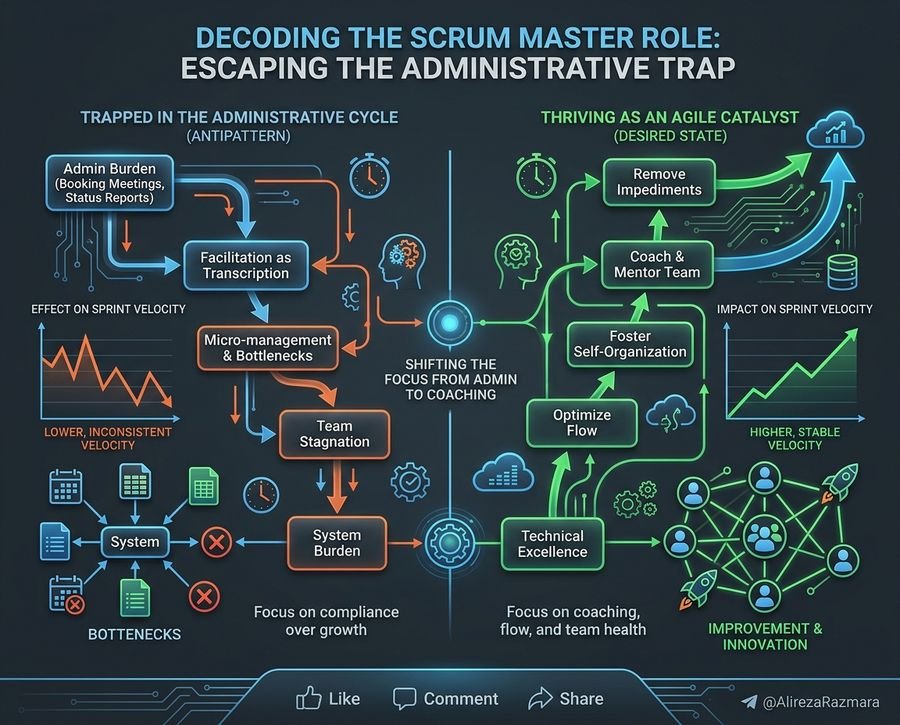
They coach the Product Owner on how to write clearer acceptance criteria and how to slice work vertically to deliver incremental value. Simultaneously, they coach the developers to ask tough questions about user impact. The result? Engineers who care about the product, not just the code.
Coaching for Autonomy: Building Teams That Don’t Need You
Coaching for autonomy means building self-organizing systems and practices so robust that the team can execute sprints flawlessly even when the Scrum Master is absent. The ultimate goal of a Scrum Master is not to control the team, but to render their own daily intervention obsolete.
This is often a tough pill to swallow for project managers transitioning into Scrum Master roles. Your instinct is to coordinate, assign, and direct. You want to be the center of the communication hub. But holding that central position creates a single point of failure. If the team cannot resolve a merge conflict or run a daily standup without you, you have failed as a coach.
- Shift decision-making: Push technical decisions back to the engineers.
- Step back during events: Let the team run their own standups. Intervene only to keep them time-boxed.
- Teach facilitation: Rotate retrospective facilitation among team members.
A high-performing engineering culture thrives on self-organization. You are there to guide the framework, not micromanage the execution.
Protecting Sustainable Pace and Preventing Burnout
Protecting a sustainable pace requires shielding the engineering team from scope creep and executive pressure, ensuring consistent quality over short-term heroics. It is the active management of Work In Progress (WIP) limits to prevent mental exhaustion and technical debt accumulation.
In the tech industry, burnout is a massive risk. Stakeholders always want more features, delivered yesterday. Without a strong Scrum Master, developers will naturally absorb this pressure, working nights and weekends to hit arbitrary deadlines. This “hero culture” destroys morale and leads to brittle, poorly tested code.
An experienced Scrum Master holds the line. They use data—velocity trends, cycle time, and capacity planning—to push back against unreasonable demands. They force the difficult conversations about trade-offs, reminding stakeholders that adding scope mid-sprint means dropping something else. By enforcing a sustainable pace, they ensure the team delivers high-quality software consistently, sprint after sprint, year after year.
The Bottom Line
Stop treating your Scrum Masters like glorified meeting schedulers. Give them the authority to challenge broken systems, push back on executives, and coach your teams toward genuine autonomy. When you empower a Scrum Master to operate at a strategic level, they stop managing tasks and start building high-performing engineering cultures.
Over to you: What do you think is the most underrated responsibility of a Scrum Master in tech teams today? Let’s spark a conversation.