
Listen In: Process Versus Culture in Sprint Retrospectives (21 min)
As an Agile Coach and Technical Project Delivery Consultant, tech leaders constantly ask me how to fix teams that consistently deliver late or suffer from low morale. The first thing I look at is their calendar. If the Sprint Retrospective is missing, or frequently skipped because the team is “too busy,” I immediately know the root cause. You cannot improve a system you refuse to inspect.
A Sprint Retrospective isn’t a complaint session. It is definitely not a status report for management. It is a sacred, dedicated space for a team to inspect and adapt their processes, tools, and collaboration. If your team isn’t evolving after every Sprint cycle, you aren’t doing Agile. You are just doing fast Waterfall.
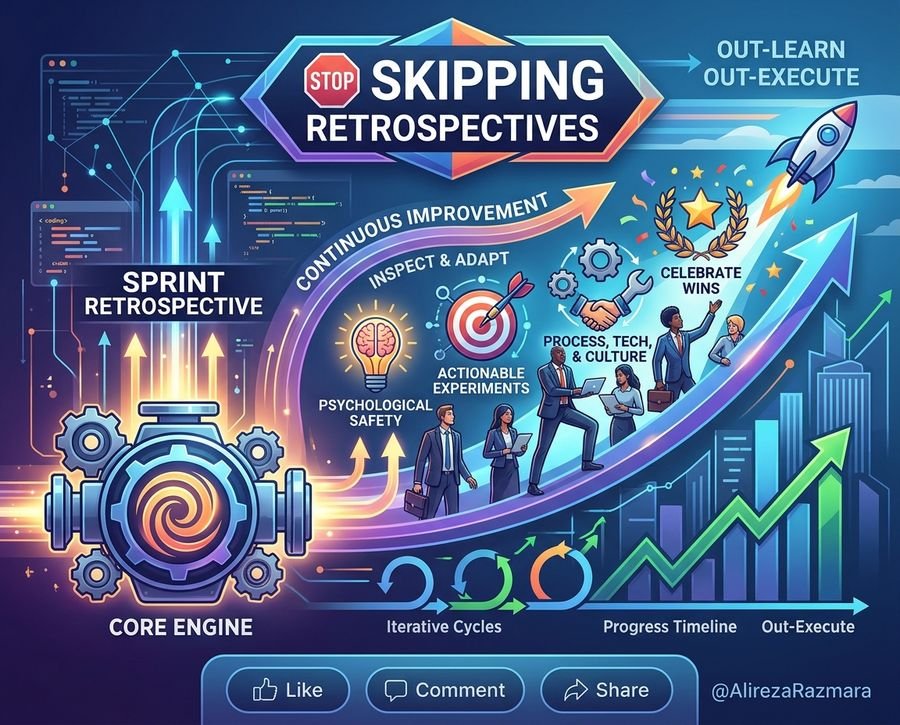
Great engineering teams aren’t born. They are iteratively built sprint by sprint. The Sprint Retrospective is your ultimate weapon to out-learn and out-execute the competition every single cycle. Here is how top-tier teams unlock its true power.
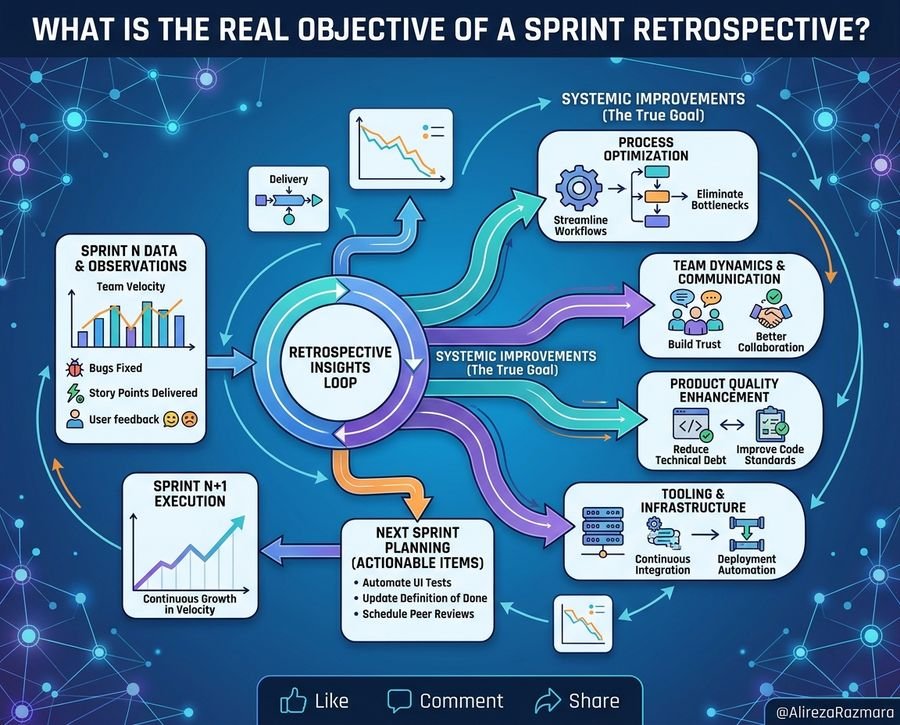
What is the Real Objective of a Sprint Retrospective?
The primary objective of a Sprint Retrospective is continuous improvement. It is a dedicated, recurring meeting where Agile teams inspect their past sprint and adapt their processes, tools, and collaboration to increase quality and effectiveness. The goal is to exit the meeting with concrete, actionable steps to make the next sprint better than the last.
When teams misunderstand this objective, the event devolves into a venting session. Developers complain about technical debt, QA complains about late code handoffs, and the Product Owner complains about missed deadlines. Nothing changes, and eventually, everyone agrees to stop holding the meeting because it feels like a waste of time.
To fix this, you must reframe the event. The retrospective is the engine of your team. It is the designated time to pop the hood, figure out what is misfiring, tighten the bolts, and get back on the road. It requires structure, focus, and a relentless commitment to action.
1. Cultivate Psychological Safety
Psychological safety in a retrospective means team members can discuss failures, mistakes, and friction without fear of punishment or personal blame. Without this foundational trust, retrospectives become silent, useless, or highly political.
If you ask the room, “What went wrong this sprint?” and you hear absolute silence, you do not have a perfect team. You have a team that does not feel safe speaking up. People will hide mistakes to protect their jobs or their reputations. To build a high-performing team, you have to break this cycle.
- Focus on the system, not the person: If a developer broke the build, do not ask why they made a mistake. Ask why the CI/CD pipeline allowed broken code to be merged. Shift the conversation from human error to systemic weakness.
- Adopt the Prime Directive: Start your meetings by reminding the team of Norm Kerth’s Retrospective Prime Directive: Regardless of what we discover, we understand and truly believe that everyone did the best job they could, given what they knew at the time, their skills and abilities, the resources available, and the situation at hand.
- Model vulnerability: As a Scrum Master, Agile Coach, or Tech Lead, admit your own mistakes first. When leadership owns their failures openly, the rest of the team will follow suit.
2. Focus on Actionable Micro-Experiments
Instead of building a massive list of generic fixes, teams should pick one or two actionable micro-experiments to test in the very next sprint. This ensures clear ownership and measurable progress, preventing retrospective fatigue.
The most common failure pattern I see in retrospectives is the “10-item wishlist.” The team identifies ten massive problems: the monolith is too slow, we need automated end-to-end testing, and the backlog is messy. They write these down, close the meeting, and forget about them until the next retro.
You cannot fix everything at once. You have to think in terms of micro-experiments.
Pick one or two impactful improvements. Frame them as experiments with clear owners. For example:
- Bad: “We need to do code reviews faster.”
- Good (Micro-Experiment): “For the next sprint, Sarah and John will test a new working agreement where all Pull Requests get reviewed within 4 hours. We will see if this unblocks QA faster.”
Once you define the experiment, create a ticket for it. Put it in the next Sprint Backlog. If it isn’t tracked alongside your regular engineering work, it simply will not happen.
3. Inspect Process, Tech, and Culture Holistically
A healthy retrospective examines every element that impacts value delivery, including code review bottlenecks, deployment friction, communication gaps, and overall team morale. You have to look beyond just the Jira board to find the real friction points.
Many teams limit their retrospectives to discussing ticket completion rates. This is a massive mistake. Value delivery is a complex ecosystem. If you want to optimize workflow, everything is on the table.
Break your inspection down into three distinct pillars:
- Process Friction: Are daily standups taking too long? Is the Product Owner unreachable when developers have clarification questions? Is the Definition of Done too vague?
- Technical Friction: Are local environments taking three days to set up? Is flaky test data causing false failures in the pipeline? Tech debt silently kills velocity; the retro is the place to quantify that pain and negotiate time to fix it.
- Cultural Friction: Are remote team members feeling isolated? Is there friction between frontend and backend engineers? Address interpersonal dynamics before they turn into toxic conflicts.
4. Celebrate the Wins and Repeat Good Habits
Continuous improvement requires identifying what went brilliantly and turning it into a repeatable habit, not just fixing what is broken. Acknowledging wins boosts morale, provides dopamine, and reinforces high-performance behaviors.
Agile teams are naturally wired to look for problems. We hunt for bugs, we look for bottlenecks, and we obsess over missed story points. But if your retrospective is strictly a list of everything that went wrong, team morale will eventually tank.
You must dedicate time to celebrate the wins. Did QA catch a critical bug before it hit production? Call it out. Did a senior engineer spend three hours pairing with a junior developer to unblock them? Praise that behavior publicly.
More importantly, figure out why the win happened. If a specific feature was delivered flawlessly and ahead of schedule, ask the team what made that process so smooth. Once you identify the root cause of success, standardize it. Turn that isolated win into a repeatable workflow for future sprints.
The Cost of Skipping the Retrospective
Skipping the sprint retrospective halts your team’s growth, silently compounding process debt and technical friction until velocity completely stalls. You aren’t saving time; you are just deferring the cost of inefficiency.
“We are too busy this sprint, let’s just skip the retro.” I hear this phrase constantly. It is the equivalent of a lumberjack saying they are too busy chopping down trees to stop and sharpen their axe. Eventually, you are just violently swinging a dull piece of metal, exhausting your team while producing terrible results.
Do not skip this meeting. Protect it fiercely. A well-facilitated Sprint Retrospective is the single most powerful tool you have to build an autonomous, high-performing engineering culture. Treat it with the respect it deserves, focus on micro-experiments, and watch your team’s delivery capabilities transform.