
Listen In: Escaping the Fake Agile Trap (18 min)
The Component Misalignment Crisis
If your engineering team runs two-week Sprints but still ships buggy code, misses delivery targets, and feels perpetually burned out, you do not have an Agile problem. You have a component misalignment problem. Moving a Jira ticket from “To Do” to “Done” on a digital Kanban board is not Agile. It is simply status tracking masquerading as project management.
Agile is not a single tool, a weekly meeting, or a specific certification. It is a highly integrated ecosystem. To build a truly adaptive, high-velocity software organization, you need four core components firing perfectly on all cylinders. When organizations treat Agile as a simple process rollout rather than a structural shift, they end up with all the overhead of Scrum and none of the speed. Let’s break down the four pillars you need to stop faking agility and start shipping real value.
1. The Mindset: The Engine of Agile Delivery
The Agile mindset is the cultural operating system of your team, prioritizing customer value, radical transparency, and psychological safety over rigid task execution. Process means absolutely nothing without a foundation where developers feel safe admitting mistakes, questioning requirements, and pivoting based on new information.
Mindset is often dismissed by heavily traditional project managers as soft corporate fluff. That is a massive mistake. If you impose Agile frameworks onto a command-and-control culture, your team will simply optimize for avoiding blame rather than delivering value. True agility requires developers to care more about solving the user’s problem than strictly adhering to the original spec.
Symptoms of Mindset Failure
- Estimation Anxiety: Developers treat Story Points like blood oaths because management punishes them for missing arbitrary targets.
- The Permission Waiting Game: Engineers spot obvious flaws in a feature but wait for a Product Owner’s explicit permission to fix them.
- Success Theater: Sprint Reviews are carefully orchestrated to hide technical debt and systemic delays from stakeholders.
How to Fix It
Stop weaponizing metrics. Velocity is a capacity planning tool for the team, not a performance metric for leadership. Build psychological safety by loudly celebrating when a team member catches a critical flaw before deployment. Reward engineers who push back on poorly defined requirements.
2. The Frameworks: The Chassis That Provides Structure
Frameworks like Scrum, Kanban, or SAFe provide the structural boundaries that enable team autonomy without devolving into dynamic chaos. They dictate the operational cadence and the rules of engagement, ensuring everyone understands how work flows from an idea into production.
You need structure to move fast. Without a framework, you get wild west engineering where priorities change hourly and nobody knows what anyone else is doing. However, a framework is a chassis, not a prison cell. If a specific Scrum event is actively blocking your team from shipping code, you must adapt it or drop it.
Symptoms of Framework Failure
- Zombie Scrum: You go through the motions of every Agile ceremony, but nothing actually improves. Standups regularly drag on for 45 minutes of status updates.
- The Infinite Backlog: Your Kanban board has 50 tickets stuck in “In Progress” and 400 stale stories in the backlog that nobody will ever touch.
- Role Confusion: The Scrum Master acts like a traditional project manager dictating tasks, and the Product Owner acts like an absent stakeholder.
How to Fix It
Audit your meetings immediately. A 15-minute Daily Scrum should focus strictly on blockers and sprint goals, not a rundown of timesheets. Enforce strict Work In Progress (WIP) limits on your board to stop context switching and force the team to finish old work before starting new tasks.
3. Technical Practices: The Wheels That Drive Velocity
Technical agility relies heavily on Extreme Programming (XP) practices like Test-Driven Development (TDD), CI/CD pipelines, and automated testing to ensure software can change rapidly without breaking. You simply cannot be functionally Agile if your underlying codebase is fragile.
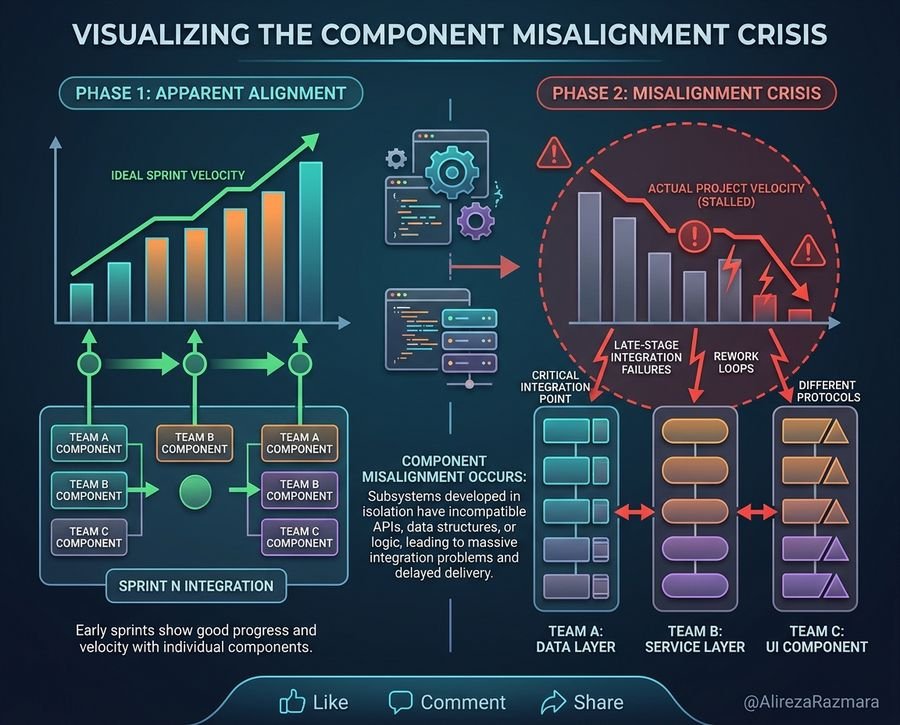
This is where 90% of enterprise Agile transformations fail. Management buys new software, renames project managers to Scrum Masters, and ignores the engineering floor. If your deployment process requires a weekend outage and 14 manual sign-offs, you will never be Agile. Without technical excellence, executing Sprints just means you are shipping technical debt on a strict two-week schedule.
Symptoms of Technical Failure
- The Testing Bottleneck: Stories are frequently marked as “Code Complete but Needs Testing,” dragging them across multiple sprints.
- Deployment Terror: Releasing to production is a high-stress event requiring all hands on deck and frequent hotfixes.
- Manual Regression: QA spends days manually clicking through the application because test automation is an afterthought.
How to Fix It
Treat technical debt as a first-class citizen on your product backlog. Mandate that Continuous Integration and Continuous Deployment (CI/CD) pipelines are established before a single feature is built. Implement Pair Programming on complex features to organically distribute knowledge and catch bugs before they enter the repository.
4. Relentless Feedback Loops: The GPS for Course Correction
Feedback loops are rapid validation mechanisms—such as honest Retrospectives, stakeholder Sprint Reviews, and live system telemetry—that tell you if you are actually building the right thing. If your team does not actively adjust its trajectory based on real-world data, you are just executing a mini-Waterfall project.
Agile assumes you do not know everything up front. The only way to survive that uncertainty is to build a small piece, put it in front of users, and measure the reaction. Without relentless feedback loops, teams spend months building beautiful, technically flawless features that customers completely ignore.
Symptoms of Feedback Failure
- Ghost Town Demos: Sprint Reviews are attended only by the development team, with zero actual stakeholders or customers present.
- Whining Retrospectives: Sprint Retrospectives are just a venting session where the same complaints are raised every two weeks, but no action items are ever completed.
- Flying Blind: Features are deployed, but nobody knows if they are actually being used because there is zero analytics or telemetry instrumented in the code.
How to Fix It
Make stakeholder attendance mandatory for Sprint Reviews—if they don’t show up, their feature requests drop in priority. During Retrospectives, identify exactly one systemic impediment to fix in the next sprint, assign a specific owner, and track it aggressively. Instrument your code to capture user behavior so you can make data-driven product decisions.
The Leadership Reality Check
Agile leaders must act as ecosystem builders rather than rule enforcers, focusing entirely on removing systemic impediments so these four components can thrive naturally. The harsh reality of technical project delivery is that frameworks provide the necessary structure, technical practices deliver the speed, but engineering culture dictates the long-term sustainability.
If you force a rigid framework but ignore technical practices, your team will drown in bugs. If you focus solely on CI/CD but lack continuous feedback loops, you will efficiently build the wrong product. Miss even one of these four components, and your costly Agile transformation devolves into just another piece of empty corporate jargon.
Stop obsessing over the metrics on your Jira dashboard and start looking at the actual ecosystem of your engineering department. Remove the blockers, elevate your technical standards, and let the team build.