Why Agile is Much More Than Just Scrum
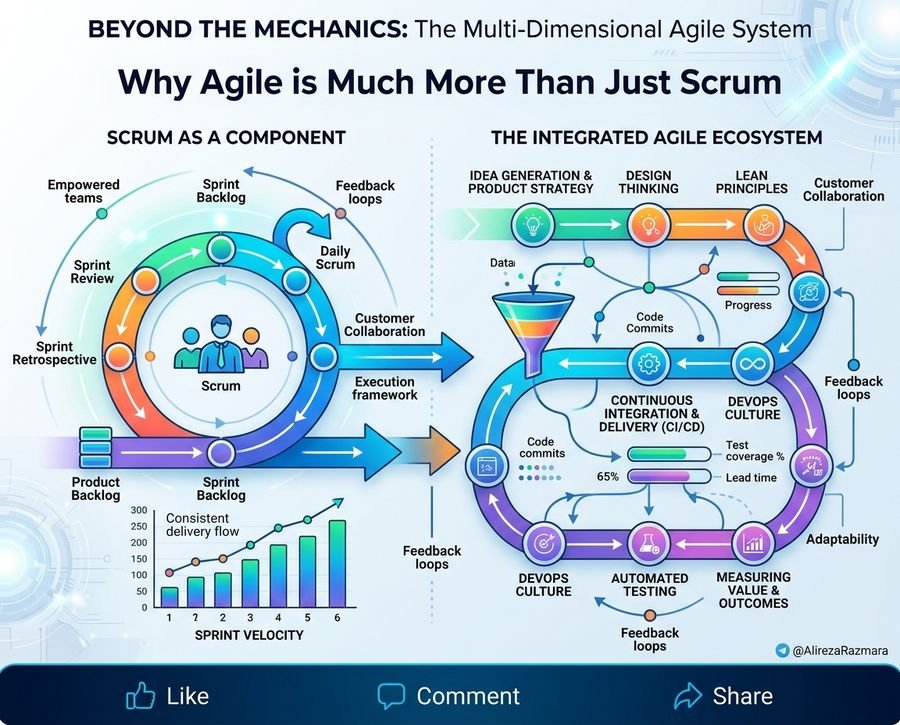
Agile is a broad, dynamic ecosystem of methodologies designed to improve software delivery, whereas Scrum is merely one specific framework within that larger ecosystem. While Scrum provides a highly structured iterative process, limiting your engineering organization exclusively to it often ignores powerful tools required for continuous flow, extreme technical excellence, and enterprise-wide scaling.
Nine out of ten times, when a tech leader asks me how their organization should “do Agile,” they are actually just talking about Scrum. Confining your engineering teams to a single framework is like trying to build a modern smart home using only a standard claw hammer. Yes, you absolutely need the hammer for the framing. No, it will not help you run the electrical wiring.
The reality on the ground is that relying solely on Daily Standups, two-week Sprints, and Story Points leaves massive delivery gaps. This becomes painfully obvious when dealing with suffocating technical debt, unplanned production incidents, or attempting to synchronize dozens of dependent teams. True operational maturity requires understanding the entire Agile landscape. Here is a definitive look at the methodologies every tech leader, project manager, and developer needs to master.
The Core Classics: Scrum vs. Kanban
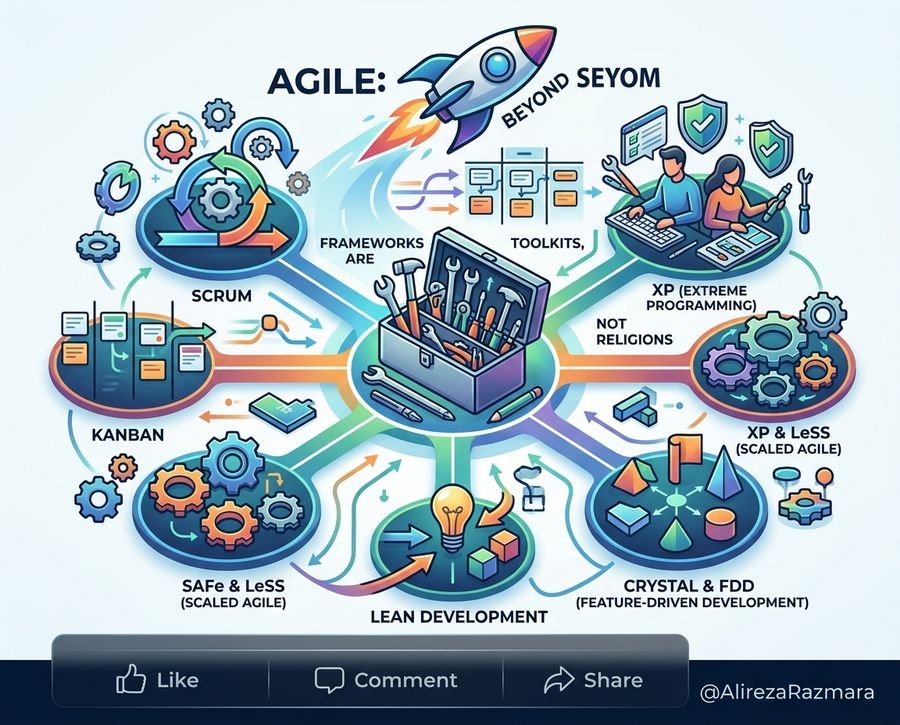
Scrum relies on time-boxed iterations known as Sprints to deliver complex products with strict predictability, while Kanban focuses entirely on continuous flow and operational efficiency by heavily restricting Work in Progress (WIP). Choosing between them depends directly on whether your specific team requires protected delivery cycles or rapid, interrupt-driven adaptability.
When to Stick with Scrum
Scrum is the industry default for a valid reason. It is excellent for new product development where cross-functional teams need clear, short-term goals and a predictable cadence. The standard ceremonies—Sprint Planning, Daily Scrum, Sprint Review, and Sprint Retrospective—provide immediate, structured feedback loops. It creates a safe container for developers to focus on a committed block of work without scope creep.
When to Pivot to Kanban
Scrum struggles significantly when work is purely reactive. If you are managing a Site Reliability Engineering (SRE) team, a Tier-3 support desk, or a DevOps pipeline group, forcing work into two-week Sprints usually creates artificial overhead. Enter Kanban.
Kanban visualizes the actual workflow, immediately highlights systemic bottlenecks, and forcefully limits how many tickets can exist in the “Doing” column at any given time. If your team constantly fails to finish Sprint commitments because high-priority bugs constantly derail the plan, Kanban is usually the exact remedy needed to restore sanity and throughput.
The Engineering Powerhouse: Extreme Programming (XP)
Extreme Programming (XP) is a software development framework explicitly focused on uncompromising technical excellence and high code quality. While Scrum is highly effective at managing the organizational workflow, XP dictates the actual engineering practices through strict disciplines like Test-Driven Development (TDD), pair programming, and continuous integration.
Many failed Agile transformations occur because leadership ignores the code itself. You can curate the most beautiful, meticulously groomed Jira backlog on the planet, but if your deployment process requires manual regression testing that takes four days, you are not Agile. You are simply doing Waterfall in two-week increments.
The Core Practices of XP
- Test-Driven Development (TDD): Engineers write the automated test for a function before writing the actual production code. This guarantees that code is testable from conception and prevents massive technical debt accumulation.
- Pair Programming: Two developers share a single workstation. One writes the code (the Driver) while the other reviews each line as it is typed (the Navigator). It results in vastly fewer bugs, faster onboarding of junior developers, and immediate peer review.
- Continuous Integration (CI): Code is integrated, tested, and built multiple times a day. Conflicts are resolved immediately rather than piling up into massive merge nightmares at the end of a release cycle.
By layering XP practices inside a Scrum or Kanban workflow, you successfully bridge the historically fragile gap between product management and hardcore software engineering.
Scaling the Enterprise: SAFe and LeSS
Enterprise Agile frameworks like SAFe (Scaled Agile Framework) and LeSS (Large-Scale Scrum) exist specifically to synchronize multiple interdependent teams working on the same massive product or value stream. They directly solve the dependency chaos and communication breakdowns that inevitably occur when scaling standard team-level Agile beyond a few isolated groups.
SAFe: The Enterprise Heavyweight
SAFe is robust, highly prescriptive, and adds necessary layers of governance, portfolio management, and structured quarterly planning events. Its hallmark is PI (Program Increment) Planning, a massive event where all teams in an Agile Release Train align their dependencies for the upcoming quarter. SAFe is an incredibly comfortable bridge for heavily regulated industries, banks, and massive legacy enterprises transitioning away from rigid Waterfall processes, as it still provides executives with the forecasting and budgetary predictability they demand.
LeSS: The Minimalist Scaler
LeSS takes the exact opposite approach to scaling. Instead of adding new layers of management and complex ceremonies, LeSS scales Scrum by keeping the rulebook aggressively minimal. The framework asks a foundational question: “How can we structure multiple teams to share a single Product Owner and a single Product Backlog without stepping on each other?”
LeSS forces organizations to descale their management overhead and relies heavily on cross-team collaboration rather than top-down coordination. Choose SAFe for strict, predictable enterprise alignment; choose LeSS for stripped-down, developer-centric agility.
Lean Software Development and Niche Methodologies
Lean Software Development adapts traditional manufacturing principles to software engineering, obsessively focusing on eliminating organizational waste, amplifying team learning, and delivering value as fast as possible. Niche methodologies like Crystal and Feature-Driven Development (FDD) offer highly adaptable, specialized alternatives based on specific variables like team size, system criticality, and feature progression.
The Power of Lean Thinking
Lean forces leadership to ask one brutal, clarifying question regarding every process: “Does this activity directly add value to the end user?”
If a mandatory architectural approval gate, a recurring status meeting, or an excessively detailed documentation requirement does not add tangible value, Lean categorizes it as waste. You cut it. Lean also preaches “Deferring Commitment,” which means keeping your options open and making architectural or product decisions at the last responsible moment, ensuring you act on the most current data available.
Crystal and FDD
Crystal is fascinating because it recognizes that a massive, life-critical system (like aviation software) cannot use the same methodology as a small web-development agency. It provides a family of methodologies color-coded by team size and risk—ranging from Crystal Clear for small, low-risk teams to Crystal Red for massive, high-risk systems. Feature-Driven Development (FDD) takes a different angle, breaking the entire product down into a comprehensive domain model and managing work exclusively through strictly defined, easily trackable features.
Agile Leadership: Frameworks are Toolkits, Not Religions
True Agile leadership is about assessing your specific team context, organizational culture, and technical complexity, then actively selecting the right mix of methodologies to unlock sustainable flow. Dogmatic, uncompromising adherence to a single framework usually creates bloated process overhead rather than delivering real, measurable business value.
Process maturity is not executing Scrum perfectly by-the-book. Maturity is knowing exactly when to drop Sprints entirely because the team is bleeding from constant production fires, and swapping to Kanban to stabilize the bleeding. It is recognizing when technical debt is stalling feature delivery, and deliberately weaving in XP practices to rescue your codebase.
Do not confine your engineers to a single ideology. The ultimate goal of your organization has never been to simply “do Agile.” The goal is to deliver excellent, high-quality software that solves real user problems, securely, sustainably, and efficiently. Assess your reality, mix your toolkits, and relentlessly iterate on your delivery processes.