
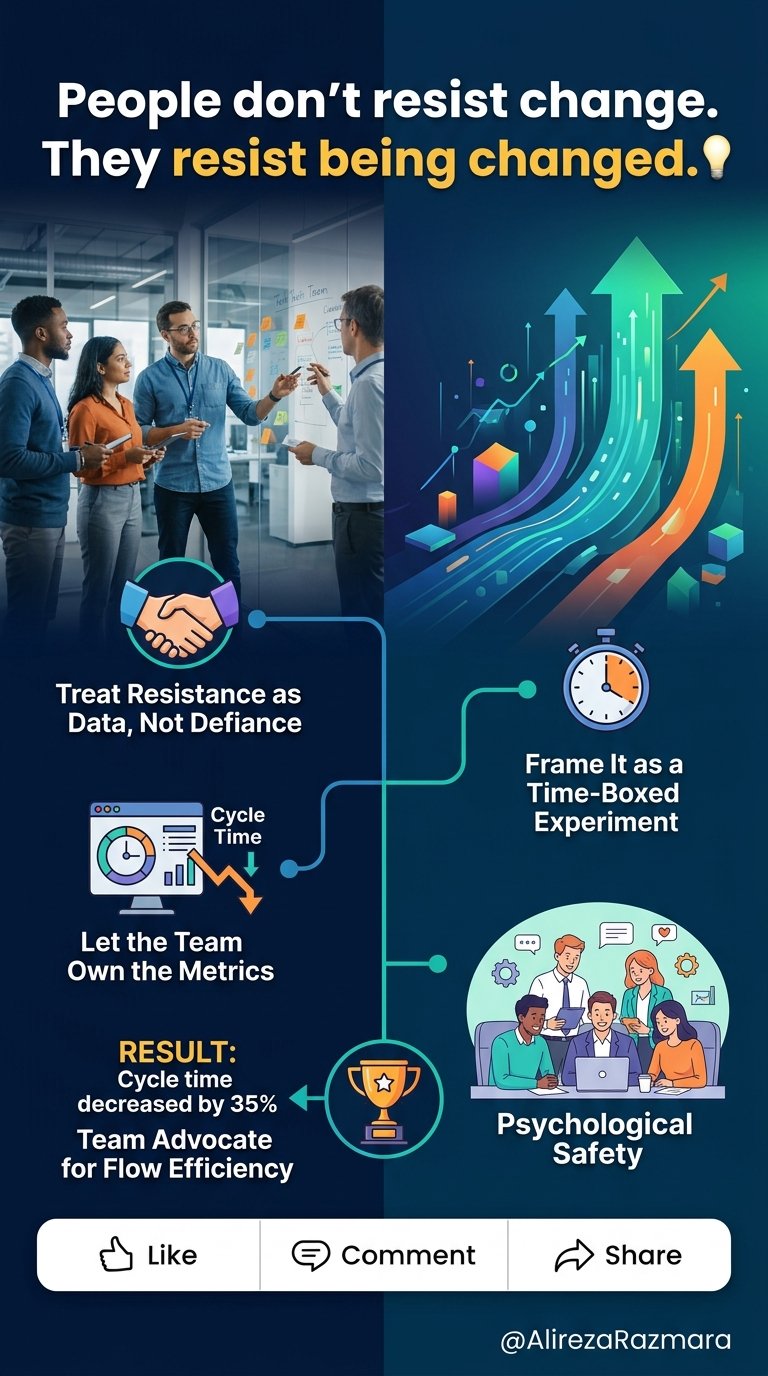
People do not resist change. They resist being changed.
Early in my coaching career, I almost derailed a high-performing engineering team by introducing strict Work-in-Progress (WIP) limits. Our lead architect immediately pushed back, arms crossed in the sprint room: “This is micromanagement. It is going to throttle our velocity and kill developer flow.”
As a Scrum Master and PMP, my initial instinct was to point to the data. I wanted to quote Agile theory, lean manufacturing, and Kanban principles. I wanted to prove him wrong.
But textbook answers do not build trust. Servant leadership does.
If you want to turn vocal resistance into sustainable buy-in, you have to stop arguing about the framework and start addressing the underlying friction. True Agile leadership is not about imposing processes top-down. It is about creating the psychological safety required for teams to experiment, fail safely, and evolve together.
Here is exactly how we took a deeply skeptical engineering team, navigated their pushback, and ultimately decreased their cycle time by 35% while turning our biggest critic into a flow-efficiency advocate.
Why Senior Tech Teams Resist Process Changes
Senior tech teams resist process changes because they view new frameworks as a direct threat to their autonomy, delivery speed, and developer flow. They are usually protecting an ecosystem that allows them to do deep, uninterrupted work.
Let us be honest about the reality of software engineering. Senior developers have survived countless management fads. They have seen badly implemented SAFe transformations, weaponized velocity charts, and daily standups that feel more like interrogations than planning events.
When you walk in and suggest a new constraint—like WIP limits, mandatory pair programming, or stricter definition of ready criteria—they do not hear “efficiency.” They hear “bureaucracy.”
You are stepping into a territory where context-switching is the enemy. Every new Jira field, every new meeting, and every new rule feels like a tax on their primary job: writing great code. Understanding this defensive posture is your first step as an Agile Coach. They are not being stubborn. They are trying to protect their craft.
Treat Resistance as Data, Not Defiance
Treating resistance as data means objectively listening to team pushback to identify hidden systemic flaws, rather than viewing their complaints as insubordination. When someone argues against a new process, they are usually handing you a roadmap of your system’s current bottlenecks.
When my lead architect called WIP limits “micromanagement,” I stopped defending the Kanban guide. I asked him to walk me through his day.
It turned out his fear of a slowdown was incredibly valid. His daily reality was an obstacle course of context-switching. Because PR reviews took three days to get approved by external security teams, engineers had to pick up new tickets constantly just to stay busy. If we capped their WIP at two items without fixing the PR bottleneck, they would literally be sitting idle by Tuesday afternoon.
Pushback is usually rooted in valid fear. It might be a fear of losing autonomy, a fear of metric manipulation, or a fear of exposing broken dependencies that the team has learned to silently work around.
How to Decode Engineering Pushback
- “This will slow us down.” Translation: Our downstream dependencies are broken, and we rely on multitasking to look busy while we wait.
- “This is micromanagement.” Translation: I do not trust leadership with this data. I am worried these metrics will be used against me in a performance review.
- “We don’t need another meeting.” Translation: Our current meetings lack clear agendas and actionable outcomes, so I assume this one will too.
By listening to the architect’s concerns about PR blockers, we identified the real problem. The WIP limit wasn’t the enemy; the organizational structure was.
Frame Process Changes as Time-Boxed Experiments
Framing a change as a time-boxed experiment lowers the barrier to entry by making the new process temporary and strictly measurable. If the hypothesis fails after a predetermined period, the team has full permission to revert to the old way of working.
Nobody wants to sign a permanent contract for a workflow they have not tested. If you mandate a permanent policy shift, you trigger immediate defensive posturing.
Instead of declaring that we were now a “WIP-limited team,” I proposed a compromise. We designed a two-Sprint hypothesis. The agreement was incredibly simple and transparent: “If we cap WIP at 2 items per engineer, and aggressively swarm on PR reviews, our overall cycle time will drop. If it does not drop after four weeks, we scrap the limits entirely.”
This approach changes the entire dynamic of the room. You transition from being a dictator to being a scientist.
Structuring a Successful Agile Experiment
When pitching a new process to an autonomous team, use this exact framework:
- Define the Hypothesis: What specific outcome do we expect to see? (e.g., Cycle time decreases).
- Establish the Boundary: How long will we try this? (e.g., Two consecutive Sprints).
- Identify the Metrics: How will we objectively know if it worked? (e.g., Jira control chart data).
- Commit to Reverting: Promise the team that if the data does not support the change, the experiment ends. Hold yourself to this promise.
By lowering the stakes, the lead architect agreed. It was only four weeks. If I was wrong, he got to say “I told you so.” If I was right, his life got easier.
Let the Team Own the Metrics
Giving teams ownership of their metrics means letting them measure, interpret, and present their own performance data rather than using those numbers for top-down surveillance. Metrics used for discovery build trust, while metrics used for evaluation destroy it.
During our two-Sprint experiment, I did not report the numbers to engineering directors. I did not put them in a slide deck for the PMO. I brought the raw data directly to the team during our Sprint Retrospective.
We pulled up their Cumulative Flow Diagram (CFD). I handed the screen share over to the lead architect and asked him what he saw.
Instead of me lecturing the team on flow efficiency, they saw the reality themselves. The CFD clearly showed the massive “waiting for review” bubble shrinking. Because engineers could not pull new work (due to the WIP limit), they were forced to review their peers’ code. Blocker resolution accelerated natively.
The result? Cycle time decreased by 35%. Work flowed from “In Progress” to “Done” faster than it had in a year.
When developers own the data, they internalize the victory. The same architect who threatened to walk out over WIP limits suddenly started coaching junior developers on the importance of finishing current tasks before starting new ones. He owned the success because he owned the data.
Cultivating Psychological Safety for Continuous Improvement
Psychological safety in agile teams is the shared, implicit belief that members can take risks, experiment, and admit systemic failures without fear of punishment or embarrassment. Without this foundation, continuous improvement is completely impossible.
If you want a team to adapt quickly to changing market demands, they need to feel safe failing. Our WIP limit experiment worked because the team knew that if cycle time went up, nobody would be reprimanded. It would just be a failed experiment.
As an Agile Coach, Project Manager, or Scrum Master, your primary job is acting as the heat shield for your team. You intercept the pressure from stakeholders demanding predictable outputs, and you translate that into a safe environment where developers can optimize their inputs.
Actionable Ways to Build Psychological Safety
- Admit your own mistakes publicly. Start retrospectives by highlighting a bad call you made during the Sprint. Normalize being wrong.
- Kill the “Resource” terminology. Stop calling engineers resources. Servers are resources. Desks are resources. Engineers are creative problem-solvers. Language shapes culture.
- Protect the Retrospective Vegas Rule. What happens in the retro stays in the retro. Never share individual quotes or complaints with outside management. Only share systemic impediments that require leadership intervention.
The Real Measure of Agile Leadership
Introducing new frameworks to senior engineering teams is never about forcing compliance. It is about removing the friction that prevents them from doing their best work. When you treat pushback as valuable data, frame new processes as temporary experiments, and hand metric ownership back to the creators, you stop being a process enforcer.
You become a true servant leader.
The next time you face a room full of crossed arms and skeptical stares, put the framework manual away. Ask them what hurts. Listen to their answers. Then, design an experiment together. That is how real agility is born.