
🎧 Listen to the AI Deep Dive: A high-energy debate on surviving the “Day 6 Dilemma,” the hidden cost of the Reassembly Tax, and when to use the nuclear option of Sprint Cancellation (17 Min).
The Day 6 Dilemma: When the Business Pivots Mid-Sprint
It is Day 6 of a 10-day sprint. The team is finally hitting their stride, code is moving through the review pipeline, and the burndown chart actually looks healthy. Then, your Product Owner walks into the team room—or drops into the Slack channel—with a familiar look of stress.
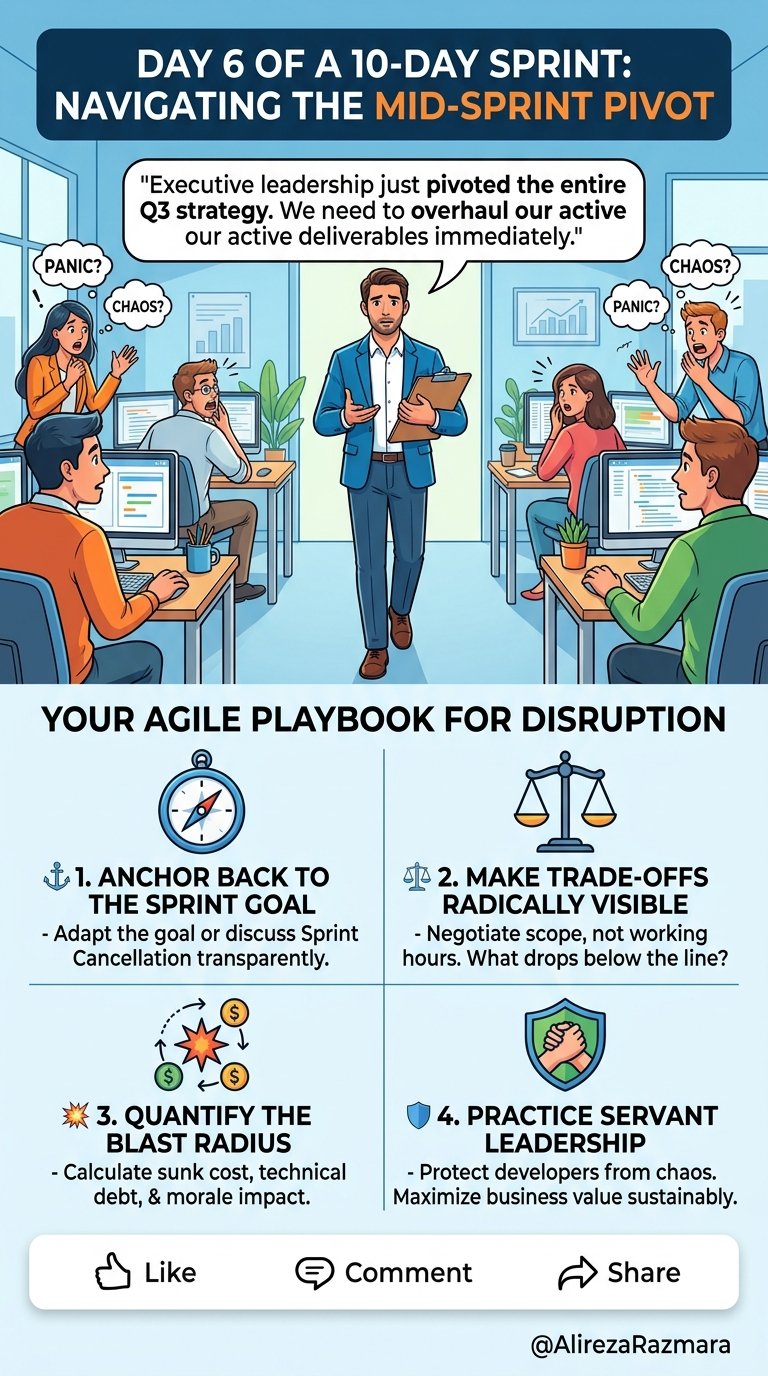
“Executive leadership just pivoted the entire Q3 strategy. We need to overhaul our active deliverables immediately.”
Panic? Chaos? Outright rejection?
If you have been a Scrum Master, Agile Coach, or Technical Project Manager long enough, you have lived this exact scenario. How you respond in this specific moment dictates your team’s psychological safety and defines your organization’s actual agile maturity.
When disruption strikes, true agility is never about blindly saying “Yes” and forcing your engineering team to burn the midnight oil. Conversely, it is not about hiding behind dogmatic rigidity and shouting, “Wait until the next sprint!” Both extremes destroy trust.
Navigating a mid-sprint seismic shift requires a structured, pragmatic approach. Here is the exact, field-tested playbook I use to handle mid-sprint disruptions effectively, protect the team, and keep the business moving forward.
How do you handle a mid-sprint change in scope?
You immediately evaluate the new request against your active Sprint Goal. If the change supports or slightly alters the goal, you negotiate swapping backlog items. If the executive pivot entirely invalidates the current Sprint Goal, you must facilitate a conversation around Sprint Cancellation.
The first step in any mid-sprint crisis is to anchor the conversation back to the Sprint Goal. A Sprint Goal is a commitment to a specific business outcome. It is not a legally binding contract for a rigid checklist of Jira tickets.
When a massive disruption occurs, ask the Product Owner one clarifying question: Does this new request align with what we set out to achieve this sprint?
If the answer is yes, you are simply looking at a change in tactics. The team can drop a lower-priority task and pull in the new requirement to meet the agreed-upon objective. But if the business has completely changed direction, the active Sprint Goal becomes obsolete.
This is where you discuss the ultimate Scrum lever: Sprint Cancellation.
Canceling a sprint sounds drastic, and it should be rare. However, continuing to write code for a feature the business no longer wants is the definition of waste. If the current work provides zero value based on the new Q3 strategy, the Product Owner has the authority to cancel the sprint. Do this transparently. Call a halt, conduct a rapid retrospective, run a new Sprint Planning session, and start fresh. It is vastly superior to zombie-walking through four more days of irrelevant work.
How do you manage capacity when new requirements arrive during a sprint?
You manage mid-sprint capacity by making trade-offs radically visible to stakeholders. Because sprint capacity is finite, introducing a new requirement means an equivalent or larger piece of active work must be removed from the sprint backlog to maintain a sustainable pace.
One of the most dangerous traps a team can fall into is the “illusion of infinite capacity.” When a mid-sprint request arrives, the natural inclination of a people-pleasing team is to try and squeeze it in alongside their existing commitments.
As an agile leader, you must put a hard stop to this. Velocity and human capacity are finite.
When Requirement X comes in mid-flight, you must immediately bring the Product Owner and the developers together to negotiate scope, not working hours. The conversation needs to shift instantly from “Can we do this?” to “What drops below the line so we can do this?”
- Use the One-for-One Rule: If an 8-point story comes in, at least 8 points of unstarted or low-priority active work must be removed.
- Visualize the Impact: Open your Kanban board or active sprint backlog. Physically move the new ticket into the sprint and ask the Product Owner to physically move a ticket out. This tactile exercise makes the reality of the trade-off sink in.
- Protect Quality: Remind stakeholders that forcing 60 hours of work into a 40-hour box does not yield faster delivery; it yields technical debt, bugs, and production outages.
What is the true cost of context switching in Agile delivery?
Context switching mid-sprint imposes a 20% to 40% cognitive penalty on developer productivity. The actual cost of disruption includes the sunk time on current tasks, the effort required to re-establish deep work states, and the increased risk of introducing technical debt.
Before anyone pulls the trigger on a massive mid-sprint pivot, you must quantify the blast radius. Mid-flight context switching is incredibly expensive, yet the business rarely sees the receipt.
Engineers do not operate like light switches. You cannot simply turn off their focus on an API integration and immediately turn on their focus for a frontend user flow. Programming requires deep, sustained concentration. When you interrupt a developer on Day 6, you are blowing up their flow state.
When guiding a Product Owner through a pivot, lay out the tangible costs:
- The Sunk Cost: If a developer drops half-written code today, it will likely rot. When they return to it next sprint, they will spend hours figuring out where they left off.
- The Reassembly Tax: It takes an average of 23 minutes to return to a state of deep focus after an interruption. If an entire team pivots, you are losing days of cumulative productivity just to shifting mental gears.
- The Testing Overhead: Abruptly stopping active work often leaves branches open, testing environments cluttered, and integration pipelines in a messy state.
By presenting these facts objectively, you empower the Product Owner to make a data-driven business decision rather than an emotional one. Sometimes, the new executive strategy is so critical that the business is willing to pay the context-switching tax. That is perfectly fine, as long as they pay it with their eyes wide open.
How can a Scrum Master protect the team during executive pivots?
A Scrum Master protects the team by acting as a pragmatic buffer between executive chaos and developer focus. You enforce a sustainable pace by structuring the pivot conversation around data, capacity, and trade-offs rather than letting panic dictate the workflow.
In moments of crisis, your leadership style is put to the test. Bad Scrum Masters fall into two predictable camps during a mid-sprint disruption. The first camp caves completely, acting as a passive order-taker and letting the business run roughshod over the development team. The second camp becomes a dogmatic wall, citing page 14 of the Scrum Guide and aggressively rejecting any business reality that does not fit into their neat agile boxes.
Great Scrum Masters practice servant leadership under pressure. They find the middle ground.
You must protect the developers from the sheer chaos of executive pivots, but you must also remain highly empathetic to the shifting realities of the business. The Product Owner asking for the change is likely dealing with massive pressure from their own leadership. Treat them as a strategic partner, not an enemy trying to ruin your sprint.
To navigate this dynamically:
- Absorb the Panic: Keep your tone calm, objective, and solution-oriented. Do not let the stakeholder’s urgency translate into team anxiety.
- Isolate the Impact: If the pivot only requires two developers, do not disrupt the entire daily standup. Let the rest of the team continue their progress against the remaining Sprint Goal.
- Document the Pivot: Ensure that the disruption is tracked. During the upcoming Sprint Retrospective, bring data showing how the pivot impacted velocity, morale, and burndown. This helps leadership understand the downstream effects of their strategic shifts.
Being Agile does not mean operating with zero plan, nor does it mean throwing your team under the bus every time a stakeholder changes their mind. True agility requires the discipline to adapt the plan, negotiate scope openly, and maintain operational integrity when the pressure is highest.