
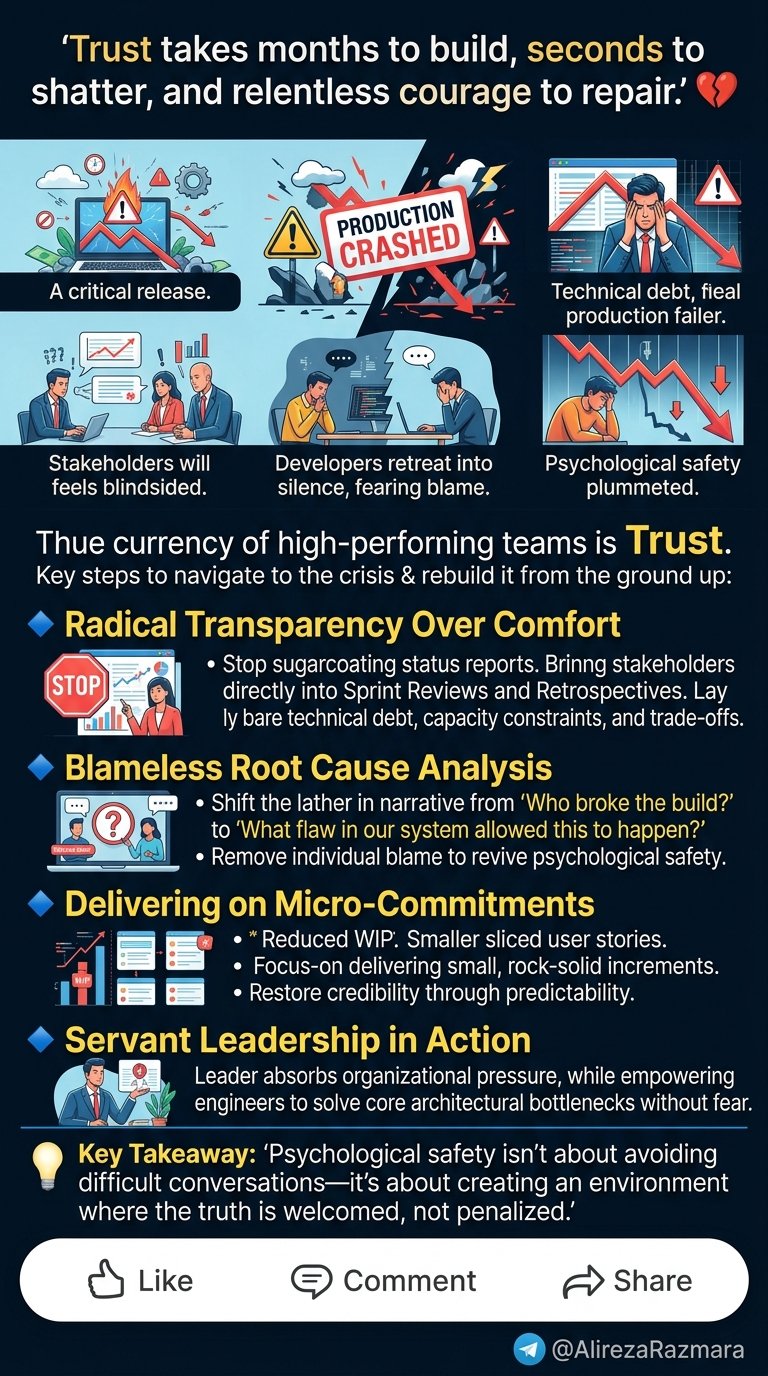
The True Cost of a Failed Delivery
Trust takes months to build, seconds to shatter, and relentless courage to repair. Early in my career as a Scrum Master, I watched a high-stakes project completely derail. We had a critical release on the horizon, but escalating technical debt was quietly ignored to hit an unrealistic deadline.
When the sprint failed and production crashed, the fallout was brutal. Stakeholders felt blindsided and deceived. Developers retreated into silence, fearing blame. Psychological safety plummeted to absolute zero.
As agile leaders, we spend an enormous amount of time talking about velocity, burndown charts, and story points. But the true currency of high-performing teams is Trust. Without it, your metrics are just fiction, and your delivery framework is merely an administrative burden. If you are sitting in a retro room right now with a team that has lost the faith of its stakeholders, you cannot process-engineer your way out of it. You have to rebuild the culture from the ground up.
How Do You Know When Agile Team Trust is Eroding?
Trust erosion becomes obvious when stakeholders demand highly detailed traditional status reports instead of trusting the agile artifacts, and when developers stop challenging bad ideas. It is rarely a sudden explosion. It is a slow leak.
You can spot a low-trust environment by observing meeting dynamics. In a healthy team, the Daily Scrum focuses on blockers and collaboration. In a low-trust team, it devolves into a defensive status-reporting session where everyone simply justifies their existence for fifteen minutes. Developers say they are ‘on track’ right up until the day before a release, not because they are lying, but because they are surviving.
Stakeholders react to this uncertainty by tightening their grip. They ask for Gantt charts. They demand to know exactly what every engineer is doing at every hour. They manage risk through micromanagement because they have been burned by unpleasant surprises. This cycle of hidden technical debt and executive micromanagement creates the classic ‘Watermelon Project’—green on the outside, completely red on the inside.
What Causes a Breakdown of Trust Between Engineering and Stakeholders?
Agile teams lose stakeholder trust when there is a persistent gap between what is communicated and what is actually delivered. This breakdown usually stems from a culture that penalizes bad news, forcing teams to mask status reports and ignore structural software issues.
Stakeholders are fundamentally risk managers. They can handle bad news, but they despise surprises. When a team hides a massive database architecture flaw because they are afraid of missing an arbitrary Q3 deadline, they are robbing the business of the ability to pivot. When that flaw inevitably takes down the production environment, the business leaders do not just see a technical failure. They see a massive breach of professional integrity.
On the engineering side, developers lose trust in leadership when arbitrary deadlines are prioritized over software craftsmanship. If an engineer raises a red flag about a brittle legacy API and is told to ‘just make it work for the release,’ they learn very quickly that quality does not matter. The next time they see a problem, they will stay quiet.
How to Rebuild Psychological Safety and Trust (Step-by-Step)
You rebuild trust by demonstrating predictable, reliable behavior over time through radical transparency, blameless problem-solving, and executing on micro-commitments. You cannot talk your way out of a problem you behaved your way into. You have to deliver your way out.
Enforce Radical Transparency Over Comfort
Radical transparency means sharing the unfiltered reality of your project’s health directly with stakeholders, including your capacity limits and ugly technical debt. You must stop sugarcoating your status reports immediately.
Following our catastrophic failure, we made a hard pivot. We brought key stakeholders directly into our Sprint Reviews and Retrospectives. We laid bare our architectural bottlenecks, the exact nature of the technical debt we had accumulated, and the painful trade-offs required to fix them. It was deeply uncomfortable. The initial meetings were tense and awkward.
But a funny thing happened. Suddenly, the stakeholders were no longer guessing. They saw the actual, tangible constraints the engineering team was fighting against daily. Exposing the ugly truth transformed the business leaders from angry critics into active collaborators. They started helping us negotiate scope rather than just demanding dates.
Shift to Blameless Root Cause Analysis
Blameless root cause analysis shifts the organizational focus from finding a specific person to punish to finding a system flaw to fix. Removing the threat of individual blame is the fastest way to revive team morale and open communication.
When our production environment crashed, the immediate executive reaction was predictable: ‘Who broke the build?’ As an agile coach or Scrum Master, you have to throw yourself in front of that question. We forcefully changed the narrative in the room to: ‘What gap in our testing pipeline allowed a broken build to reach production?’
This single shift in phrasing changed the entire dynamic of the engineering floor. Developers stopped hiding their mistakes. They started actively volunteering information about flaky tests, missing documentation, and brittle code because they knew they wouldn’t be fired for bringing it up. You fix the system, not the person.
Execute on Micro-Commitments
Micro-commitments involve breaking down large, risky features into the smallest possible deliverable units and shipping them flawlessly. This restores credibility by proving the team can meet its promises on a tight, predictable cadence.
We had zero credibility, so promising a massive deployment in a month was useless. Instead, we heavily reduced our Work in Progress (WIP) limits. We took user stories and sliced them so thin that completing them within a few days was nearly guaranteed. We focused on delivering small, rock-solid increments.
Instead of a huge launch, we promised one fully tested, stable integration by Friday. We hit that goal. Then we made another small promise for the following Wednesday. We hit that one, too. Predictability is the ultimate antidote to stakeholder anxiety. By shrinking the time horizon of our promises and consistently delivering, we slowly refilled the trust bank account.
Practice Genuine Servant Leadership
Servant leadership in a crisis means acting as a shield for your team while equipping them with the tools and space they need to solve core technical issues. It is about absorbing organizational pressure so engineers can focus on the work.
As a leader during that fallout, my primary job was to sit in the uncomfortable executive meetings and take the heat. I managed the anger, the frustration, and the demands for faster output. I acted as a shield so the engineering team could actually focus on writing automated tests, untangling the database architecture, and stabilizing the platform without someone looking over their shoulder every five minutes.
You empower engineers by giving them the space to do the job right, free from the shadow of arbitrary deadlines. You clear the path, you remove the administrative blockers, and you trust them to execute.
The True Definition of Psychological Safety in Tech
Psychological safety is not about being nice, lowering standards, or avoiding difficult conversations; it is about creating a high-performance environment where the truth is welcomed, not penalized. It is the bedrock of continuous improvement.
There is a massive misconception in the corporate world that psychological safety means protecting people’s feelings. It doesn’t. True psychological safety means a junior developer feels perfectly comfortable telling the seasoned CTO that a technical approach is flawed or that a deadline is physically impossible. It means the team can engage in fierce, passionate debates about system architecture without anyone taking it personally.
When a team lacks this safety, they hide risks until they explode in production. When they have it, they identify risks early enough in the sprint to actually mitigate them. The success of your agile transformation does not hinge on how well you write Jira tickets. It hinges entirely on whether your team feels safe enough to tell you the truth.