
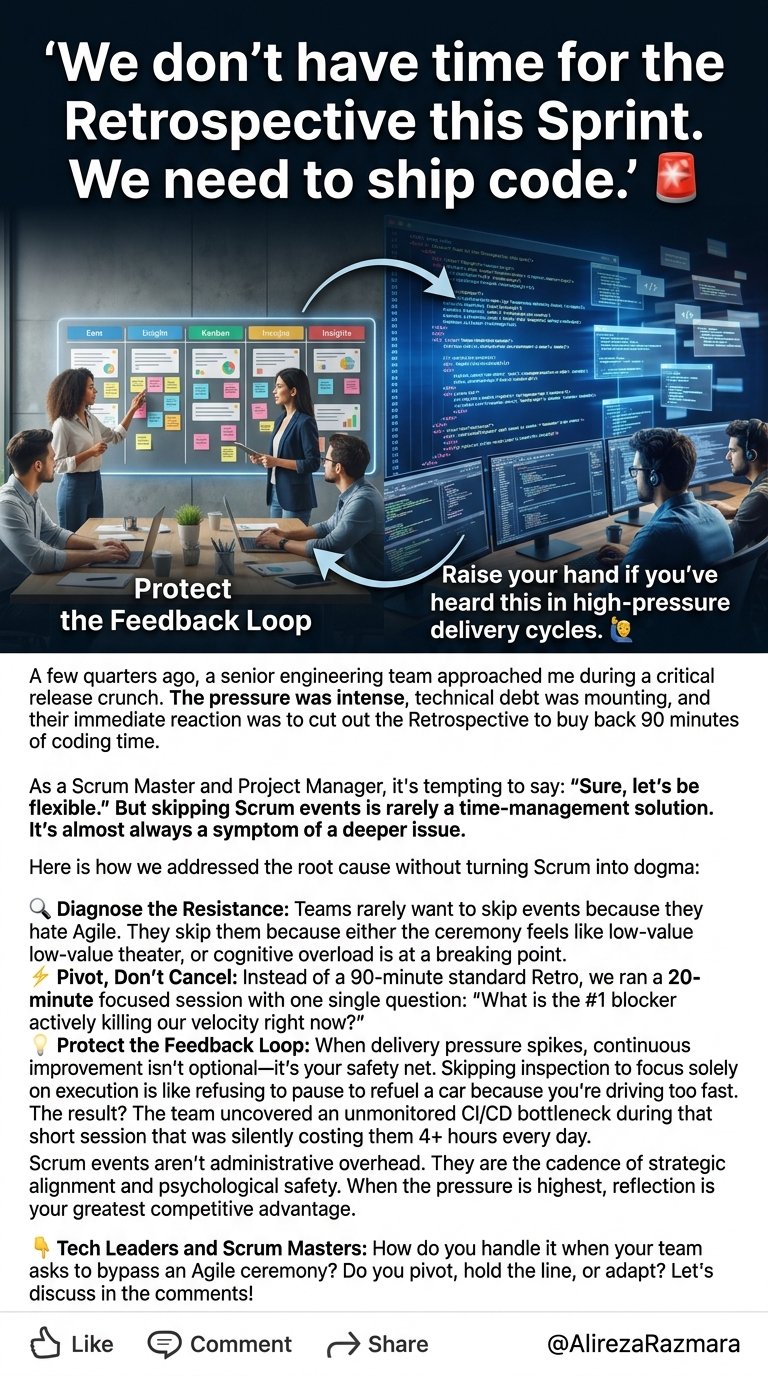
“We don’t have time for the Retrospective this Sprint. We need to ship code.”
Raise your hand if you have heard this during a high-pressure delivery cycle. If you have spent any real time working as an Agile Coach, Scrum Master, or Technical Project Manager, this phrase is entirely familiar. The pressure mounts, technical debt starts blocking progress, and the team searches desperately for a way to buy back a few hours.
The immediate temptation is to act accommodating. You want to be a team player. You want to show that Agile processes are flexible, so you consider canceling the calendar invite to give the engineers 90 minutes of uninterrupted coding time. It feels like a pragmatic compromise.
It is almost always a trap.
Skipping core Scrum events is rarely a sustainable time-management solution. It is a loud, flashing warning sign of a deeper structural issue. Letting the team abandon the Retrospective does not fix the delivery problem; it merely postpones the inevitable collision. Here is exactly how to handle the situation without turning your Agile framework into dogmatic punishment.
Why do Agile teams actually want to skip the Retrospective?
Teams usually want to skip the Retrospective for two specific reasons: cognitive overload has reached a breaking point, or the ceremony itself has degraded into low-value administrative theater. Engineers rarely ask to bypass an event because they genuinely hate Agile principles. They ask because the current format is not solving their immediate pain.
When developers are pushed to the brink by looming deadlines, their focus narrows entirely to execution. Context switching becomes painful. If your past few Retrospectives consisted of vaguely discussing the same recurring problems without generating actionable changes, the team will naturally view the meeting as a roadblock.
If you force a stressed team into a rigid, 90-minute brainstorming session with digital sticky notes and icebreaker games, you will lose their trust entirely. They do not want to play games. They want to clear the deck and get back to work. As a facilitator, your job is to read the room and adapt the format to their reality.
The Hidden Cost of Canceling Scrum Events Under Pressure
When you skip a Retrospective under heavy pressure, you abandon your primary continuous improvement feedback loop right when the system is most unstable. The friction slowing your team down this Sprint will inevitably carry over into the next Sprint, compounding the very delays they are trying to avoid.
Think of it like a race car driver who refuses to pull into the pit stop to refuel because they are driving too fast. The short-term gain of staying on the track is immediately wiped out by running out of gas two laps later.
A few quarters ago, a senior engineering team approached me during a critical release crunch. They were behind schedule, exhausted, and bluntly asked to kill the Retrospective. If we had simply agreed and sent everyone back to their IDEs, they would have kept pushing against an invisible wall.
Instead, we adapted. We paused just long enough to inspect the friction. That brief pause uncovered an unmonitored CI/CD bottleneck that was silently failing and forcing manual pipeline restarts. This obscure issue was costing the engineering team over four hours every single day. By taking a few minutes to identify and fix the bottleneck, the team bought back dozens of hours for the remainder of the release cycle.
How to Pivot the Retrospective When You Need to Ship Code
When a team asks to bypass an Agile ceremony, you do not cancel it, but you also do not enforce strict, by-the-book compliance. You pivot the event to serve the team’s immediate survival needs. Here is a field-tested playbook for adapting the Retrospective during a crunch.
1. Diagnose the Root Cause of the Resistance
Before changing the meeting, find out exactly why the team wants out. Ask the Tech Lead or a senior engineer privately: “Is this about a specific deadline today, or do these meetings feel like a waste of time lately?” If it is an immediate fire, you can shorten the meeting. If it is meeting fatigue, you have a facilitation problem that you must fix before the next Sprint.
2. Shorten the Timebox, Sharpen the Focus
You do not need an hour and a half to run a valid Retrospective. If the team is drowning in work, offer a compromise: “Give me 20 minutes. We will skip the standard boards, identify the biggest blocker, and get you right back to your code.” A 20-minute, hyper-focused session shows empathy for their workload while firmly protecting the Agile feedback loop.
3. Ask One High-Impact Question
Drop the standard “What went well, what didn’t go well” format. When time is scarce, you only need to ask one strategic question. In the scenario mentioned earlier, we used this exact prompt:
- “What is the number one blocker actively killing our velocity right now?”
That is it. Do not ask for five items. Do not ask about minor annoyances. Force the team to ruthlessly prioritize the single largest threat to their current delivery goal. Write it down, assign a clear owner to resolve it, and end the meeting early.
4. Execute the Fix Immediately
If you promise a 20-minute Retro and pull a critical blocker out of the team, you must follow through. As the Scrum Master or Project Manager, your immediate priority is to clear that specific hurdle. If the team sees that their brief moment of reflection directly resulted in an easier workload the very next day, they will never ask to skip a Retrospective again.
Protecting the Feedback Loop During Critical Releases
Continuous improvement is not an optional luxury reserved for slow Sprints and easy release cycles. It is your ultimate safety net. Skipping inspection to focus exclusively on execution removes the psychological safety required to raise red flags before they turn into critical failures.
Scrum events are not administrative overhead. They are the cadence of strategic alignment. They force everyone to step out of the weeds, look at the horizon, and confirm they are still running in the right direction.
During a crisis, you will face intense pressure to revert to old, chaotic habits. The instinct to abandon process and just “work harder” is incredibly strong. Leadership might even encourage it. But working harder on a broken process yields diminishing returns.
Final Thoughts on Agile Adaptability
When the delivery pressure is highest, structured reflection is your greatest competitive advantage. The teams that survive high-stakes releases without burning out are the ones that ruthlessly protect their time to inspect and adapt.
The next time a developer tells you they do not have time for the Retrospective, do not panic and do not preach the Scrum Guide at them. Acknowledge their stress, pivot the format, shrink the timebox, and ask them exactly what is standing in their way. You will almost always uncover the exact problem preventing them from shipping that code in the first place.