Why the Product Owner Should Not Write Every User Story
The Product Owner should not write every user story because it creates a severe bottleneck and reduces the development team to passive order-takers. When one person drafts every Jira ticket in isolation, you lose the technical insights of your engineers, and your PO sacrifices valuable time that should be spent on customer discovery and market strategy.
Look at your current product backlog. If your Product Owner spends 80% of their week staring at a screen, agonizing over acceptance criteria, and typing out exhaustive technical details, you do not have an Agile team. You have a highly paid administrative assistant masquerading as a product leader.
This is a massive anti-pattern in modern software delivery. We have somehow convinced ourselves that a user story is a comprehensive requirements document disguised in a “As a… I want to… So that…” format. It is not. Writing out a five-page specification before a sprint begins completely ignores the core Agile principle of valuing customer collaboration over rigid contract negotiation.
When a PO writes every story, Refinement sessions turn into painful reading exercises. The PO reads the ticket out loud, asks the team if they have any questions, is met with dead silence, and assumes alignment. Later in the sprint, developers inevitably build the wrong thing because they were never invested in the problem. They were just following the instructions on the ticket.
Who Exactly Should Write User Stories?
Anyone on an Agile team can write a user story, and high-performing teams actively expect everyone to contribute to the backlog. While the Product Owner retains ultimate accountability for maximizing product value, developers, designers, and stakeholders should all be holding the pen and drafting solutions collaboratively.
To shift away from a solo-author mentality, you need to redefine what ownership actually looks like across the team.
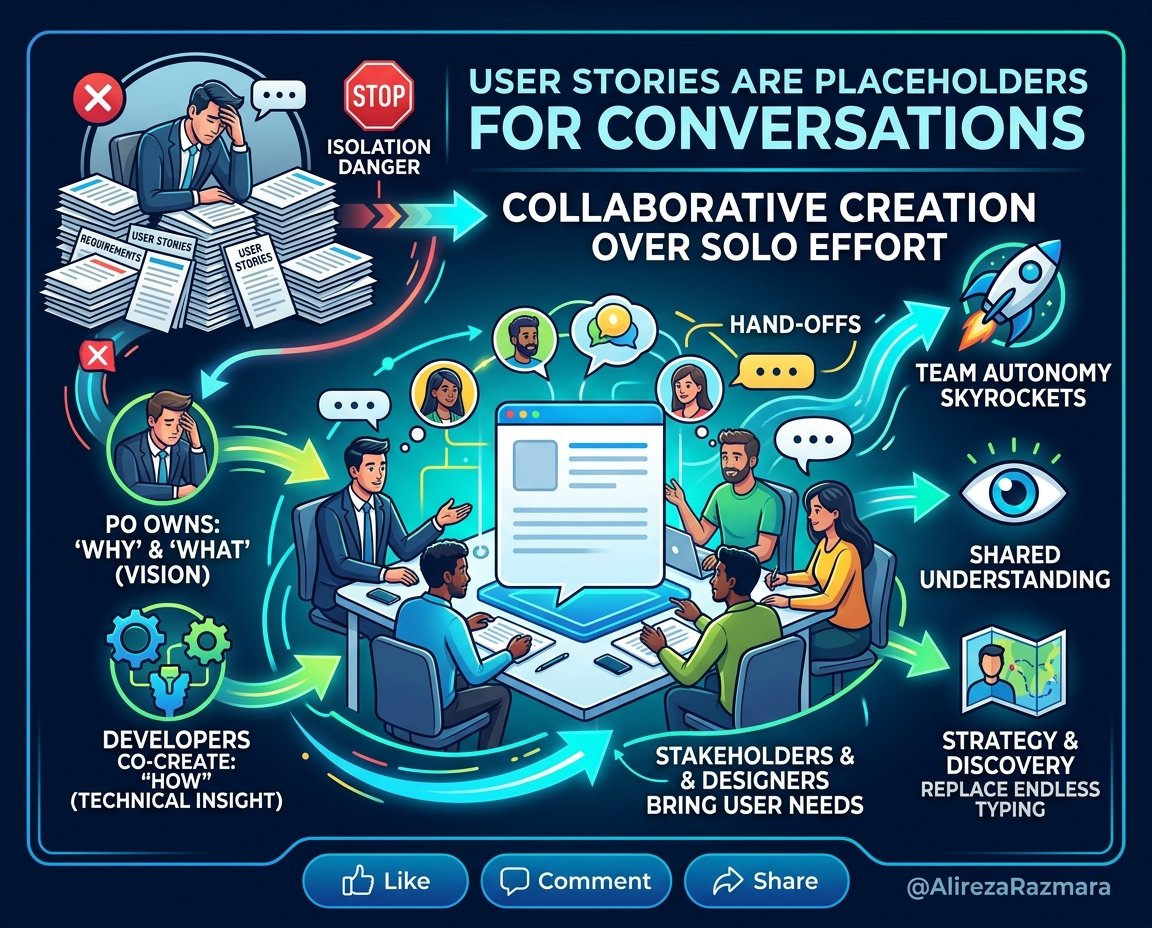
The Product Owner: Owning the “Why” and “What”
Accountability does not mean doing all the typing. The Product Owner is the visionary of the team. Their primary job is to provide business context, market alignment, and the target outcome. They set the boundaries and define the problem to be solved.
A PO should come to the team and say, “We are seeing a 40% drop-off at the checkout screen for returning mobile users. We need to eliminate friction so they can purchase in under three taps.” That is the what and the why. They do not need to sit down and write six technical tickets detailing database schema updates and API payloads to achieve that goal. They simply present the business objective.
Developers: Co-creating the “How”
When engineers write or refine stories themselves, psychological ownership shifts immediately. They transition from “doing what management told us to do” to “solving a real customer problem.”
Developers bring a critical lens to backlog items that a PO simply cannot provide. They identify the technical enablers required to make a feature work. They spot edge cases, map out architectural dependencies, and ensure non-functional requirements like system performance, accessibility, and security are integrated from day one. If your engineers are writing the tickets, the tickets will naturally reflect the realities of the codebase.
Stakeholders and Designers: Voicing User Needs
UX researchers, UI designers, and QA engineers are consistently on the front lines of user behavior. If a customer service representative identifies a recurring pain point, capturing that friction as a new user story should be completely frictionless.
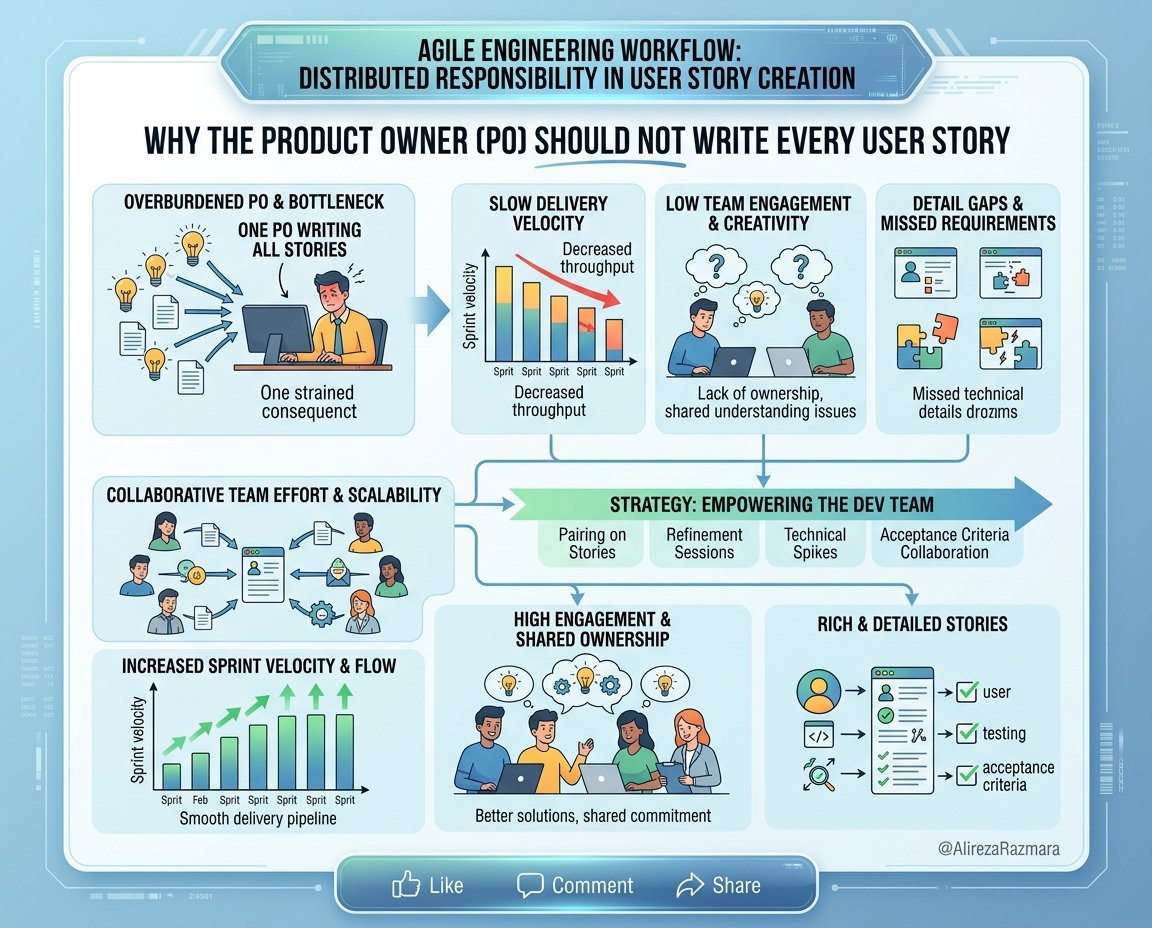
By opening the backlog up to the entire cross-functional team, you ensure that usability, testing, and actual customer empathy are baked into the workflow rather than treated as afterthoughts.
The 3 C’s Rule: Why Conversations Trump Documentation
A great User Story is not measured by its word count or how detailed the text is. It is measured by the quality of the shared understanding reached during the conversation before sprint planning begins. If your team is struggling with overly complex tickets, return to the foundational concept introduced by Ron Jeffries: The 3 C’s.
- Card: The ticket itself is just a placeholder. It is a physical or digital token that serves as a reminder to talk about a specific problem. It only needs enough text to trigger the memory of what needs to be solved.
- Conversation: This is where the actual work happens. The team gathers around the Card to debate, ask questions, and explore solutions. The dialogue uncovers hidden complexities and aligns everyone on the desired outcome. The conversation replaces the heavy requirements document.
- Confirmation: After the discussion, the team agrees on how to test the outcome. This is documented as Acceptance Criteria. It is the final handshake that answers the question: “How will we know when we are done?”
If you skip the Conversation and go straight from Card to Confirmation, you are reverting to waterfall project management in small, two-week chunks.
How to Shift Your Team from Ticket Takers to Problem Solvers
Transitioning from a PO-dominated backlog to a collaborative model requires active coaching and intentional changes to your team rituals. You cannot just tell developers to “write more tickets” and expect immediate results. Here are the specific strategies you need to implement.
1. Stop Reading Tickets Out Loud in Refinement
Change the format of your Backlog Refinement meetings. Instead of projecting Jira on a screen and reading pre-written tickets, the Product Owner should present a user problem. Give the team a blank whiteboard—physical or virtual—and ask them how they would solve it. As the team maps out the solution, capture the distinct pieces of work as new user stories. You will immediately notice a spike in engagement when the team realizes they are designing the solution rather than auditing someone else’s work.
2. Implement the “Three Amigos” Strategy
Do not wait for a formal team-wide meeting to start talking about upcoming work. Encourage the “Three Amigos” pattern, where a business representative (PO), a technical representative (Developer), and a quality representative (QA) meet informally for 15 minutes to draft upcoming stories. This ensures that every ticket is instantly balanced with business value, technical feasibility, and testability before it ever reaches the wider group.
3. Celebrate Incomplete Tickets
If a Product Owner brings a perfectly polished, highly detailed ticket to the team, there is no room for collaboration. The team will just nod and estimate it. As a Scrum Master or Coach, you should actively praise backlog items that are slightly vague but present a compelling business problem. A ticket that says, “The analytics dashboard is too slow for enterprise users to load on Monday mornings” is a fantastic starting point. It forces the team to ask questions, pull data, and define the technical boundaries together.
4. Show the Product Owner the Value of Their Time
Many Product Owners resist giving up control of the keyboard because they believe writing tickets is their primary job. You need to show them what they are missing out on. Calculate the hours they spend acting as a Jira scribe and redirect that time toward customer interviews, competitive analysis, and strategic roadmapping. When a PO realizes that empowering the team frees them up to do actual product management, the resistance usually fades.
The Bottom Line on Backlog Ownership
Agile frameworks are designed around shared responsibility. The moment you isolate the creation of user stories to a single role, you build a silo. Hand-offs reappear. Miscommunications multiply. Team autonomy plummets.
By treating user stories as collaborative problem-solving exercises rather than top-down directives, you fundamentally change the culture of your engineering team. Stop aiming for perfectly written Jira tickets and start aiming for perfectly understood customer problems.