
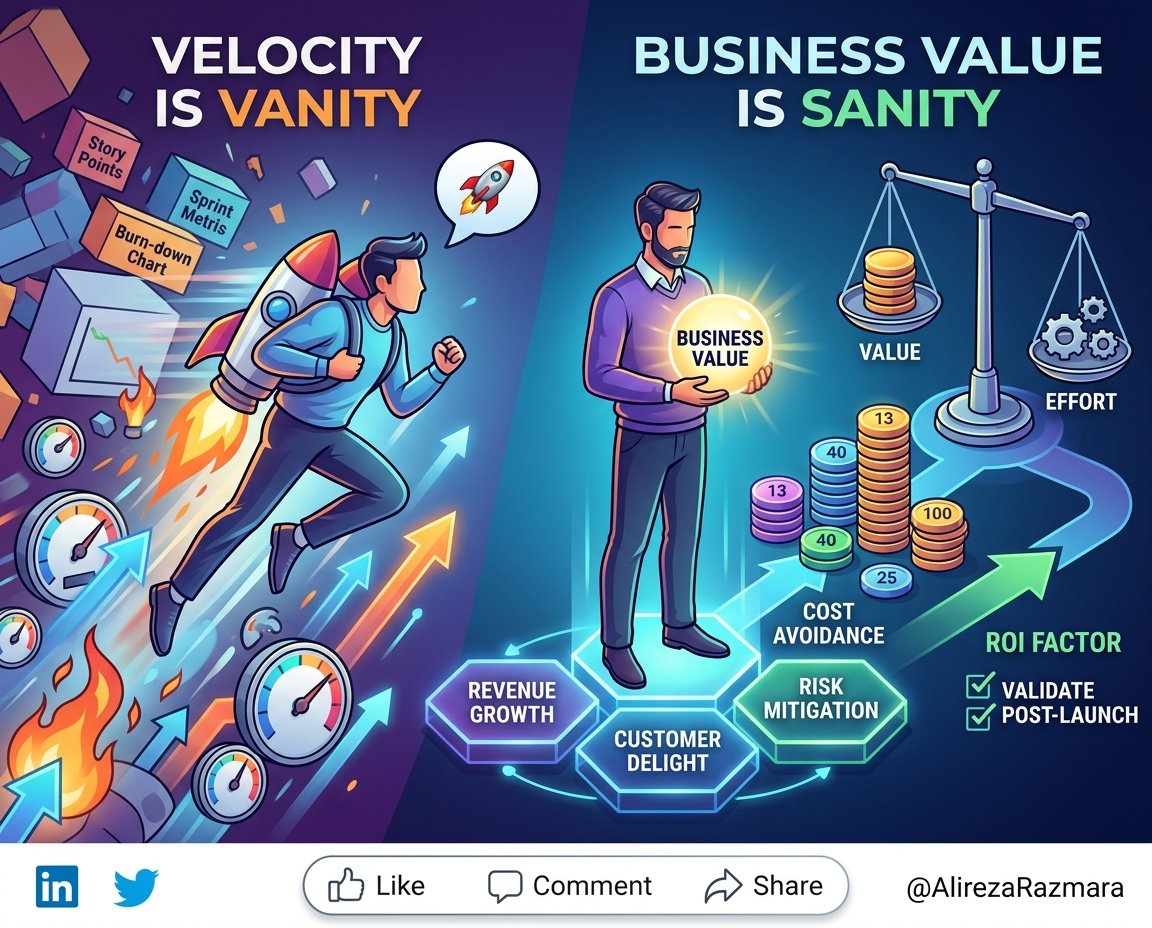
Why Sprint Velocity is a Vanity Metric
Sprint velocity is a vanity metric because it measures output, not outcome. It tracks the volume of effort a team completes during a sprint, completely ignoring whether that effort solved a user problem or generated revenue.
When leadership fixates on velocity, teams naturally optimize for it. They cut corners on technical architecture, inflate story points, and pump out features just to keep the burndown chart trending in the right direction. This dynamic creates a “feature factory”—a group of engineers churning out code entirely disconnected from actual business goals.
Velocity tells you how fast the car is moving. Business value tells you if you are driving off a cliff.
The alternative is tracking and optimizing for business value. This acts as the ultimate sanity check against stakeholder noise, organizational politics, and the dreaded HiPPO (Highest Paid Person’s Opinion). If you want to transform your delivery culture, you must coach your Product Owner to stop guessing and start quantifying.
A 4-Step Framework to Quantify Agile Business Value
You quantify Agile business value by scoring backlog items across specific outcome pillars, assigning relative value points, calculating ROI against engineering effort, and measuring post-launch analytics. This framework transitions product prioritization from subjective debate to objective strategy.
1. Define the Four Value Pillars
Value is rarely just “more money.” To evaluate a feature accurately, you must break the abstract concept of value down into distinct, measurable drivers. If a Product Owner cannot map a user story to one of these four pillars, it simply does not belong in the sprint backlog.
- Revenue Growth: Direct financial impact. This includes generating new subscriptions, facilitating cross-sells, or unlocking a completely new geographic market segment.
- Cost Avoidance and Reduction: Internal operational efficiency. This covers automating manual internal processes, reducing expensive infrastructure spending, or minimizing support ticket volume.
- Customer Delight: Enhancements that directly impact user behavior metrics. Look for features that improve retention rates, Net Promoter Score (NPS), or solve core usability friction points.
- Risk Mitigation: Critical non-functional requirements. This means applying critical security patches, meeting impending regulatory compliance deadlines, or paying down crippling technical debt before it halts future development.
2. Assign Relative Value Points (Fibonacci for Value)
Relative value points apply the Fibonacci sequence (1, 2, 3, 5, 8, 13, 21) to business impact instead of engineering effort. This allows Product Owners to estimate the strategic weight of a feature by comparing it to a known baseline, rather than struggling to predict exact dollar amounts.
Stop letting stakeholders demand that everything is “high priority.” If everything is critical, nothing is. Coach your Product Owner to establish a benchmark story—a recently delivered feature with undisputed, moderate value. Assign it an arbitrary score, such as an 8.
From there, calibrate the entire product backlog against it. Run a “Value Poker” session with key stakeholders. Is this proposed feature roughly twice as valuable as your benchmark? Give it a 13. Is it barely moving the needle compared to the benchmark? Give it a 2.
When you force stakeholders to hold up a card and justify their value estimation, you eliminate back-channel lobbying. It forces the room into making real product trade-offs.
3. Calculate the ROI Factor (Value vs. Effort)
The ROI Factor is calculated by dividing a feature’s Business Value Points by its Story Points. This provides a clear, mathematical ratio that helps Agile teams instantly identify quick wins and deprioritize heavy, low-impact work.
Many mature organizations use Weighted Shortest Job First (WSJF) from the SAFe framework, but a simple Value-to-Effort ratio works exceptionally well for standard Scrum teams. Let us look at a practical example. Feature A has a Value of 13 and an Effort of 5 (Score: 2.6). Feature B has a Value of 8 and an Effort of 13 (Score: 0.6). Prioritizing Feature A is no longer a debate; it is a mathematical certainty.
When the Product Owner plots these two metrics together, backlog prioritization becomes brutally obvious:
- High Value + Low Effort: These are your quick wins. Pull them into the immediate next sprint.
- High Value + High Effort: Strategic bets. These require product management to slice the epics into smaller, independently deliverable increments.
- Low Value + Low Effort: Fillers. Keep them near the bottom of the backlog to grab when engineers have awkward spare capacity at the end of a sprint.
- Low Value + High Effort: The danger zone. Kill these items immediately, regardless of whose pet project they happen to be.
4. Validate Post-Launch Hypotheses
Post-launch validation involves reviewing analytics and user behavior after a feature hits production to confirm whether the anticipated business value actually materialized. Value is not delivered at the moment of deployment; it is delivered only when the end-user realizes the benefit.
This is the exact step most Agile teams skip entirely. They ship the feature, celebrate briefly at the sprint review, and immediately pivot to the next backlog item. As a technical delivery consultant, I force teams to review releases from three sprints ago.
Did that new checkout flow actually reduce cart abandonment by 15% as the Product Owner hypothesized? If yes, celebrate it. If not, the team needs to investigate why the hypothesis failed. Treating every business value score as a hypothesis keeps the team fiercely grounded in reality and continuously sharpens the product organization’s estimation accuracy over time.
Overcoming Stakeholder Pushback and the HiPPO Effect
To protect the Product Owner from the Highest Paid Person’s Opinion (HiPPO), Scrum Masters must arm them with transparent, data-driven prioritization frameworks. When value criteria are standardized and agreed upon publicly, executives can no longer force arbitrary, low-value features into an active sprint.
It is incredibly daunting for a mid-level Product Owner to tell a demanding VP of Sales “no.” But it is highly effective for them to say, “Based on our organizational value pillars, this CRM integration scores a 3 for revenue and an 8 for engineering effort. That gives it a low ROI compared to our current sprint commitments.”
The business value framework acts as a professional shield. It depersonalizes the rejection. You are not rejecting the executive’s idea; the math is simply indicating a better path forward.
If an executive insists on overriding the scoring system, let them. However, you must enforce weaponized transparency. Document exactly which high-value items are being actively removed from the sprint to accommodate their specific request. Make the cost of their decision visible to the entire organization. Transparency acts as a brutal but highly effective disinfectant for terrible Agile practices.
From Feature Factory to High-Impact Product Team
Transitioning from a feature factory to a high-impact product team requires shifting the primary metric of success from sprint output to user outcome. When teams obsess over business value instead of sprint velocity, they build software that actually matters to the market.
Stop treating your software engineers like ticket-takers at a fast-food counter. When developers understand the actual business value and strategic “why” behind the user stories they are sizing, they consistently make better technical decisions. They will proactively suggest simpler architectural solutions to achieve the exact same business goal. They transform from coders into true partners in the product strategy.
Velocity will always have a necessary place in sprint capacity planning. It helps Scrum teams understand what realistically fits into a two-week timebox. But it should never be the headline metric of a sprint review. Put business value front and center, and watch the quality of your stakeholder conversations, your team morale, and your final software product transform entirely.