
Are You Managing Uncertainty or Hiding Behind It?
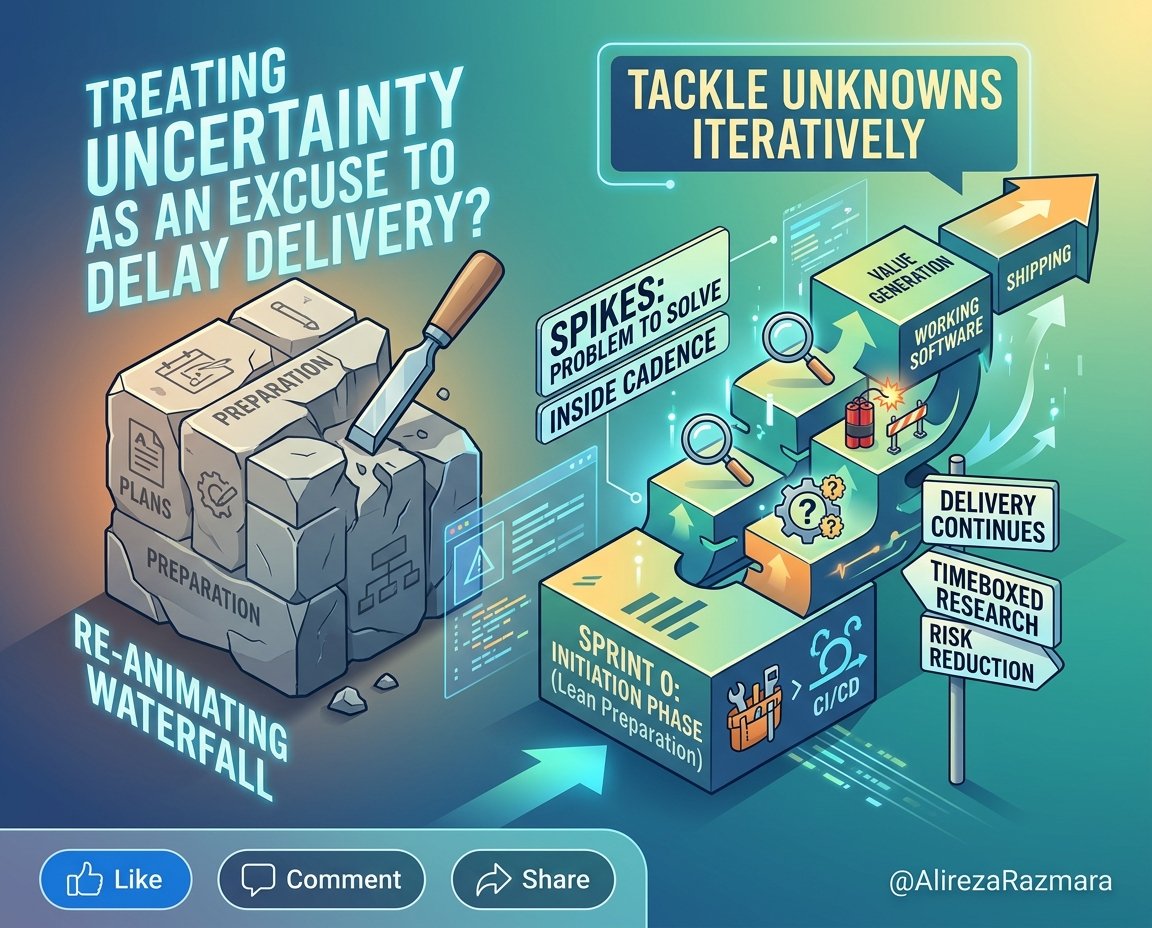
Let’s get straight to the uncomfortable truth. Too many software engineering teams treat uncertainty as a free pass to delay delivery. When teams encounter ambiguity in a new project or a complex feature, the natural instinct is to pump the brakes. They ask for more time to research. They ask for a “Sprint 0” to figure out the architecture.
Before you know it, you have accidentally revived Waterfall under the convenient guise of Agile readiness.
As an Agile Coach, I see this anti-pattern constantly. Engineering leaders, Product Managers, and Scrum Masters frequently confuse the purpose of Sprint 0 and Spikes. They blend project initiation with feature discovery, resulting in bloated timelines, frustrated stakeholders, and a distinct lack of working software.
High-performing teams do not wait for total certainty to start shipping. They launch on day one and systematically turn unknowns into actionable insights inside their regular cadence. Let’s unpack the critical differences between Sprint 0 and Spikes so you can stop over-planning and start delivering.
What is Sprint 0 in Agile?
Sprint 0 is an upfront, non-standard project initiation phase used strictly to prepare a team’s technical and operational foundation before regular delivery sprints begin. It focuses on essential setup tasks like configuring CI/CD pipelines, provisioning cloud environments, onboarding team members, and doing the initial shaping of the product backlog. Importantly, Sprint 0 is not recognized in the official Scrum Guide.
Because the Scrum framework expects teams to deliver a potentially releasable increment every sprint, Sprint 0 exists outside canonical Scrum. It is a pragmatic compromise for brand-new teams or entirely new codebases.
The Reality and the Risk
The concept of Sprint 0 is incredibly dangerous in the wrong hands. It is the easiest place for old-school, phase-gate habits to hide. What starts as a simple two-week setup phase easily morphs into a hidden six-week “design and architecture” phase.
When a team spends a month doing nothing but drawing UML diagrams and debating tech stacks, they are not doing Agile. They are doing Water-Scrum-Fall.
Best Practices for Sprint 0
- Keep it lean: A successful Sprint 0 should rarely last longer than a week. Sometimes, it only takes a few days.
- Focus on the environment, not the product: Your goal is to build the factory, not the car. Secure your repositories, set up your Jira boards, define your Definition of Done, and stop there.
- Move to delivery immediately: Do not try to plan the entire year’s roadmap. Get just enough of the backlog refined to feed Sprint 1, then pull the trigger.
What is an Agile Spike?
An Agile Spike is a strictly timeboxed research, exploration, or prototyping task placed inside an active sprint to investigate a specific technical or functional unknown. Originating from Extreme Programming (XP), a spike produces actionable knowledge, architectural decisions, and story estimates rather than production-ready software.
Unlike Sprint 0, which happens before delivery begins, Spikes happen during continuous delivery. They are the tactical tools you use when a team picks up a story and realizes, “We actually have no idea how to implement this.”
The Purpose of a Spike
Spikes de-risk the work itself. Imagine your Product Owner wants to integrate a new payment gateway, but the engineering team isn’t sure if the API can handle your specific data payload or security requirements. Instead of guessing the effort and blowing up the sprint, the team creates a Spike.
The Spike might be titled: Investigate Gateway X rate limits and payload structure.
The Iron Rule of Timeboxing
The most critical element of a Spike is the timebox. A Spike is not an open-ended research grant. If you allocate eight hours to a Spike, the developer stops working at the eight-hour mark.
When the timer expires, the team regroups. The output is usually a brief technical document, a throwaway prototype, or simply the ability to now accurately point and plan the actual user stories for the integration. If you still don’t know enough after the timebox expires, you make the best architectural decision possible with the data you have, or you pivot.
Sprint 0 vs. Spikes: The Core Differences
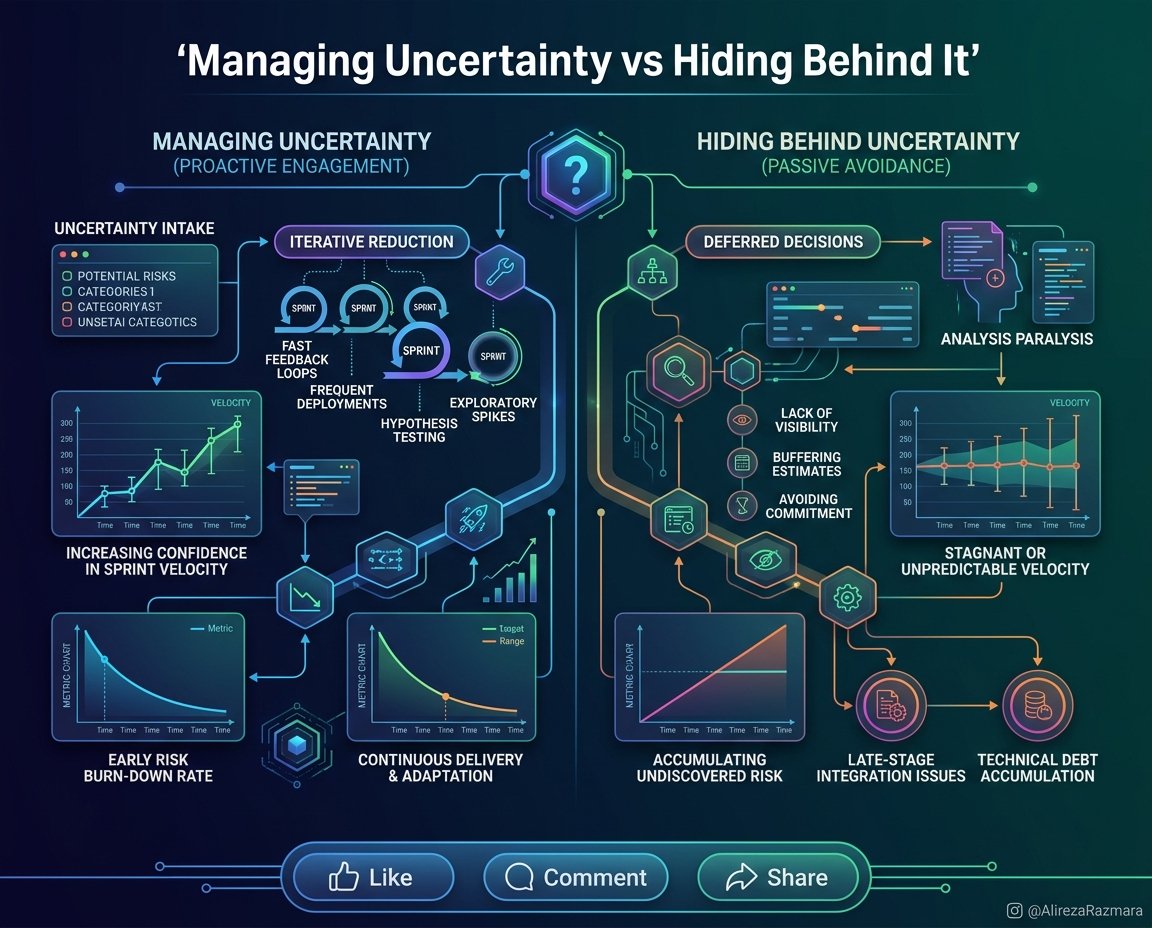
To master agile delivery, leaders must clearly separate these two concepts. Here is the direct breakdown of how they differ in practice.
1. Level of Focus (Project vs. Story)
Sprint 0 is a project-level event. It is about getting the team and the infrastructure ready to do the work. Spikes are story-level events. They are about investigating a specific, isolated piece of technical work so that a user story can be completed.
2. Timing and Frequency (Upfront vs. Iterative)
Sprint 0 happens exactly once per project lifecycle—right at the very beginning. If you find yourself doing a Sprint 0 in the middle of a project, you have fundamentally broken your flow. Spikes happen continuously. A healthy Agile team might execute one or two Spikes every single sprint to prepare for upcoming backlog items.
3. The Expected Output (Foundation vs. Knowledge)
The output of Sprint 0 is operational readiness: a working pipeline, access rights granted, and a shaped backlog. The output of a Spike is knowledge: a decision on a database schema, validation of a third-party library, or a clear estimate for a complex feature.
How to Stop Using Uncertainty as a Crutch
If your organization struggles with slow delivery and endless planning loops, you need to change how you talk about ambiguity. Here is how technical leaders and Agile coaches can drive that change.
Embrace “Day One” Delivery
Stop waiting for perfect clarity. Perfection is the enemy of iteration. If your team claims they cannot start Sprint 1 because the architecture isn’t fully defined, challenge that assumption. Ask them: What is the smallest, simplest slice of end-to-end value we can build to prove our initial assumptions?
Building a “walking skeleton”—a tiny, bare-bones implementation that touches the database, the backend, and the UI—is infinitely more valuable than spending three extra weeks in Sprint 0 drawing diagrams.
Schedule Discovery Just-in-Time
Do not try to solve all your technical unknowns upfront. Use Backlog Refinement sessions to identify upcoming risks. When you spot a risk three sprints out, drop a Spike into the current sprint. This allows the team to research the unknown concurrently while delivering other value. By the time the risky feature reaches the top of the backlog, the Spike has already provided the answers.
Kill the “Spike-to-Code” Anti-Pattern
Watch out for developers treating Spikes as a head-start on coding. A Spike should produce throwaway code. If a developer uses a Spike to secretly build the feature and then tries to merge it into production, they are bypassing your quality gates, code reviews, and testing standards. Enforce the rule: Spikes generate knowledge. Stories generate production code.
The Leadership Takeaway
As a tech leader or project delivery consultant, your job is to build systems that absorb uncertainty without grinding to a halt.
Sprint 0 sets up the environment to work. Spikes de-risk the work itself continuously.
If you blur these lines, you will end up with heavy, upfront design phases that delay time-to-market. Stop over-planning your initial setups. Keep your initiation phases incredibly lean, launch into value-generating sprints immediately, and embed targeted Spikes to chew through ambiguity week after week.
Uncertainty is not a reason to stop moving. It is simply a problem to solve inside your cadence.