Do Agile Certifications Actually Fix Broken Pipelines?
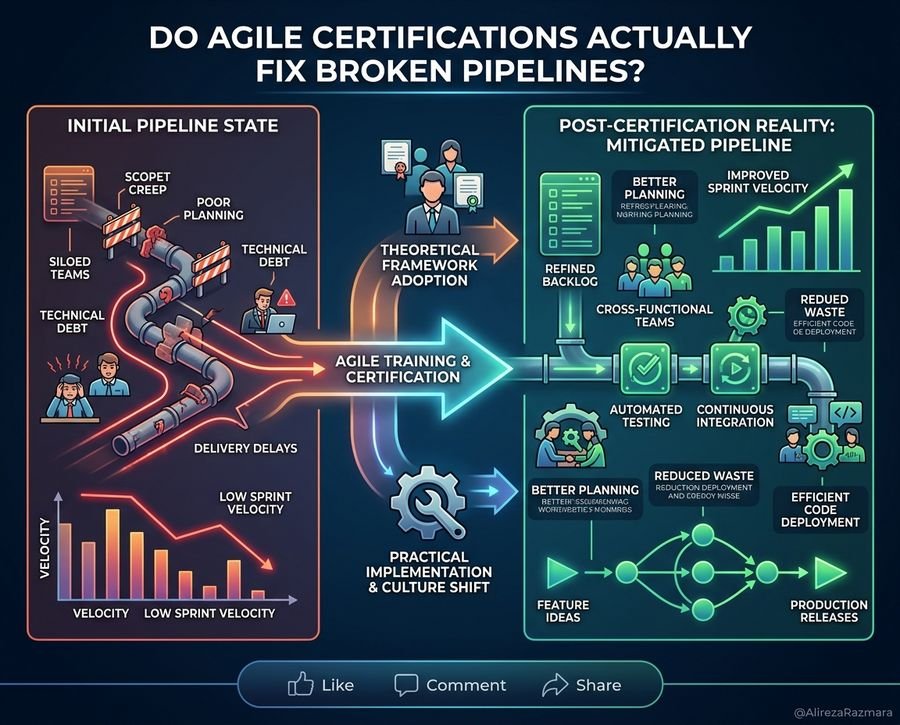
No, an Agile certification alone will never fix a broken delivery pipeline. Certifications establish a baseline vocabulary and operational framework, but they cannot replace the technical competence, organizational design, and engineering practices required to ship reliable software. They get your resume past the recruiter, but your ability to execute keeps you in the room.
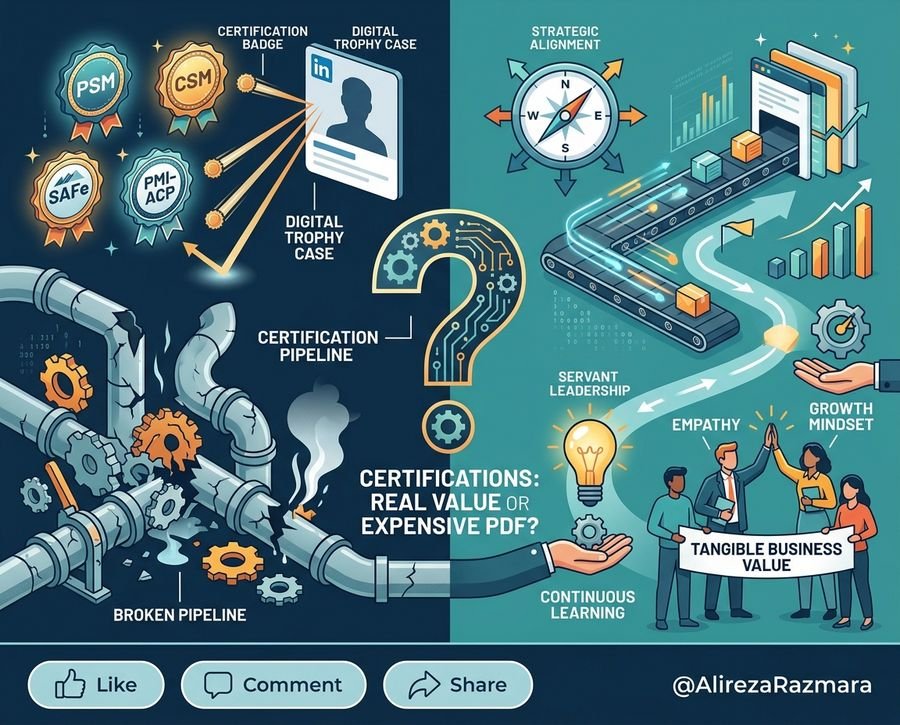
You log into LinkedIn and inevitably see another connection proudly displaying a shiny new Scrum Master badge. Yet, behind the scenes, their actual development pipeline might be a tangled mess of delayed deployments, ignored technical debt, and burnt-out engineers. As an Agile Coach who has spent years in the trenches, I see this disconnect constantly. The industry debate never stops: Are Agile certifications actually worth the time and money, or are they just expensive PDF trophies?
I have coached highly certified Scrum Masters who freeze during a simple backlog dispute, unable to navigate basic team conflict. Conversely, I have worked alongside engineering managers holding zero formal credentials who naturally orchestrate brilliant, highly autonomous, self-organizing teams. The brutal reality is that a digital badge will not save a bad process. However, when pursued for the right reasons, these certifications serve a critical, often misunderstood purpose in the tech ecosystem.
What Is the Real Value of Scrum and Agile Certifications?
The primary value of an Agile certification is creating cross-functional alignment and proving a baseline commitment to professional growth. They ensure that product, engineering, and business teams operate using the exact same definitions and operational rules, significantly reducing daily friction. Beyond that, pursuing credentials signals to leadership that you actively benchmark your knowledge against global standards.
When teams lack a shared vocabulary, you waste countless hours in meetings arguing over semantics. Is this a spike or a chore? What constitutes a minimum viable product? Can we extend the sprint by two days? Without a shared framework, the definition of “Done” means something entirely different to a backend developer, a QA automation engineer, and a product marketing manager.
Certifications provide a structured baseline. Having a certified practitioner in the room means you have a neutral facilitator who knows the rulebook. They can quickly resolve process disputes so the engineering team can get back to what actually matters: writing code and delivering value. Furthermore, the act of studying for a rigorous exam like the PSM requires you to confront your own bad habits. It forces you to unlearn the anti-patterns your previous companies normalized and realign your thinking with pure Agile principles.
Which Agile Certification Should You Actually Choose?
You should choose an Agile certification based on the specific operational friction you need to solve in your daily workflow, rather than simply collecting industry acronyms. Look at your current team size, architectural complexity, and organizational governance to determine the right educational path.
Stop collecting badges just to build a digital trophy case. Strategic alignment beats vanity metrics every time. Here is how to break down the major paths based on real-world needs:
PSM and CSM: Mastering the Agile Baseline
If you are working with single teams or need to master fundamental Scrum values, start here. The Certified ScrumMaster (CSM) is highly interactive and requires attendance in a live class, making it excellent for beginners who need foundational, hands-on coaching. The Professional Scrum Master (PSM), on the other hand, is highly rigorous, requires a steep passing score, and proves you deeply understand the mechanics of the Scrum Guide. Both are phenomenal for establishing core team facilitation skills and mastering sprint events.
SAFe and LeSS: Navigating Enterprise-Scale Complexity
Scaling Agile is incredibly messy. If you are managing dependencies across a dozen teams or aligning a massive portfolio, a basic Scrum certification simply won’t cut it. Scaled Agile Framework (SAFe) or Large-Scale Scrum (LeSS) credentials are essential if you are navigating heavy organizational complexity. These frameworks teach you how to manage release trains, synchronize multiple backlogs, and align legacy enterprise architecture with modern iterative workflows.
PMI-ACP: Bridging Traditional Governance
Many organizations are stuck in an uncomfortable transitional phase between traditional waterfall project management and modern continuous delivery. The PMI Agile Certified Practitioner (PMI-ACP) is fantastic for project managers and PMO leaders who need to bridge traditional governance with Agile execution. It proves you understand how to manage strict enterprise risk, compliance, and budgeting constraints while still iterating rapidly.
What Can a Certificate Not Teach You About Agile Delivery?
A multiple-choice certification exam cannot teach you emotional intelligence, servant leadership, or how to navigate complex political conflicts. These deeply human, situational skills require field experience, active listening, and the resilience to fail and adapt in front of your team. Real-world software delivery is wildly unpredictable and entirely dependent on human relationships.
A PDF certificate does not prepare you for a sprint retrospective where the lead backend developer and the product owner are locked in a shouting match over technical debt prioritization. It doesn’t teach you how to motivate a team that has been demoralized by three consecutive failed product launches driven by executive whims. It certainly doesn’t teach you how to spot the early warning signs of burnout before a critical engineer hands in their notice.
Take metrics, for example. A certification course will teach you exactly how to calculate team velocity. It will not teach you that velocity is a highly volatile trailing indicator that development teams will inevitably game if middle management uses it as a performance metric. True, hard-earned experience teaches you to ignore vanity metrics and look closely at lead time, cycle time, and psychological safety.
You build these vital coaching skills through painful trial and error. You have to learn how to read a room, push back against unreasonable stakeholder demands without burning bridges, and negotiate compromises that keep business value flowing without destroying engineering morale.
How Should Tech Leaders Evaluate Certified Agile Candidates?
Hiring managers must look past the credentials on a resume and use behavioral, situational interview questions to test a candidate’s pragmatic problem-solving skills. You need to discover how they adapt rigid frameworks to messy, real-world constraints when textbook answers fail.
Never ask a Scrum Master candidate to define a sprint goal or explain the purpose of a daily standup. Anyone can memorize those definitions. Instead, test their agility and empathy with scenarios they will face on day one.
- Scenario 1: The Irrelevant Sprint. Ask them: “What do you do when the sprint goal becomes completely irrelevant halfway through the iteration because a massive severity-one production bug takes down the main database?” A candidate who relies on textbook answers will say the sprint must be canceled. A seasoned practitioner will discuss swarm tactics, immediately triaging the issue, communicating the pivot to stakeholders, and salvaging whatever value remains in the sprint once the fire is out.
- Scenario 2: The Dominant Voice. Ask them: “You have a senior principal engineer who talks over everyone during planning and dictates all estimates. How do you handle it?” A weak answer involves establishing meeting ground rules. A strong, experienced answer involves taking the engineer aside for 1-on-1 coaching, restructuring the meeting to use silent estimation techniques like planning poker, and addressing the root psychological cause of the behavior.
- Scenario 3: The Absent Product Owner. Ask them: “Your Product Owner is too busy dealing with sales calls to refine the backlog. What happens next?” A bad answer is that the team refuses to work. A practical answer involves defining what the team can safely do, documenting the block, and escalating directly to product leadership to unblock the PO’s schedule.
The Bottom Line: Invest in Value, Not Just Badges
Agile certifications are powerful tools, but they are the beginning of your professional journey, not the destination. They provide the map, but you still have to hike the trail. If you are going to invest the time and money into credentialing, do it to solve a tangible problem in your current environment.
Focus intensely on solving real friction in your daily delivery pipelines. Cultivate empathy for your engineers. Protect your team’s focus. Your ultimate metric of success is not how many letters follow your name on LinkedIn, but rather your consistent ability to deliver tangible, high-quality business value to your users. That is the only framework that truly matters.