
The Agile by Routine Trap
Too many tech teams fall into the “Agile by routine” trap. You know the drill. You religiously hold Daily Standups, meticulously burn down Jira tickets, and run Retrospectives every two weeks. Yet, deadlines continually slip, and the business complains you shipped the wrong feature. Why?
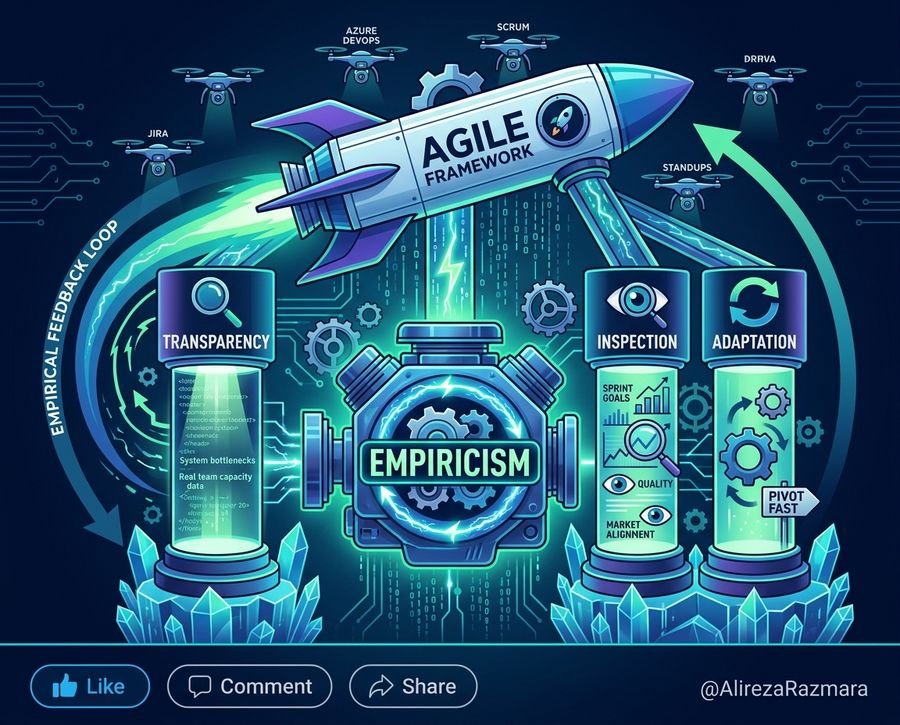
Because you are copying the framework but completely ignoring the engine behind it: empiricism. Scrum isn’t a silver-bullet process or a strict methodology that guarantees success through blind compliance. It is an empirical feedback loop designed to expose reality so you can act on it.
What is Agile Empiricism?
Empiricism is the practice of making decisions based on what is actual, observed, and experienced—not on assumptions, outdated specifications, or wishful thinking. In Agile frameworks, empiricism acts as the core operating system.
It turns a rigid, theoretical project plan into a dynamic reality check. Instead of attempting to predict the future over a twelve-month timeline, you build a small piece of working software, release it to users, measure the actual results, and adjust your next move accordingly.
At the heart of this engine sit the three load-bearing pillars of Scrum: Transparency, Inspection, and Adaptation. If your team is struggling to deliver value despite executing all the standard rituals, I can guarantee one or more of these pillars is actively crumbling. Let’s break down exactly what they mean, how they fail, and how to rebuild them in the real world.
The 3 Pillars of Scrum (And Why They Crumble)
1. Transparency: You Can’t Fix What You Can’t See
Transparency means making the true state of the product, the code, and the team’s capacity entirely visible to everyone from junior developers to the CTO. It is the absolute prerequisite for empiricism because you cannot inspect or adapt a reality you are hiding.
In many organizations, transparency dies quietly at the hands of fear and corporate politics. Teams generate what we call “watermelon status reports”—bright green on the outside to keep executives happy, but blood-red on the inside. Developers obscure spaghetti code because they are pressured to deliver new features faster. Product Owners hide shifting stakeholder requirements to avoid stressing the engineering team.
To fix this, tech leaders must establish a blameless single source of truth. Make technical debt highly visible on the backlog. Stop punishing teams for accurately sizing complex legacy integrations, even if the timeline upsets the business. When a sprint is failing, that failure needs to be loudly visible on day three, not quietly discovered on day twelve. Transparency isn’t about exposing individuals to blame; it is about exposing the workflow to improvement.
2. Inspection: Intentional Reflection, Not Micromanagement
Inspection is the regular, critical assessment of your team’s progress toward the Sprint Goal to catch small deviations early. It is intentional reflection on the state of the product and the viability of the architecture.
Teams frequently confuse inspection with status reporting. A Daily Scrum where everyone mutters, “Yesterday I did ticket 402, today I am doing ticket 403, no blockers,” is completely devoid of inspection. That is simply a mechanical roll call. True inspection looks at the actual working software and the sprint board to evaluate imminent risk. If the burndown chart has flatlined for three consecutive days, inspection demands the team openly discuss why the database migration is taking much longer than anticipated.
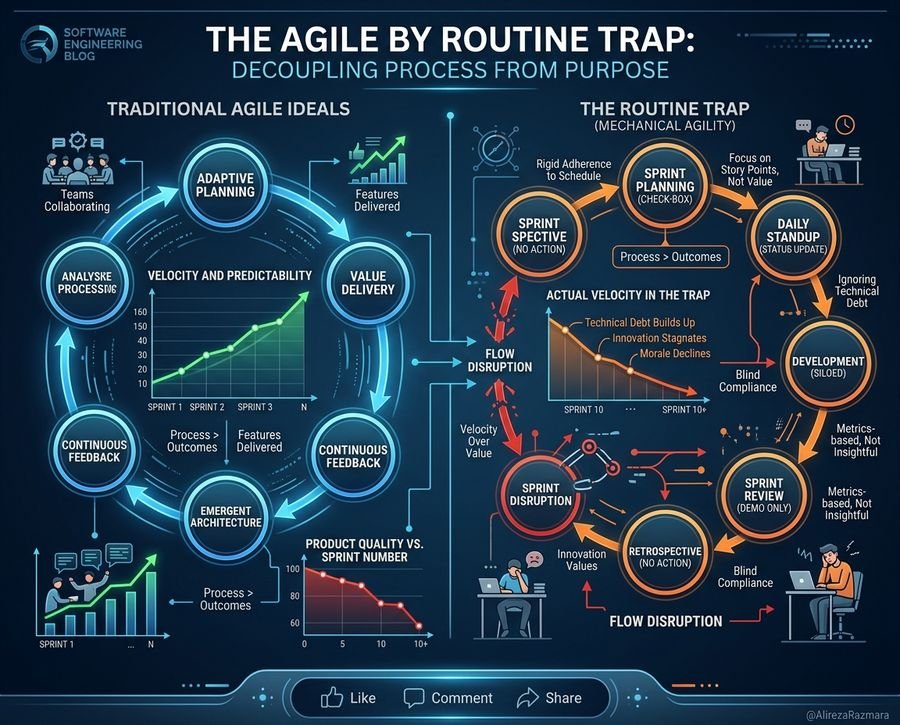
Effective inspection is done by skilled practitioners directly at the point of work. It shouldn’t be a monthly audit conducted by a detached PMO. It happens daily in code reviews, in pair programming sessions, and in Sprint Reviews where stakeholders actually test drive the software instead of watching a sanitized PowerPoint presentation.
3. Adaptation: Pivoting Based on Data
Adaptation means changing course immediately when inspection reveals that a process is broken or a feature is failing to deliver value. Inspection without adaptation is just expensive complaining. If the data shows you are heading off a cliff, adaptation is turning the steering wheel.
This is usually where enterprise Agile transformations go to die. Teams inspect the product, realize the original roadmap is fundamentally flawed, but are forced to deliver it anyway because “it was promised to the board in Q1.” Adaptation requires immense psychological safety and strong leadership cover.
When a team realizes a specific third-party library is causing severe memory leaks mid-sprint, they must be empowered to abandon it and try an alternative without begging for permission from an architecture review board that only meets once a month. As a Scrum Master or Agile Coach, your primary battleground is defending the team’s right to adapt. If your environment penalizes teams for pivoting based on new empirical data, you are not doing Agile. You are doing a Waterfall project heavily disguised in two-week phases.
Why Do Agile Frameworks Fail in Large Organizations?
Agile frameworks fail in large organizations because leadership focuses on scaling the mechanics of the framework rather than scaling the empirical mindset. They obsess over standardizing Jira workflows and synchronizing SAFe increment planning, but entirely ignore the culture of the teams doing the actual work.
Frameworks and tools are utterly useless without the three empirical pillars intact. You can buy the most expensive enterprise software licenses and enforce strict Agile rituals across a thousand developers. It will not save you. If your culture lacks transparency, you are just meticulously tracking bad data. If you lack inspection, you are highly efficiently building the wrong product. If you lack adaptation, you are marching confidently in the wrong direction.
True agility is not about perfectly executing a script written by a certification body. It is about building an organizational system that learns, reacts, and adapts faster than your market competition. When a stakeholder demands a rigid 12-month delivery plan, it is our responsibility as tech leaders to push back with an empirical approach. We promise them a clear vision, a ruthlessly prioritized backlog, and working, tested software every two weeks. We do not promise them fiction.
How to Audit Your Team’s Empiricism Engine
How do you know if your team is actually operating empirically or just going through the motions? Ask yourself these brutal, field-tested questions during your next Retrospective.
- Audit your Transparency: If the CEO walked into the team room right now, could the developers accurately explain the current state of technical debt without fear of reprisal? Do your bug reports reflect the actual user experience, or are they massaged to look less severe?
- Audit your Inspection: Does your Sprint Review consist of live, interactive working software, or just bullet points on a slide deck? Are you actively inspecting the underlying quality of the product, or are you just measuring velocity and capacity metrics?
- Audit your Adaptation: Look at the historical notes from your last three Retrospectives. Did the team identify a core process issue, decide on a measurable, actionable change, and actually implement it successfully in the following sprint? If the answer is no, your feedback loop is broken.
The Leadership Takeaway
Tools like Jira, Azure DevOps, and complex scaling frameworks provide structure, but they do not provide agility. As Technical Project Delivery Consultants, Scrum Masters, and tech leaders, our job is not to enforce administrative mechanics. Our job is to protect and cultivate the environment where Transparency, Inspection, and Adaptation can thrive.
The ultimate test of your organization’s Agile maturity is how a team handles unexpected reality. Stop obsessing over whether you are executing Scrum perfectly according to the guide. Focus intensely on whether you are seeing reality clearly, evaluating it honestly, and reacting to it swiftly. Drop the mechanical theater, focus on empiricism, and rebuild your engine.