
🎧 Listen In: Should Scrum Masters Become Obsolete (19 min)
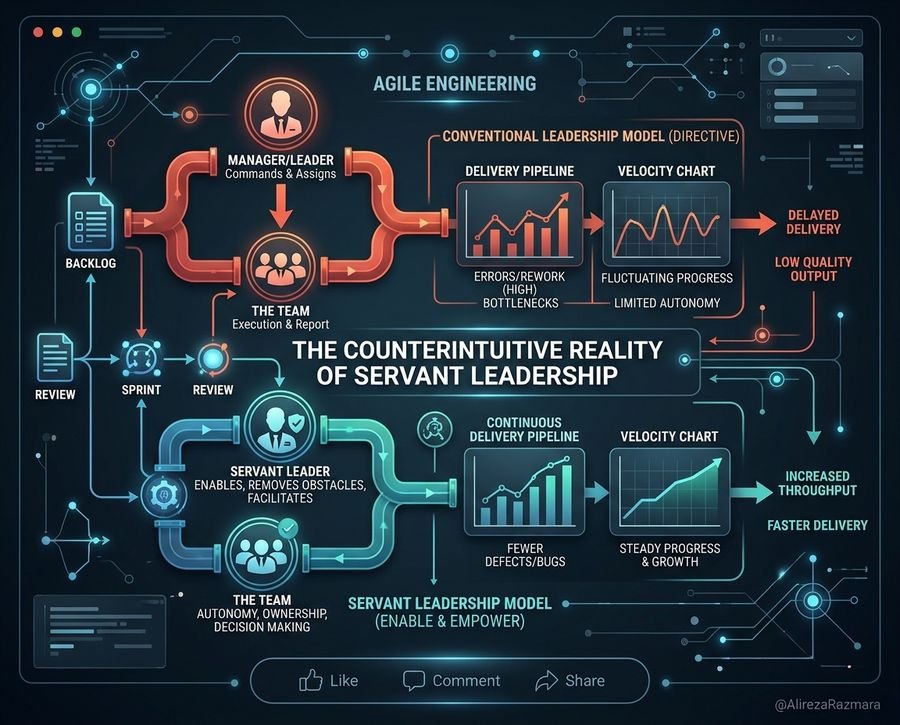
The Counterintuitive Reality of Servant Leadership
Most Agile courses teach you that facilitation is your primary tool. You earn your certification, walk into a team room, and immediately begin running every Daily Scrum, Sprint Planning, and Retrospective. At first, it feels right. You are adding structure. You are keeping things on track. But there is a counterintuitive truth you learn after a few years in the trenches: the best Scrum Masters know exactly when to step away from the whiteboard.
Constantly occupying the facilitator seat actively stifles your team’s autonomy. It creates a bottleneck and subtly shifts the team dynamic from self-management to dependency. True servant leadership is not about running every meeting. It is about growing a resilient team that operates seamlessly whether you are in the room or not.
Why Default Facilitation Harms Agile Teams
Default facilitation harms Agile teams by creating a single point of failure and preventing developers from learning how to resolve conflicts, manage time, and organize their own work. When a Scrum Master insists on leading every event, the team never builds the muscle memory required for genuine self-management.
If you are the only person who can keep a Sprint Retrospective productive, or if the Daily Scrum devolves into chaos the moment you take a sick day, you are not functioning as an Agile Coach. You are acting as a traditional project manager wearing an Agile mask. Your goal is to make yourself functionally obsolete in the day-to-day mechanics of the Scrum framework. To achieve that, you must recognize the specific moments when stepping back is more powerful than stepping in.
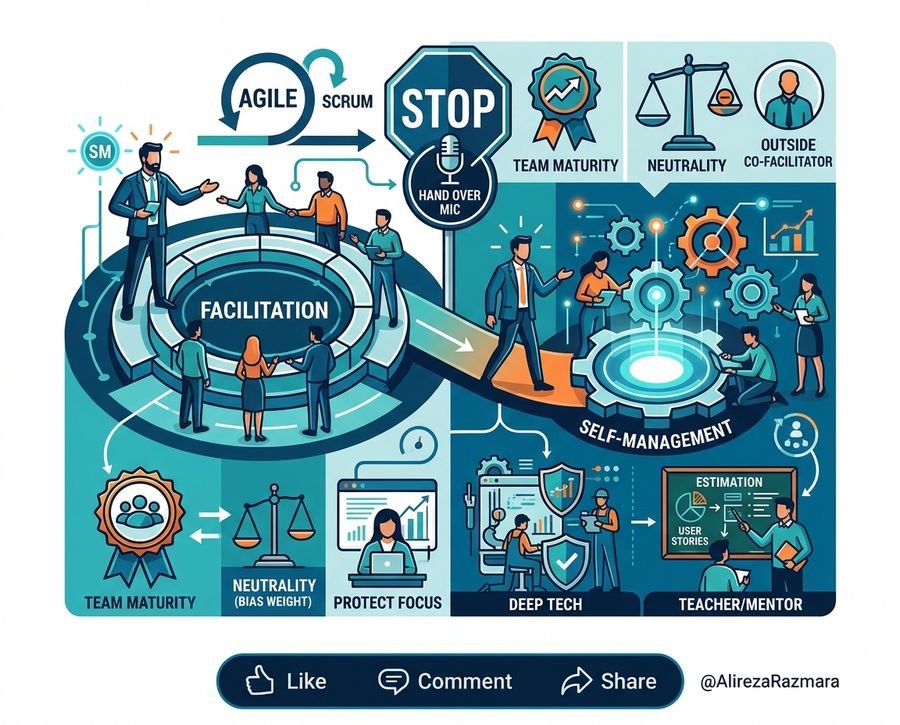
4 Times a Scrum Master Must Hand Over the Mic
1. When the Team Reaches High Maturity
A Scrum Master should stop facilitating when a team reaches high maturity because the core objective of Agile is self-management. If developers still rely on you to run the Daily Scrum, you have built a dependency instead of a resilient system.
You can spot a dependency easily. Watch the eye contact during a Daily Scrum. If developers are looking at you while giving their updates, they are providing a status report to a manager, not synchronizing a plan with their peers. Mature teams understand the purpose of Scrum events and can navigate the agendas themselves.
To fix this, step back. Suggest that team members take turns facilitating the Retrospective or guiding Backlog Refinement. Let them own the silence. If a meeting starts to drift, resist the urge to immediately jump in and save it. Let the team feel the friction of a disorganized meeting—that friction is exactly what teaches them to self-correct.
2. When You Have a Personal Stake in the Outcome
You must step down from facilitating when you have a personal stake in the outcome because true facilitation demands strict neutrality. If you hold a strong bias on a process change or operational decision, you cannot objectively guide the conversation.
Facilitators do not evaluate ideas; they guide the process of evaluating ideas. When a Scrum Master has strong opinions—perhaps regarding whether the team should adopt a new testing framework or how to restructure the deployment pipeline—neutrality vanishes. You will unconsciously give more airtime to arguments you agree with and quickly shut down dissenting views under the guise of time management.
When this happens, explicitly declare your bias to the team. Say, “I have a strong opinion on this topic, so I am going to step out of the facilitator role today and participate as a team member.” From there, either let a senior developer run the discussion or ask a peer Scrum Master from another team to step in and facilitate for you.
3. During Deep Technical and Architecture Sessions
Scrum Masters should avoid facilitating deep technical sessions because forced structure often disrupts engineering flow. Let domain experts lead technical problem-solving while you protect their focus from outside distractions.
There is a massive difference between facilitating a Sprint Planning session and facilitating a debate on database schema architecture. Complex technical problem-solving is non-linear. Engineers need space to argue, draw on whiteboards, erase everything, and start over. If a Scrum Master tries to enforce strict timeboxes, sticky-note voting, or rigid turn-taking during a deep architectural debate, it derails the cognitive process.
Respect the domain experts. Your job during these sessions is boundary management, not internal meeting mechanics. Ensure they have a clear goal before they start, protect their time from external stakeholders, and then get out of the way. Let the lead engineer or architect guide the technical debate.
4. When the Team Needs Teaching, Not Guiding
You must stop facilitating and start teaching when the team lacks foundational knowledge. Facilitation helps teams find their own answers, but you cannot facilitate ignorance; you must educate first.
Coaching and facilitation assume the team already has the necessary raw materials (knowledge, experience, context) to solve a problem. But what if they don’t? Imagine trying to facilitate a discussion on how to vertically slice User Stories when the team has only ever worked in horizontal architectural layers. You can ask open-ended questions all day, but they will only stare back at you blankly.
In these moments, pivot immediately from Facilitator to Teacher. Put away the coaching questions. Explain the concept clearly, provide concrete examples, and offer a framework. Once the foundational knowledge is transferred, you can switch back into coaching mode and ask, “Now that we understand vertical slicing, how can we apply it to this specific feature?”
A Practical Guide to Stepping Back
Transitioning out of the default facilitator role requires intent. You cannot simply abandon your team and expect them to instantly absorb the responsibility. Here is how to transition smoothly:
- The Rotation Method: Create a schedule where a different team member facilitates the Retrospective or Daily Scrum each Sprint. This distributes the administrative load and builds empathy for the facilitation process.
- The Silent Shadow: Attend the event but physically position yourself away from the focal point (like the digital board or the center of the room). Tell the team you are just observing today. Take notes on team dynamics and discuss them later.
- Explicit Coaching: Before a developer facilitates their first event, spend fifteen minutes with them. Help them design the agenda, prepare a few powerful questions, and give them a fallback plan if the conversation stalls.
The Bottom Line on Scrum Master Facilitation
Great Scrum Masters do not build reliance; they create resilient ecosystems. Measuring your worth by how many meetings you run is a fast track to burnout and team stagnation. The highest level of Agile coaching is recognizing that sometimes, the most powerful facilitation move you can make is walking away from the whiteboard entirely.
Evaluate your calendar this week. Pick one event, hand the mic to the team, and see what happens. The results might surprise you.