
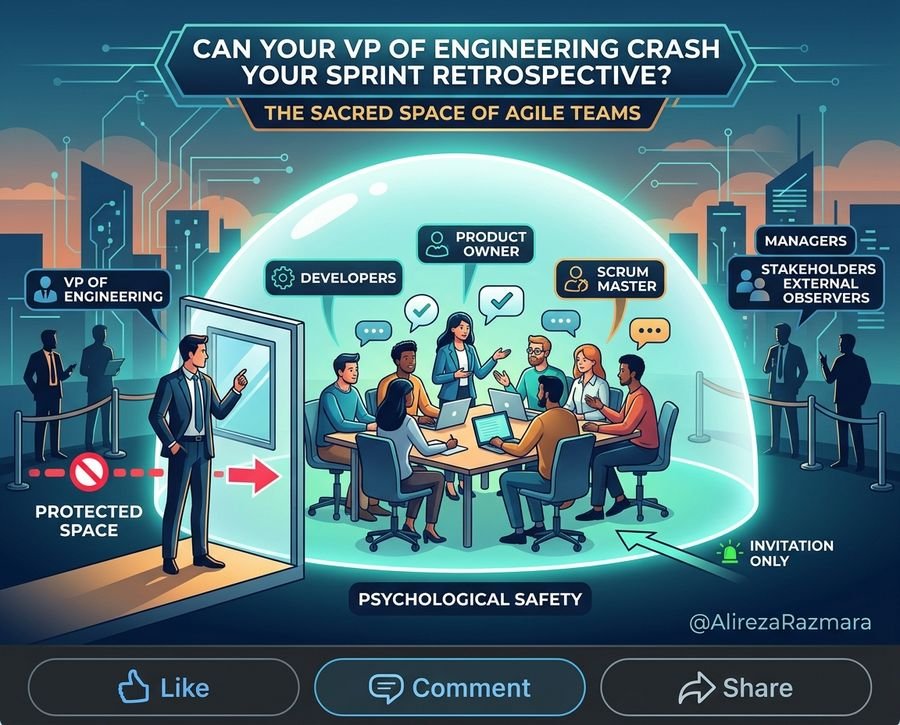
A Slack message pops up an hour before your Sprint Retrospective. It is from the VP of Engineering. “Hey! I’d love to drop in on the Retro today just to listen and see how things are going.”
It sounds harmless. It sounds supportive. But as an Agile Coach and Technical Project Delivery Consultant, I have watched this exact scenario play out countless times. Allowing leadership to “just drop in” on a Retrospective is one of the fastest ways to destroy team trust.
As Scrum Masters and Agile leaders, we face constant pressure from well-meaning managers wanting visibility into how the team operates. But a Sprint Retrospective is not a status meeting. It is not an executive showcase. It is a sacred space designed specifically for honest, unvarnished continuous improvement.
Getting the attendee list wrong does not just ruin a single meeting. It systematically erodes the culture of your entire engineering organization. Let’s break down exactly who belongs in the room, why management needs to stay out, and how to protect your team’s boundaries without damaging your career.
Who Actually Belongs in a Sprint Retrospective?
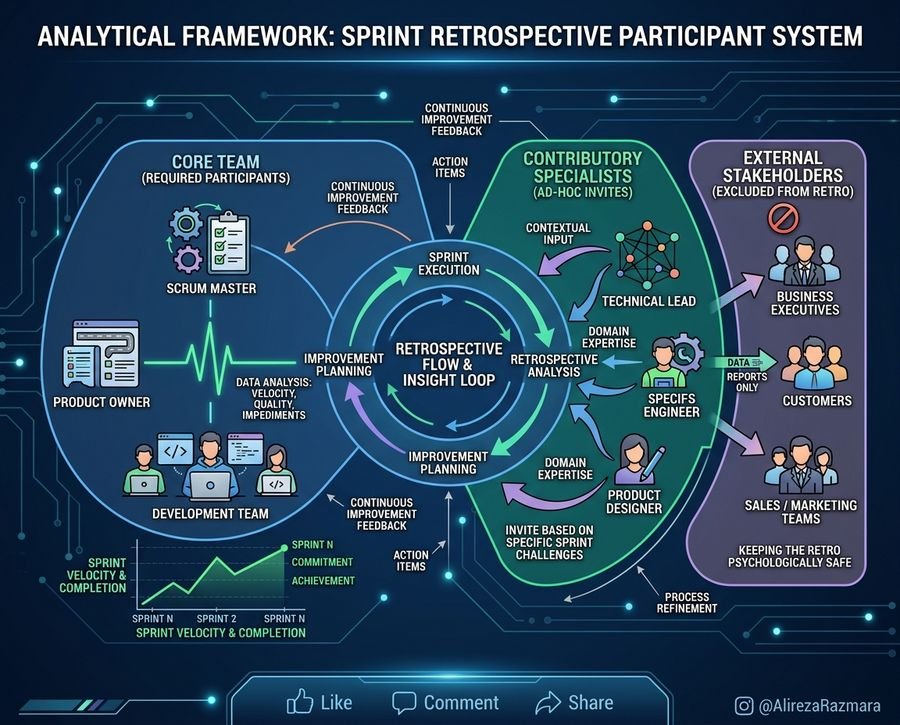
The only people who belong in a Sprint Retrospective are the core members of the Scrum Team: the Developers, the Product Owner, and the Scrum Master. No one else has a default invitation to this event.
The Scrum Guide is deliberately strict about team composition for a reason. To achieve true agility, you need a closed loop of accountability. Here is the breakdown of why each core member is present:
- Developers: These are the people actively building the product. They are the ones feeling the friction of bad deployment pipelines, dealing with technical debt, and navigating communication gaps. They need a space to air these grievances without judgment.
- Product Owner: The PO is there to align on process, communication, and collaboration. They are part of the team, not a manager overseeing the team. If the Developers are struggling with vague acceptance criteria or shifting priorities, the PO needs to be in the room to hear that feedback directly and adjust.
- Scrum Master: The Scrum Master is present to facilitate the event, ensure the timebox is respected, and help the team identify systemic impediments. They guide the conversation toward actionable outcomes rather than letting it devolve into a complaining session.
Together, these three roles form the Scrum Team. No more, no less. If you are not directly accountable for delivering the Sprint Goal, you do not get a permanent seat at the table.
Why Management Cannot Default-Attend Retrospectives
Management cannot attend Retrospectives because their presence immediately destroys psychological safety. The second an uninvited executive, line manager, or external stakeholder enters the room, candid feedback transforms into filtered performance art.
Retrospectives thrive on vulnerability. Team members need to feel safe saying things like, “I completely messed up that database migration because I didn’t read the documentation properly,” or “We are moving too fast and our code quality is dropping.”
When the person who signs your paycheck, approves your PTO, or decides your next promotion is sitting in the corner “just observing,” that vulnerability vanishes. Radical candor evaporates. Instead of discussing real root causes, the team will subconsciously pivot to discussing safe, surface-level issues.
You will no longer hear about interpersonal conflicts or struggles with new technology. Instead, you will hear generic statements like, “I think we just need to communicate better next sprint.” The Hawthorne effect takes over—people change their behavior simply because they are being watched by an authority figure. The meeting becomes a theater of productivity rather than a workshop for continuous improvement.
The Rare Exceptions: When to Invite an Outsider
An outsider can join a Sprint Retrospective only if the Scrum Team explicitly agrees to the invitation and the guest is there to collaborate on a specific cross-functional blocker. They never attend simply to observe or evaluate.
Agile is pragmatic, not dogmatic. There are times when bringing an external perspective into the Retrospective is highly beneficial. However, it must be done strictly under the team’s terms.
Condition 1: Unanimous Team Consent
The Scrum Master should never unilaterally invite a guest. If you think an external expert is needed, propose it to the team beforehand. If even one team member is uncomfortable with the guest’s presence, the invitation does not get sent. The team must own their space.
Condition 2: A Specific, Actionable Purpose
Tourists are not allowed. If an outsider attends, they must have a job to do. For example:
- Inviting an Infrastructure Engineer to help unravel a persistent deployment bottleneck that ruined the last three sprints.
- Bringing in an Agile Coach to observe the team’s facilitation dynamics and provide direct feedback on how to run better Retros.
- Asking a Compliance Officer to explain a new regulatory requirement that is drastically slowing down the workflow.
Once the specific topic involving the guest is concluded, they should politely leave the room so the team can finish the rest of their Retrospective in private.
The Scrum Master’s Mandate: How to Say No to Leadership
Protecting the team’s safe space is a core responsibility of servant leadership. A Scrum Master must actively intercept uninvited guests and redirect their requests, keeping the team’s boundary intact without damaging the relationship with management.
Saying a polite, firm “no” to a VP or Director is intimidating. Many junior Scrum Masters fold under the pressure, assuming that refusing leadership is a career-limiting move. In reality, failing to protect the team is the true failure of the role. You are not gatekeeping; you are safeguarding your team’s agility and culture.
When a leader asks to attend, do not just say no. Redirect their curiosity to the appropriate venue. Here is a field-tested script you can adapt:
“I really appreciate you wanting to engage with the team! The Retrospective is a closed working session for the Developers to debug their own internal processes, so we keep it strictly to the Scrum Team to maintain psychological safety. However, if you are looking for project status, want to see what we built, or want to give feedback on our direction, I would love to have you at our Sprint Review on Thursday. We need your insights there.”
This response accomplishes three things. It acknowledges their intent, clearly states the boundary and the reason behind it, and offers an immediate, productive alternative.
What Happens When Retrospectives Lose Psychological Safety?
When a team does not feel safe to fail, speak up, and be vulnerable in a Retrospective, you are no longer doing Scrum. You are just holding meetings.
The fallout of compromised psychological safety is quiet but deadly. You will start to notice the “crickets” phenomenon. The Scrum Master asks, “What didn’t go well this sprint?” and is met with dead silence. Team members will stare at their shoes, wait for the clock to run out, and give non-committal answers.
Without honest input, the action items generated from the Retrospective become superficial. The team will stop taking ownership of their improvement, assuming that management is running the show anyway. Over time, unresolved technical debt and broken processes pile up. Frustration builds in private backchannels instead of being resolved in the open. Eventually, your best engineers will simply leave.
Giving Leadership What They Actually Need
Leaders who ask to attend Retrospectives are usually just looking for visibility into team challenges, delivery risks, or team morale. You can completely satisfy this need outside of the Retrospective.
If a VP of Engineering wants to know what is slowing the team down, the Scrum Master can provide aggregated, anonymized themes from the Retrospective. You can say, “The team identified that our staging environment instability cost us two days this sprint. We are taking X action to fix it, but we might need your help securing budget for better tooling.”
You protect the who and the how, but you share the what. By doing this, you maintain the ironclad trust of your team while still acting as a transparent, valuable partner to engineering leadership.
Stand your ground. Protect your Retrospectives. A team that feels safe to diagnose its own failures is a team that will eventually become unstoppable.