
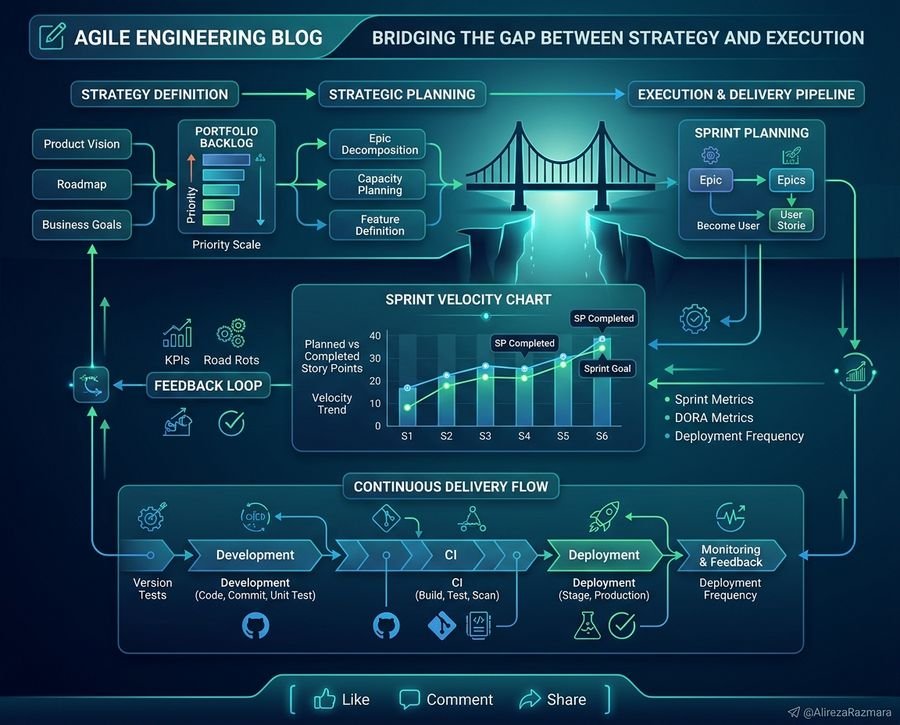
Bridging the Gap Between Strategy and Execution
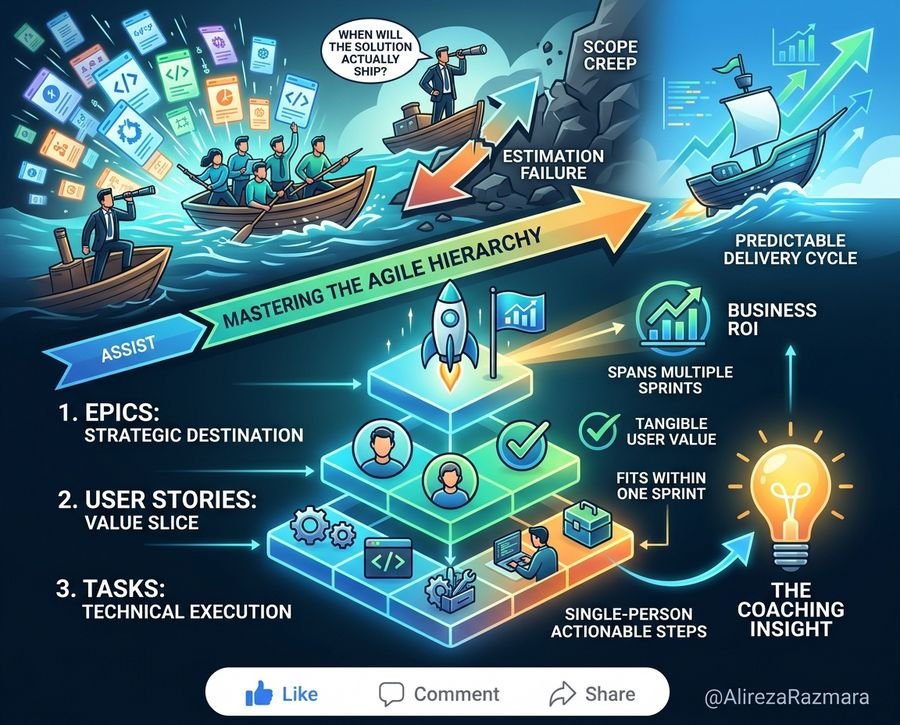
Are your engineering teams drowning in noisy Jira tickets while leadership keeps asking, “When will the solution actually ship?” You aren’t alone. I see this disconnect in almost every technical transformation I coach. The symptom is a messy backlog. The root cause is a fundamental misunderstanding of how work should be structured.
The secret to bridging strategic vision with daily execution isn’t working harder or scheduling more status meetings. It is mastering the Agile Hierarchy: Epics, User Stories, and Tasks.
When teams blur these boundaries, scope creep explodes. Sprint estimations fail. Commitments crumble. Developers feel micromanaged, and product owners feel ignored. By defining strict rules for how work is categorized, high-performing tech organizations structure their backlogs for maximum clarity and predictable velocity.
The Tooling Trap vs. Agile Reality
Before breaking down the hierarchy, we need to address the elephant in the room: your project management tool. Whether you use Jira, Azure DevOps, or Linear, tools do not solve delivery problems. They only magnify your existing organizational habits.
Many teams treat Jira like a digital dumping ground. If a stakeholder has a random thought, it becomes a ticket. If an engineer finds a minor bug, it becomes a ticket. Soon, you have a backlog of 800 items with zero context, priority, or alignment. You cannot run an efficient sprint planning session when the team is sifting through a graveyard of undefined ideas.
To fix this, you must adopt a disciplined approach to the Agile hierarchy. Every piece of work must have a clear place and purpose. Let’s break down the three core layers.
1. Epics: The Strategic Destination
What is an Agile Epic? An Epic is a large, strategic body of work representing a significant business outcome that spans multiple sprints. Think of it as the destination your product is heading toward.
From a leadership perspective, Epics connect engineering output directly to business ROI. Executives do not want to hear about database migrations, middleware updates, or refactoring efforts. They want to know when “One-Click Checkout” is going live to customers. That is your Epic.
The Golden Rule: If a piece of work cannot be built, tested, and shipped to production in a single sprint, it is an Epic.
Why Teams Mess Up Epics
Teams frequently fail with Epics by treating them as categorical folders. They create an Epic called “Q3 Backend Work” or “UI Improvements” and throw unrelated tickets inside. That is not an Epic. An Epic must have a clear beginning, a measurable end, and deliver a cohesive chunk of business value.
When refining Epics, ask the product managers one critical question: “What business metric moves when we close this?” If they cannot answer, the Epic is not ready for engineering to touch. It is just an idea.
Splitting Epics Effectively
A massive Epic is a major risk. To keep delivery predictable, you must break Epics down into digestible phases. I coach teams to split Epics using three practical methods:
- By User Workflow: Split “E-commerce Checkout” into “Guest Checkout” and “Registered User Checkout.”
- By Platform: Deliver the iOS experience first, then Android, then Web.
- By Data Boundary: Build the reporting dashboard for “Sales Data” first, then add “Marketing Data” in a subsequent Epic.
2. User Stories: The Value Slice
What is a User Story in Agile? A User Story is a functional, independent increment of work that delivers tangible value to an end-user within a single sprint. It is the core currency of Agile delivery.
Product Owners live and die in this layer. The focus is entirely on customer impact. You likely know the standard format: “As a [user], I want [action] so that [value].” But the format is not the magic part. The magic is the conversation it sparks between product and engineering.
The Golden Rule: User Stories must meet the INVEST criteria and fit entirely within one single sprint.
The INVEST Criteria Checklist
If you want to know if a User Story is ready for a sprint, run it through the INVEST acronym:
- Independent: The story can be completed regardless of other stories in the backlog.
- Negotiable: It is a conversation starter, not a rigid technical contract.
- Valuable: It delivers a distinct benefit to the end user or business.
- Estimable: The team understands it well enough to size the effort.
- Small: It easily fits within a single sprint (ideally taking no more than a few days).
- Testable: It has clear Acceptance Criteria proving it is done.
Slicing the Cake, Not the Layers
The most common anti-pattern I see is teams slicing stories horizontally by architectural layer. You end up with one story for the UI, one for the API, and one for the database schema. That approach is fundamentally broken.
If you build the database but not the UI, the user gets zero value. You haven’t shipped a slice of cake; you’ve just served the customer a bowl of raw flour. Slice vertically. A true User Story touches the database, the backend, and the frontend, delivering a tiny but complete feature to the user. This forces cross-functional collaboration and proves the architecture actually works.
3. Tasks: The Technical Execution
What is a Task in Agile? A Task is an actionable, single-person technical step required to fulfill a User Story. Tasks represent the exact technical execution required to get the job done.
This is where the engineers take over completely. The leadership lens stops here. Product Owners do not care about Tasks. Executives do not track Tasks. The technical team dictates the “How”—schema updates, API integrations, UI styling, and writing unit tests.
The Golden Rule: Tasks are owned exclusively by developers and are usually estimated in hours, not story points.
Technical Autonomy in Action
Letting engineers control the task layer is how you prevent micromanagement. If a User Story is “As a customer, I want to pay with Apple Pay so I can checkout faster,” the tasks are the developer’s checklist.
- Update payment gateway dependencies. (2 hours)
- Implement Apple Pay tokenization. (4 hours)
- Build the frontend button UI. (3 hours)
- Write integration tests for the payment flow. (3 hours)
When developers break stories down into tasks during Sprint Planning, they uncover hidden complexities. This is the exact moment when an engineer realizes, “Wait, our current payment API doesn’t support tokenization.” Because they broke the story into tasks, they caught the blocker on day one, not day nine of a two-week sprint.
Fueling the Daily Scrum
Well-defined tasks completely change the tone of your Daily Standup. Instead of engineers giving vague updates like, “I worked on Jira-123 yesterday and will keep working on it today,” the conversation becomes highly specific. “I finished the tokenization task yesterday, and today I am picking up the frontend UI task. I have no blockers.” This level of granularity keeps the team aligned and moving fast.
The Coaching Insight: Enforcing Lane Discipline
How do you make this Agile hierarchy actually work in practice? You enforce strict lane discipline. Executives track Epics for roadmap alignment. Product Owners manage User Stories for value delivery. Engineers own Tasks for technical excellence.
When you respect these boundaries, you create a powerful system of trust. You stop executives from arguing with developers about story points, and you stop developers from having to justify every hour of backend refactoring to the CEO.
Diagnosing a Broken Hierarchy
You can usually diagnose a broken Agile hierarchy in about five minutes by scanning a team’s backlog. Here are the glaring red flags I look for during an Agile audit:
- Stories spanning multiple sprints: If a story takes three sprints to finish, it was an Epic disguised as a story. Break it down immediately.
- Tasks masquerading as Stories: If you see a story that says, “Update npm packages,” that is a technical task. It has no direct end-user value. Attach it to a broader technical debt Epic or bundle it appropriately within an existing story.
- Story pointing tasks: Story points measure complexity, risk, and effort for value delivery. Tasks are measured in time (hours). Do not mix the two, or your team’s velocity metrics will become meaningless noise.
Execution Over Theory
Agile is not about policing Jira boards or memorizing Scrum terminology. It is about creating a shared language between the people who pay for the software, the people who design it, and the people who build it.
Getting your Epics, Stories, and Tasks properly aligned is the first critical step out of the chaos. It forces product managers to clearly define the “What” and the “Why,” while granting engineering the absolute autonomy to dictate the “How.” That is when predictable delivery cycles finally become reality.
Look at your active sprint right now. Where does your team struggle most? Is it defining the actual business value in User Stories, or is it breaking those stories down into actionable technical Tasks? Identify that bottleneck, fix the discipline, and watch your team’s velocity soar.