
Listen In: Why Scrum Becomes Zombie Scrum (19 min)
What is the Difference Between Agile and Scrum?
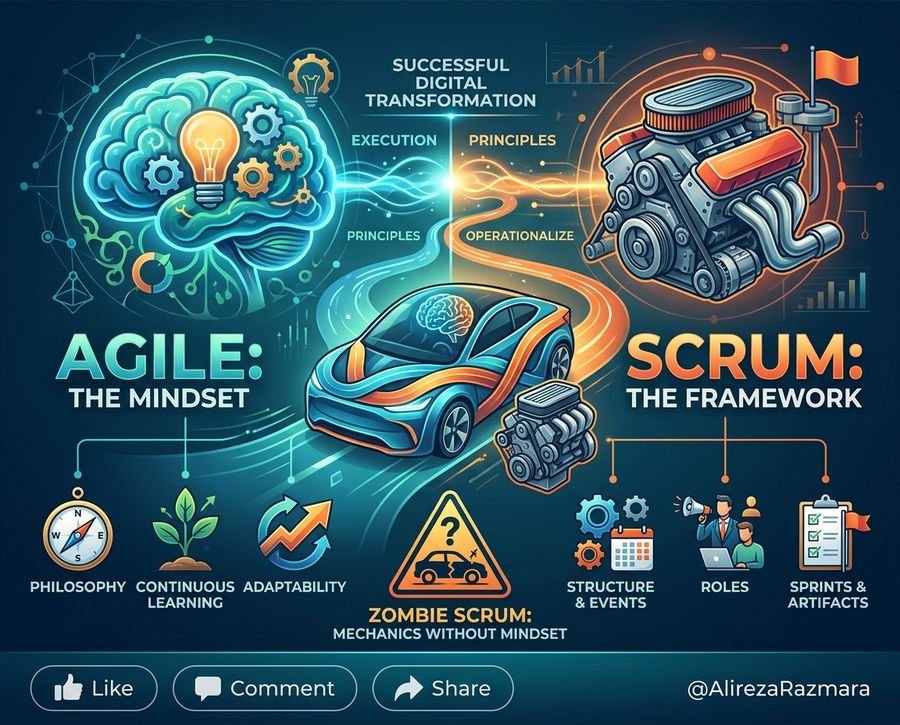
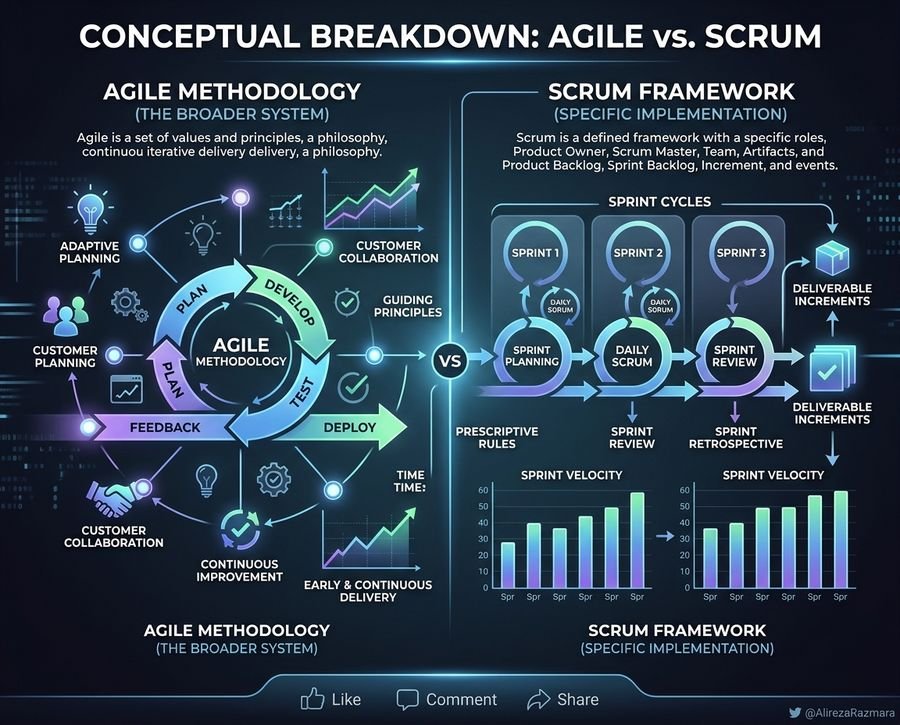
Agile is a broad philosophy and mindset based on four core values and twelve principles focused on adaptability and continuous delivery. Scrum is a specific, structured framework consisting of roles, events, and artifacts used to execute that Agile philosophy.
The most expensive mistake I see tech leaders make isn’t choosing the wrong tech stack or miscalculating a budget. It is treating Agile and Scrum as interchangeable terms. Confusing the two is rarely just a semantic error. It is usually the root cause behind failed digital transformations, frustrated stakeholders, and burnt-out development teams.
As an Agile coach and delivery consultant, I walk into organizations every month that claim they are “fully Agile.” When I look under the hood, I find rigid timelines, fixed scopes, and heavy micromanagement hiding behind a thin veneer of two-week Sprints. They bought the framework, but they completely missed the mindset. Here is the ultimate distinction every leader, project manager, and developer must master to actually deliver value.
Agile is the Mindset (The “Why” and “Philosophy”)
Agile is an umbrella philosophy defined entirely by the Agile Manifesto. It consists of just 4 core values and 12 supporting principles. It prioritizes adaptability over rigid planning, early value delivery over comprehensive documentation, and fostering a culture of continuous learning.
Agile does not tell you how to run a meeting. It does not tell you what to call your product managers. It simply tells you that responding to change is more valuable than following a plan. Agile is who you are as an organization. It is the cultural operating system that dictates how you react when a competitor launches a disruptive feature or when an API integration unexpectedly fails.
Scrum is the Framework (The “How” and “Execution”)
Scrum is a specific, lightweight framework designed to operationalize Agile principles. It provides the concrete structure that Agile lacks. Scrum gives you the boundaries: Sprints, Roles (Product Owner, Scrum Master, Developers), Artifacts (Product Backlog, Sprint Backlog, Increment), and Events (Planning, Daily Scrum, Review, Retrospective).
If Agile is the theory, Scrum is the laboratory experiment. It is a highly prescribed system for generating empirical feedback. Scrum is what you do on a daily basis to ensure the Agile mindset results in working software.
The Real-World Analogy: Modern Transportation
The easiest way to communicate this difference to a skeptical executive is through a transportation analogy.
Think of Agile as the philosophy of modern transportation. The goals are universal: prioritize passenger safety, maximize speed, and optimize energy efficiency. That is the mindset.
Scrum is one specific vehicle built on those principles—let’s say it is a Tesla Model 3. It has specific mechanics, a designated driver seat, and an explicit way it operates. You can absolutely choose a different vehicle to achieve the Agile philosophy. You could drive a Toyota (Kanban) or a heavy-duty truck (Extreme Programming). The underlying goal remains the same, but the mechanics change based on the terrain.
The problem arises when companies buy the Tesla, hand the keys to a driver who insists on steering it like a horse-drawn carriage, and then complain that the electric battery is broken.
The Danger of “Zombie Scrum” in Tech Leadership
Zombie Scrum occurs when a team mechanically executes Scrum events without adopting the underlying Agile mindset. The team holds daily standups and plans sprints, but leadership still micromanages, fears change, and demands fixed-scope deadlines.
Running two-week Sprints and holding fifteen-minute morning meetings does not mean your organization is Agile. I see this anti-pattern constantly. Symptoms of Zombie Scrum are easy to spot:
- The Daily Status Report: The Daily Scrum isn’t a planning event for developers; it is a status report given to a hovering project manager.
- Fixed-Scope Sprints: Leadership locks the team into a rigid, six-month roadmap but demands they “sprint” toward it, stripping away the ability to adapt to user feedback.
- The Order-Taker Product Owner: The Product Owner has no actual authority to say “no” to stakeholders, turning the backlog into a dumping ground for executive whims.
- Meaningless Retrospectives: The team complains about the exact same blockers every two weeks, but leadership never removes the organizational impediments.
When you force the mechanics of Scrum into a traditional, command-and-control corporate culture, you get the worst of both worlds. You get the anxiety of constant deadlines (Sprints) without the autonomy and adaptability that makes those deadlines bearable. This is a direct pipeline to developer burnout.
How to Shift Your Team from Mechanical Scrum to True Agility
To transition from Zombie Scrum to true agility, leaders must stop managing developer capacity and start measuring customer value. This requires empowering Product Owners to act as mini-CEOs of their product and treating the Retrospective as the engine for structural change.
If you recognize Zombie Scrum in your own organization, you cannot fix it by changing your Jira workflows or sending everyone to a two-day certification course. You have to change the environment. Here is a pragmatic playbook for driving that mental shift.
1. Shift Metrics from Output to Outcomes
Stop obsessing over story points and velocity. Velocity is a capacity planning metric for the developers, not a performance metric for leadership. Instead, start measuring outcomes. Did the feature we shipped in the last Sprint reduce customer churn? Did it decrease API latency? If you ship 100 story points of useless features, your Agile transformation has failed. Reward your teams for solving user problems, not for closing Jira tickets.
2. Empower the Product Owner
A true Agile mindset respects the authority of the Product Owner. They cannot be a proxy who simply writes user stories based on what the CEO wants. They need the political cover to ruthlessly prioritize the backlog based on empirical data and user feedback. If your Product Owner cannot say “no” to a VP, you are not doing Scrum; you are doing Waterfall in two-week increments.
3. Protect the Retrospective
The Sprint Retrospective is the most critical event in Scrum because it is the actual mechanism for continuous learning—a core Agile value. If teams are too busy to hold a Retrospective, they are too busy to improve. As a leader, your job is to attend to the organizational blockers that surface in these meetings. If the team says deployment pipelines are too slow, your job is to clear the budget for DevOps improvements, not to tell them to code faster.
4. Accept that Scope Must Flex
You can fix time (the Sprint), and you can fix resources (the Team), but you cannot fix scope. The Agile mindset acknowledges that we know the least about a project on the day it begins. As we build, we learn. Leaders must foster a culture where discovering that a feature is unnecessary is celebrated as a cost-saving win, not punished as a failure to deliver the original plan.
The Final Word on Agile vs. Scrum
Frameworks do not deliver working software; empowered people using an Agile mindset do. Scrum is incredibly powerful, but it is just an empty shell if it is not fueled by trust, transparency, and a genuine willingness to adapt.
Master the philosophy first. Understand why you want to be Agile. Only then should you use Scrum as your engine to scale that impact across your organization. Stop going through the motions, and start delivering value.
Over to you: Have you ever experienced a team mechanically running Scrum without true Agile thinking? What were the symptoms, and how did you help them make the mental shift? Let’s discuss your field experiences below.