
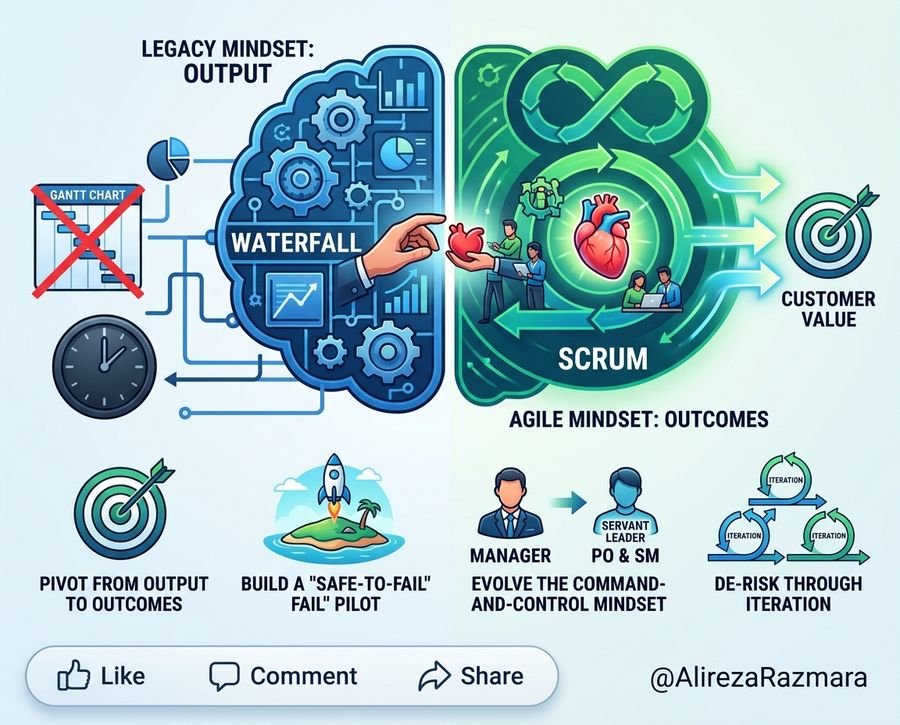
Shifting an enterprise from Waterfall to Scrum isn’t a software update. It is a heart transplant. When an organization is deeply rooted in traditional project management, moving to an Agile framework feels chaotic to leaders who equate rigid predictability with control.
As an Agile Coach, I see the same massive mistake repeatedly. Organizations swap their Gantt charts for Jira boards, run a two-week sprint, and call it a day. That is not Agile. That is just “Wagile”—a toxic middle ground where teams carry all the overhead of Agile but retain all the bottlenecks of Waterfall.
If I am guiding a legacy Waterfall organization through a Scrum transition today, I rely on a battle-tested playbook. Transformation requires dismantling legacy habits while respecting the foundation that built the company. Here is exactly how to execute that shift successfully.
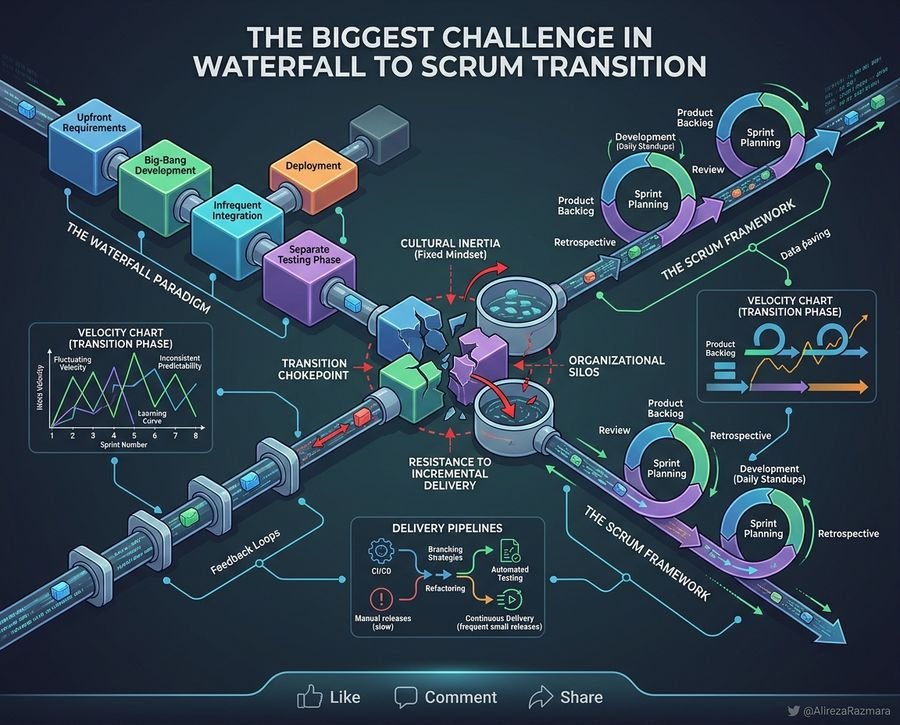
What is the biggest challenge in moving from Waterfall to Scrum?
The biggest challenge in moving from Waterfall to Scrum is the cultural shift from demanding predictable output delivery to accepting unpredictable outcome discovery. Traditional management expects guaranteed delivery dates for fixed features, whereas Scrum embraces continuous adaptation based on active user feedback.
Most Waterfall-to-Scrum transitions fail because leadership attempts to change the tools without changing the corporate culture or risk tolerance. Organizations want the speed of Agile but refuse to let go of the rigid scope, fixed timelines, and heavy governance of Waterfall.
When executives demand fixed delivery dates for a dynamically changing product backlog, you get immediate friction. Teams feel the squeeze. They try to execute standard Scrum ceremonies, but a steering committee still demands a 12-month roadmap with exact feature dates. This disconnect breeds resentment. The developers feel micromanaged, and the leadership feels blind. You have to fix the mindset before you fix the toolset.
Step 1: Pivot From Output to Business Outcomes
Pivoting from output to outcomes means measuring project success by the actual customer value generated, rather than tracking how many features were shipped against a baseline plan. Waterfall measures scope delivered on a fixed timeline, while Scrum measures problems solved continuously.
You have to shift the executive conversation. In legacy environments, steering committee meetings sound like this: “Did we ship all 50 features we promised last November?”
Your job as a change agent is to evolve that question to: “Did we actually solve the user’s problem?”
This requires breaking the illusion of upfront certainty. In Waterfall, people assume that if they write a perfect requirements document, the customer will love the product. That is rarely true. Stop celebrating feature deployment as the finish line. A feature is just a hypothesis until a user interacts with it.
- Ditch traditional metrics: Stop tracking lines of code written or hours logged.
- Adopt OKRs: Introduce Objectives and Key Results tied directly to customer behavior and business goals.
- Celebrate value over volume: If a team builds half the anticipated features but hits the revenue target early, that is a massive organizational success.
Teach your stakeholders to fund outcomes, not feature factories.
Step 2: Build a Safe-to-Fail Pilot Program
A safe-to-fail pilot isolates a single cross-functional team from legacy bureaucracy to prove Scrum works over a limited, 90-day period. You do not flip the switch for 500 people overnight; you prove the model on a micro-scale first to build organic trust.
Big-bang Agile rollouts are disastrous. When you mandate an entire department to switch to Scrum by Monday, you trigger organizational antibodies. Middle management panics. Processes break. Delivery grinds to a halt.
Instead, pick one specific product or value stream. Form a cross-functional team containing everyone needed to go from an idea to working software. Do not matrix them across multiple projects. Dedicate them 100% to this pilot.
Next, create a protective bubble. Shield this pilot team from the traditional stage-gate approvals and legacy steering committees. Give them a clear goal, ring-fence their budget, and give them 90 days to sprint. Enforce strict adherence to core Scrum events: Sprint Planning, Daily Scrum, Sprint Review, and the Sprint Retrospective. When this team starts demonstrating working, valuable software every two weeks, the rest of the company will take notice.
Step 3: Evolve the Command-and-Control Mindset
Evolving command-and-control involves transitioning traditional managers from directing daily tasks to clearing organizational roadblocks for self-managing teams. You must help project managers reframe their legacy skills into new servant-leader roles like the Scrum Master or Product Owner.
Project managers often sabotage Agile transformations out of fear. In a Waterfall world, their entire value is tied to controlling the schedule and managing resources. Scrum distributes that control. The developers manage the ‘how,’ and the Product Owner manages the ‘what.’ So, where does the legacy PM fit?
Address this anxiety head-on. Show them that their ability to navigate corporate politics, manage stakeholder expectations, and identify enterprise risks is incredibly valuable. Strong traditional project managers often make exceptional Scrum Masters if they can shift their posture from enforcement to enablement.
Coach your leadership layer, too. The hardest habit for executives to break is asking, “When will it be done?” Replace that reflex. Train leaders to walk into a sprint review and ask, “What organizational blockers can I remove for you?” When leadership moves from inspection to support, the entire delivery culture accelerates.
Step 4: De-risk Through Iteration, Not Documentation
Scrum mitigates project risk by delivering fully functional increments of working software every two weeks instead of relying on massive upfront specification documents. You de-risk a project through actual market feedback, not by securing hundreds of executive signatures on a requirements matrix.
Waterfall environments treat documentation as a security blanket. The logic is flawed but comforting: if we write down every possible requirement in a 100-page spec sheet, nothing can go wrong. But software development is complex work. What users want changes. Market conditions shift. By the time that 100-page document is fully signed, it is already obsolete.
In Scrum, your risk mitigation is the Sprint Review. Every two weeks, you put working software in front of actual stakeholders. If you misunderstood a requirement, you only wasted two weeks of effort. If the market shifts, you pivot the backlog immediately.
To execute this properly, you must teach your engineering teams how to slice work vertically. A common Waterfall hangover is horizontal slicing—building the database in Sprint 1, the backend in Sprint 2, and the UI in Sprint 3. That provides zero verifiable customer value until month two. Coach teams to build thin vertical slices of functionality so that a user can accomplish one specific task by the end of a single sprint.
Respect the Past to Build the Future
Successful Agile transformations require acknowledging the historical success of legacy systems before asking teams to adopt entirely new ways of working. Change fails when incoming coaches arrogantly dismiss past methods that actually built the company’s current revenue streams.
Transformation is not about destroying the past. It is about evolving. The people in your organization spent years mastering Waterfall. They delivered immense value with it. Respect that legacy. Validate their expertise. Then, clearly articulate why the current market demands a different approach. Speed, adaptability, and rapid feedback loops are not just buzzwords; they are survival mechanisms in modern product development.
The shift from Waterfall to Scrum takes immense patience. You will see backsliding. People will quietly recreate Gantt charts in Excel. Stakeholders will try to sneak fixed-scope demands into the backlog mid-sprint. Anticipate these behaviors. Coach through them with empathy and firm boundaries.
Over to You: What Was Your Hardest Habit to Break?
If you have navigated a Waterfall-to-Scrum shift in your own career, you know exactly how messy the reality is compared to the theory. The Agile textbooks make it sound seamless, but the sprint room tells a very different story.
Which legacy habit proved the most difficult for your organization to break? Was it the addiction to rigid release dates? The fear of putting imperfect working software in front of users? The struggle of middle management finding their new identity? The journey is tough, but doing it right is always worth the effort.