Why Jira Cannot Fix a Broken Agile Culture
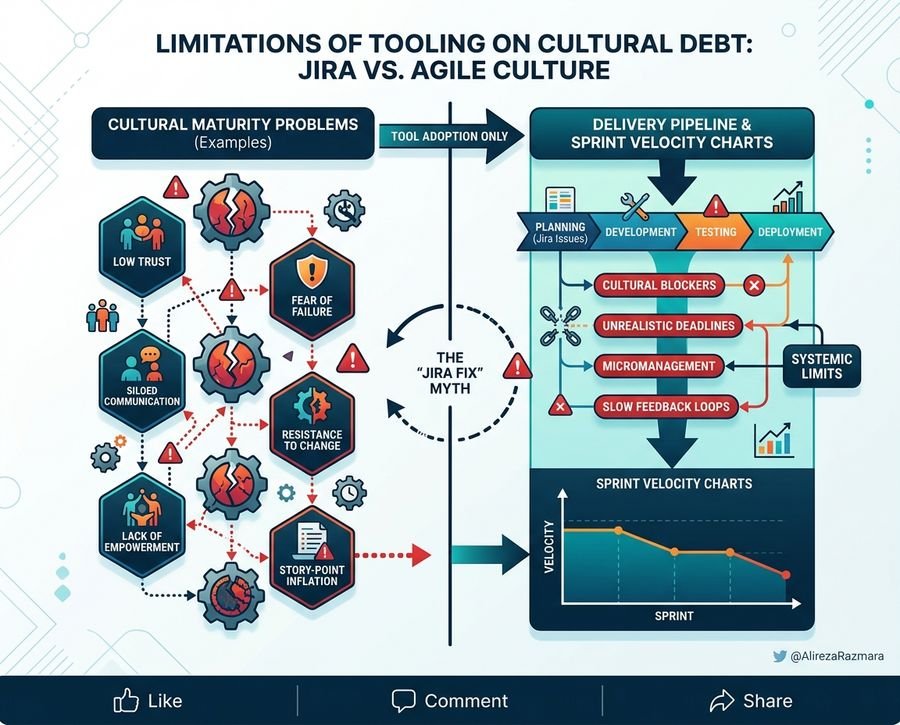
Software tools cannot fix a broken Agile culture because they only digitize existing workflows rather than changing fundamental human behavior. If your engineering team struggles with low trust, communication bottlenecks, or massive technical debt, configuring a new digital Kanban board will only highlight those dysfunctions faster.
I see this frequently in my coaching practice. A well-meaning technology organization signs a massive enterprise contract for a top-tier project management tool, expecting an overnight shift in delivery speed. But tools do not make a team Agile. They simply amplify the habits, transparency, and collaboration your team already practices. If your developers operate in strict silos, a shiny new Jira instance will just give you highly organized, color-coded silos.
As tech leaders and Scrum Masters, our default question should never be “Which tool should we buy?” We must instead ask, “Which tool eliminates friction and empowers our team to deliver value continuously?” Any platform that requires your developers to act as data-entry clerks is actively hurting your sprint cadence. Your ecosystem should be designed to support the engineers doing the work, removing blockers rather than creating new administrative hurdles.
The Essential Scrum Toolkit for High-Performing Teams
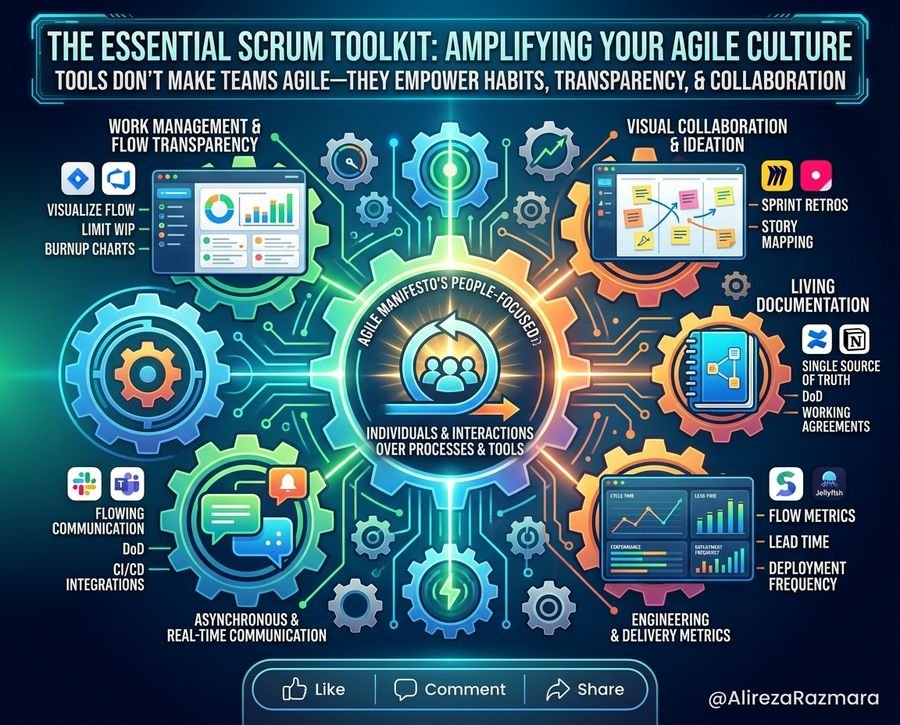
Building a modern, high-performing Scrum ecosystem requires curating tools based on their specific purpose rather than forcing an all-in-one suite to do things poorly. Below is the essential toolkit categorized by purpose, detailing exactly how top-tier engineering organizations structure their technical delivery stack.
Work Management & Flow Transparency
Work management tools exist to track Sprint Backlogs, enforce Work in Progress (WIP) limits, and visualize delivery bottlenecks. They act as the operational heartbeat of the sprint, provided they are kept clean and focused strictly on current priorities.
Platforms like Jira, Azure DevOps, and Linear are the heavyweights in this category. Jira remains the industry standard due to its deep integration ecosystem, while Azure DevOps is highly effective for teams deeply embedded in the Microsoft stack. Linear has recently emerged as a favorite for teams wanting an opinionated, lightning-fast interface that actively discourages heavy administrative bloat.
The secret to using these tools effectively is discipline. A Scrum board should tell the story of the sprint at a single glance during the Daily Scrum. If a ticket sits in “In Progress” for four days without an update, the tool is doing its job by exposing a flow issue. It is up to the Scrum Master and the team to have a conversation about swarming that bottleneck. Set strict WIP limits. Stop starting new work, and start finishing open work.
Visual Collaboration & Ideation
Visual collaboration platforms serve as digital whiteboards to facilitate interactive Sprint Retrospectives, User Story Mapping, and real-time backlog refinement. They bridge the spatial gap for distributed and remote teams who can no longer gather around a physical whiteboard with sticky notes.
Tools like Miro and Mural are indispensable for modern Agile teams. When a product manager introduces a complex new feature, reading a text-heavy user story is rarely enough. A visual mapping session allows the entire team to decompose the feature into logical, vertical slices of value. You can visually identify dependencies, map out edge cases, and align on technical implementation before writing a single line of code.
These platforms also rescue Sprint Retrospectives from becoming monotonous status meetings. By using structured templates and anonymous dot-voting, visual boards reduce the “loudest voice in the room” bias. Everyone gets a cursor, everyone gets to contribute, and the team can clearly identify actionable improvement items for the next sprint.
Living Documentation
Living documentation tools provide a single, easily updatable source of truth for the Definition of Done (DoD), team working agreements, and Architectural Decision Records (ADRs). They capture essential engineering context without creating heavy, outdated bureaucratic paperwork.
Confluence and Notion lead this category. The traditional approach to software documentation was writing massive requirements documents upfront, which were immediately obsolete the moment code was deployed. Agile living documentation flips this model. Teams document only what is strictly necessary to maintain alignment and reduce onboarding friction for new hires.
A healthy team wiki should clearly display the team’s working agreements—how they handle code reviews, core hours for availability, and emergency bug triage rules. Additionally, maintaining a log of ADRs helps future engineers understand exactly why a specific database or framework was chosen at a given time. Keep it lean, keep it searchable, and ruthlessly delete pages that no longer serve a purpose.
Asynchronous & Real-Time Communication
Communication tools integrate directly with CI/CD bots and repository triggers to keep delivery information flowing without the need for endless status meetings. They act as the central nervous system of an Agile team, enabling fast, asynchronous decision-making.
Platforms like Slack and Microsoft Teams are universally adopted, but they are frequently misused. If developers are constantly interrupted by direct messages asking for status updates, the tool is destroying their focus. High-performing teams adopt a “ChatOps” mentality. They pipe GitHub pull request requests, build failure alerts, and deployment successes into dedicated channels.
This automated flow means a developer does not have to hunt for information; the system notifies them when their attention is genuinely required. Establishing communication boundaries is a core duty of servant leadership. Define expectation windows for responses, encourage the use of threads to organize technical discussions, and support developers who need to mute notifications during deep-focus coding sessions.
Engineering & Delivery Metrics
Engineering metrics platforms measure true flow data—such as Cycle Time, Lead Time, and Deployment Frequency—to identify process bottlenecks. They shift management conversations away from misleading vanity metrics and focus entirely on actual software delivery capabilities.
Tools like Swarmia, Sleuth, and Jellyfish pull data directly from your version control and project management systems. Let’s get something straight: Story points are a capacity planning tool for the team, not a performance metric for management. Measuring a team by how many story points they deliver encourages point inflation and cuts corners on quality.
Instead, focus on flow metrics and DORA metrics. If your Cycle Time (the time from first commit to production deployment) is abnormally high, a tool like Swarmia will show you exactly where the delay lives. Is it stuck in code review? Is QA waiting on a staging environment? Use these metrics to ask better questions during your retrospectives, empowering the team to fix their own system rather than using data to punish individual contributors.
The Golden Rule: Individuals and Interactions
The golden rule of Agile tooling is that any software requiring more administrative overhead than the clarity it returns must be simplified or discarded immediately. The very first line of the Agile Manifesto reminds us to value “Individuals and interactions over processes and tools.”
We often lose sight of this in the enterprise technology space. Management falls in love with complex dashboards, forcing developers to click through seven different required fields just to move a task to “Done.” This is entirely backwards. The tool must serve the team.
As a coach, my primary advice is to audit your tool stack regularly. Sit down with your developers and watch them navigate the workflow. If they groan when they have to log into your work tracking system, you have a process issue. Strip away mandatory fields. Automate status transitions based on Git branch merges. Consolidate communication channels.
Your culture is defined by how your team communicates, how they handle failure, and how relentlessly they focus on delivering value to the customer. Once you establish a strong foundation of trust and technical excellence, the tools you choose will finally start delivering on their promises.
Over to You
Every team has a unique rhythm, and finding the right balance of software is an ongoing journey. What is the ONE tool your Scrum team absolutely cannot live without, and how has it uniquely transformed your delivery process? Let’s discuss your experiences and challenges in the comments below!