Walk into almost any engineering department, and you will see it. It is 9:15 AM. Eight developers are staring blankly at a Zoom grid or standing in a circle, waiting for their turn to mumble, “Yesterday I worked on ticket 402. Today I am still working on 402. No blockers.”
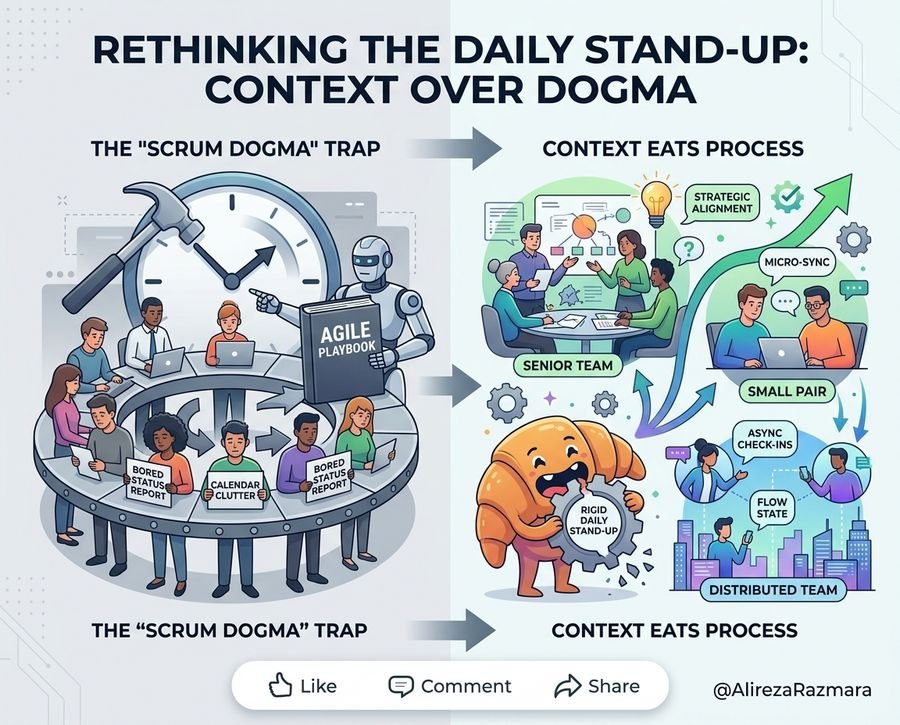
As Agile leaders, we often fall into the Scrum Dogma trap. The mindset assumes that if a ceremony is in the playbook, every single team must execute it every single day, regardless of their unique circumstances. We treat the framework as an immovable law rather than a flexible tool.
But after coaching dozens of engineering teams through messy, real-world deliveries, I have learned one universal truth: Context always eats process for breakfast.
Agile is not a rigid rulebook. It is an adaptable mindset. If your team is running “Zombie Stand-ups”—meetings where people show up physically but check out mentally—you are likely doing more harm than good. Calendar clutter destroys flow state, and repetitive status reports erode team engagement.
Are daily stand-ups mandatory for every Agile team?
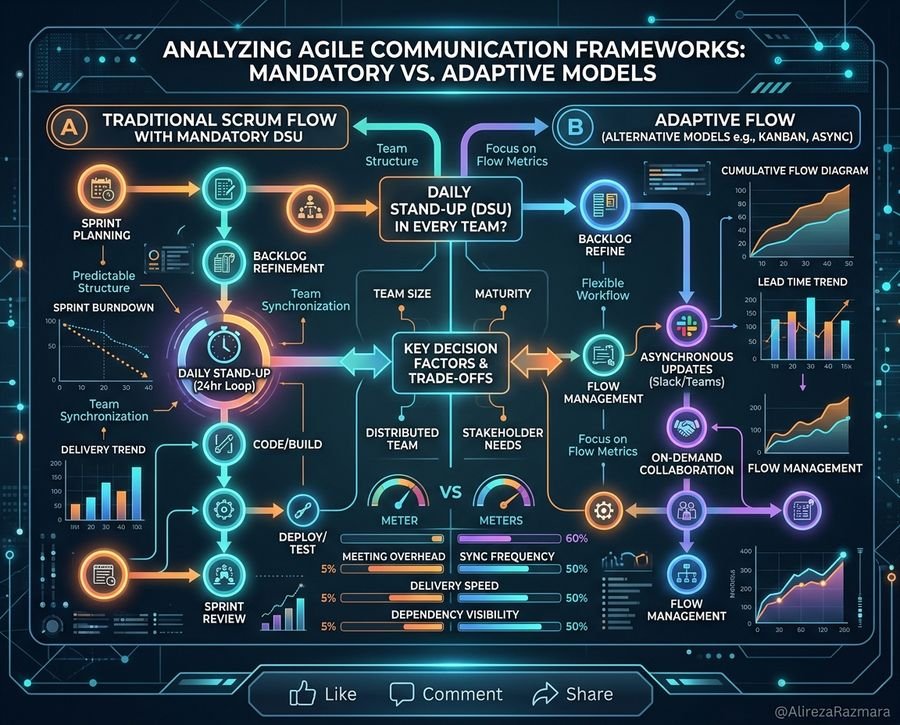
No, daily stand-ups are not mandatory for every Agile team. While traditional frameworks like Scrum prescribe a Daily Scrum, high-performing, small, or geographically distributed teams often benefit significantly more from asynchronous updates or a reduced meeting cadence that preserves focus and developer flow state.
The goal of the stand-up was never to take attendance. The goal is daily strategic alignment toward the Sprint Goal and the rapid surfacing of blockers. If your team is achieving that alignment without a 15-minute live call, forcing the meeting simply to check an administrative box is a massive waste of resources.
We need to stop asking, “Did everyone attend the stand-up?” and start asking, “Does this team actually need a daily sync to stay unblocked?” Matching your meeting cadence to your team’s specific context is critical for maintaining high velocity and high morale.
How Team Maturity Dictates Your Agile Cadence
Team maturity directly dictates your Agile cadence because senior, high-performing teams naturally communicate continuously throughout the day. Forcing a rigid, formalized daily sync on mature teams often reduces their dynamic, real-time alignment into a boring, retroactive status report.
Think about a newly formed team. They are in the “storming” or “norming” phases of team dynamics. Junior developers might be hesitant to interrupt a senior engineer to ask for help. In this context, a daily stand-up acts as a necessary safety net. It creates a dedicated, psychologically safe space to raise a hand and say, “I am stuck.”
However, an experienced team that has been working together for two years operates entirely differently. They pair-program organically. They jump into quick Slack huddles to squash bugs. They review each other’s pull requests within hours. If a senior engineer hits a blocker at 10:30 AM on a Tuesday, they do not wait until 9:00 AM on Wednesday to talk about it. They solve it immediately.
For these veteran teams, the daily stand-up often feels patronizing. By recognizing their maturity, you can dial back the mandatory ceremonies. A targeted sync on Mondays and Thursdays is usually more than enough to keep a mature team aligned while giving them back hours of uninterrupted deep work.
Why Team Size Matters More Than Strict Frameworks
Team size matters more than strict adherence to a framework because communication overhead scales exponentially with every new team member. A micro-team of two or three developers working tightly on a single product component gains zero value from a formalized daily meeting structure.
Software engineering relies heavily on the “Maker’s Schedule.” Developers need long, unbroken blocks of time to write complex logic. A 15-minute meeting right in the middle of the morning does not cost 15 minutes. It costs an hour of context-switching.
If you have a massive nine-person squad managing cross-functional dependencies, a daily sync might be essential to prevent traffic jams. But if you have three developers working on an isolated feature flag, their communication lines are incredibly simple. They do not need calendar clutter. Micro-syncs—a quick five-minute chat after grabbing coffee—will win over a formalized, calendar-blocked ceremony every time.
Distributed Workflows: Asynchronous Check-ins Over Live Meetings
For distributed teams spread across multiple time zones, asynchronous check-ins are vastly superior to live stand-ups. Mandating a live daily meeting often forces developers to log on outside their core working hours, which destroys work-life balance, breaks flow state, and rapidly leads to burnout.
The tech industry is increasingly global. You might have an architect in London, a frontend developer in New York, and a QA engineer in Sydney. Finding a single time slot that works for everyone usually means someone is taking a call at 10:00 PM or 6:00 AM.
High-trust teams thrive using asynchronous workflows. Tools like Geekbot, automated Slack workflows, or even a simple threaded message in Microsoft Teams can replicate the value of a stand-up without the geographical friction.
A strong asynchronous update should look like this:
- Done: Pushed the payment gateway integration to the staging environment.
- Next: Writing unit tests for the webhook listener.
- Blockers: I need the updated API keys from DevOps before I can test the failure states. (Tagged @DevOpsLead)
This format is instantly scannable, provides a written record of progress, and allows team members to respond and unblock each other naturally as they come online in their respective time zones.
How to Fix “Zombie Stand-ups” and Adapt Your Ceremonies
To fix zombie stand-ups, shift the team’s focus away from individual attendance toward collective outcomes and unblocking the Sprint Goal. Agile leaders must use their Retrospectives to actively experiment with alternative cadences and empower their teams to choose the alignment method that works best for them.
Focus on Outcomes, Not Individual Attendance
If your stand-up feels like a status report to the Scrum Master or Tech Lead, the format is broken. You are running a “Round Robin” meeting where developers simply justify their paychecks by listing tasks.
Instead, try “Walking the Board.” Open your Jira or Azure DevOps board and start from the right (closest to Done). Ask, “What do we need to do as a team to get this specific ticket across the finish line today?” This shifts the psychological focus from the worker to the work. It forces collaboration. If the Sprint Goal is clear and blockers are surfaced quickly, the specific method of your stand-up simply does not matter.
Inspect and Adapt in Retrospectives
The core mechanism of Agile is continuous improvement. If you sense that the daily stand-up has become a chore, bring it up directly in your next Retrospective. Ask the team point-blank: “Are we getting value out of our daily 9:00 AM sync?”
If the answer is no, run a time-boxed experiment. Propose dropping the live meeting to three times a week (e.g., Monday, Wednesday, Friday) and using asynchronous Slack threads on Tuesdays and Thursdays. Run this experiment for two sprints, gather feedback, and adjust. You are not throwing away Agile; you are actually practicing it by iterating on your own internal processes.
Empower Autonomy
The ultimate goal of an Agile Coach or Tech Lead is to build self-organizing teams. You want to reach a state where the team recognizes when they are misaligned and calls their own syncs organically.
Give mature teams the psychological safety to decide how they align best. Trust that professional engineers want to deliver great software. If you remove the bureaucratic overhead, you will often find that they collaborate more effectively, not less.
Stop dragging your engineers into Zombie Stand-ups just to satisfy a playbook. Context matters. Size matters. Experience matters. Audit your ceremonies this week, trust your developers, and watch your team’s velocity and happiness naturally increase.