
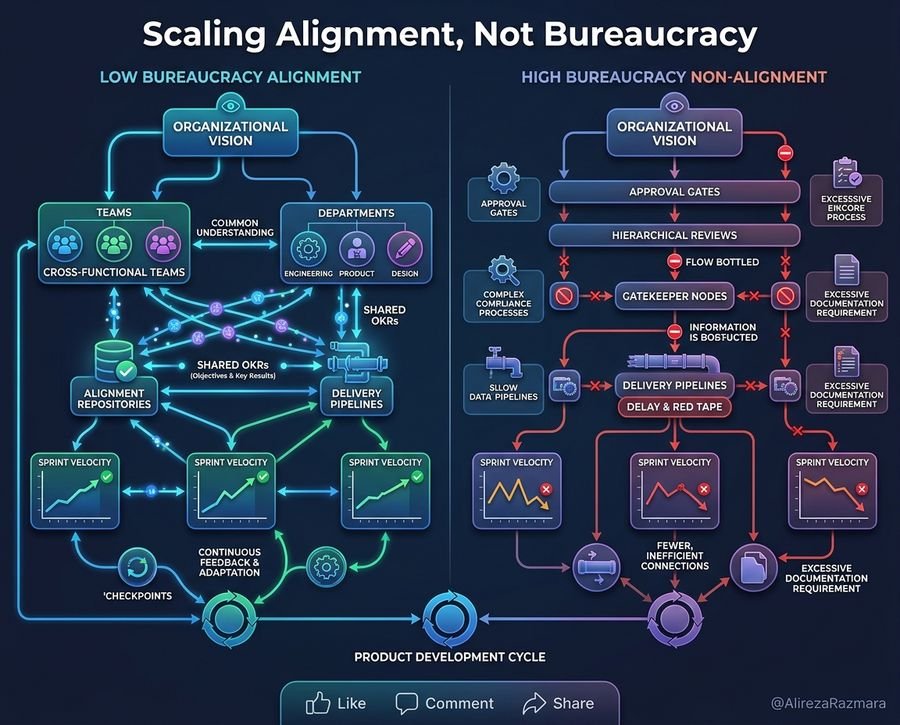
Scaling Alignment, Not Bureaucracy
Scaling Agile is not about packing more recurring calendar invites into your week. It is about scaling alignment. When your product outgrows a single Scrum team, adding more developers to the mix often triggers a familiar nightmare: dependency bottlenecks, integration friction, and severely fragmented communication.
You split your large team into multiple smaller, nimble teams to restore agility. But quickly, a new problem emerges. The frontend team gets blocked because the backend API changed, and the database team is completely unaware of the upcoming release schedule. How do you scale multi-team delivery without drowning your engineers in enterprise bureaucracy?
Enter the Scrum of Scrums (SoS).
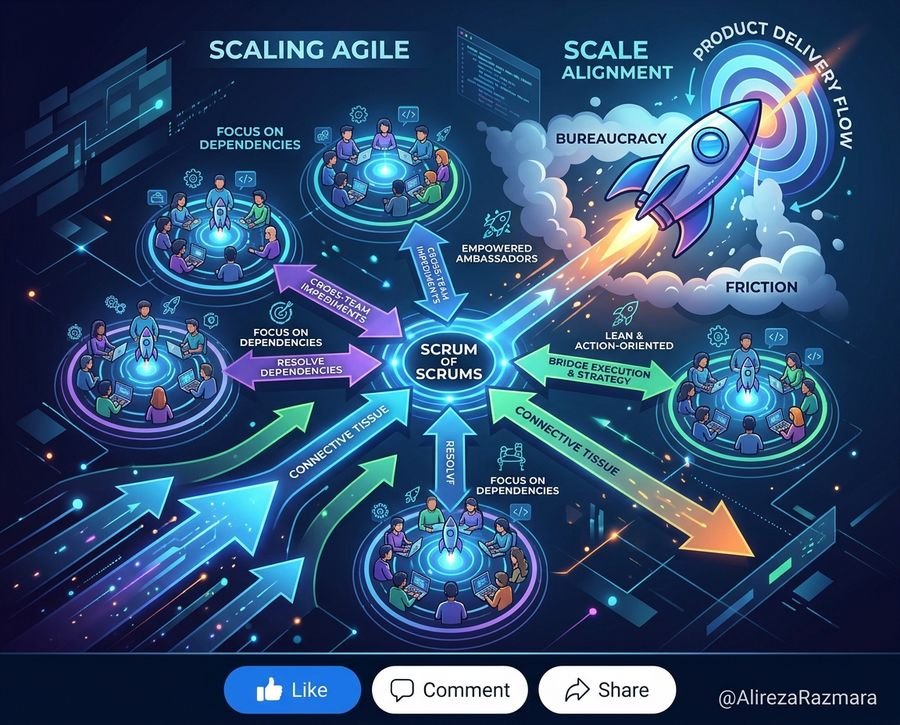
Scrum of Scrums is not an extra status meeting. It is a powerful, lightweight scaling mechanism built to connect multi-team efforts, eliminate cross-team impediments, and maintain relentless product delivery flow. Let us look at how elite tech leaders use this framework to turn organizational friction into seamless momentum.
What is Scrum of Scrums?
Scrum of Scrums is a lightweight Agile scaling technique designed to integrate the work of multiple independent teams, resolve cross-team blockers, and protect the overall product delivery flow. It scales the daily Scrum by treating each individual team as a single participant in a larger, synchronized group.
Rather than adopting a massive, prescriptive enterprise framework right out of the gate, SoS allows organizations to scale organically. When you have three to nine Scrum teams working on the same core product, they need a dedicated space to align their boundaries. The focus here is entirely on the intersection points between teams. If a piece of work never touches another team, it never gets discussed at the Scrum of Scrums.
The Breaking Point: Why Single Teams Fail at Scale
Single Scrum teams inevitably break at scale because communication pathways multiply exponentially, causing integration friction and slowing down delivery speed. Throwing bodies at a complex software problem rarely accelerates the timeline.
This is basic network complexity. A five-person team has 10 lines of communication. Expand that to a 15-person team, and you suddenly have 105 lines of communication. Daily standups turn into exhausting 45-minute marathons where engineers zone out waiting for their turn to speak. Code merges become highly volatile, and testing cycles stretch from hours to days.
Splitting the team into three autonomous pods of five developers fixes the internal communication bloat. However, those three pods still share the same codebase and the same ultimate product goal. Without a dedicated alignment mechanism, you end up with localized optimization but global chaos. Teams optimize for their own sprint goals while accidentally sabotaging the broader release.
How to Run a High-Impact Scrum of Scrums
To run a highly effective Scrum of Scrums, teams must focus exclusively on dependencies, empower authorized representatives to make decisions, and strictly time-box the meeting to 15 minutes. The primary objective is to identify friction rapidly and move deep problem-solving to smaller, focused groups.
Focus on Dependencies, Not Status Updates
The SoS exists to answer two core questions: What is my team doing that impacts another team? and What is blocking our shared delivery goal? If an ambassador starts reading off their Jira board or detailing the internal tasks of their sprint, the facilitator must cut them off.
Consider the difference between a bad update and a good update:
- Bad Update: “Yesterday my team worked on the login page. Today we are continuing to work on the login page. No blockers.”
- Good Update: “My team is deploying the new authentication service to staging this afternoon. Team B, this will cause about an hour of downtime for your testing environment. We are blocked on moving to production until Team C finishes the security audit.”
The second update provides actionable, cross-team intelligence. It alerts Team B to an impending disruption and explicitly names Team C as a dependency.
Empower the Right Ambassadors
Send representatives who possess both the technical context to understand the broader architecture and the authority to commit their team to a solution. You need individuals who can negotiate in real time.
Typically, this is the Scrum Master, a Technical Lead, or a Senior Engineer. Rotating the ambassador role among team members can build cross-functional empathy, but the golden rule remains: the person in the room must be able to speak for the team. Sending a junior developer who constantly has to “take this back to the team for discussion” introduces latency and defeats the entire purpose of the sync.
The “After Party” Protocol for Deep Dives
Keep the main SoS lean by parking deep-dive technical discussions for a separate, immediate follow-up called the “After Party.” You identify cross-team impediments fast during the 15-minute sync, and only those involved stick around to solve them.
For example, if the frontend and backend teams discover a mismatch in an API payload during the SoS, they acknowledge the blocker and move on. Once the 15-minute timebox ends, the representatives from those two specific teams stay on the call (or in the room) to hash out the technical details. The other five team representatives get to leave and go back to building software. This aggressively protects the engineering time of the broader group.
The Role of the Chief Scrum Master
The Scrum of Scrums facilitator—frequently called a Chief Scrum Master—guides the event by strictly enforcing timeboxes, steering conversations away from status updates, and tracking cross-team impediments through to resolution. They manage the flow of information, not the people.
This role is rarely a dedicated, full-time position in lightweight setups. It is usually filled by an experienced Scrum Master from one of the participating teams. Their primary responsibility is to maintain the discipline of the event. If the SoS devolves into a traditional management reporting session, it is the Chief Scrum Master’s job to reset the room, remind everyone of the Agile principles at play, and refocus the group on dependency resolution.
Bridging Execution and Enterprise Strategy
Scrum of Scrums bridges daily team execution with enterprise strategy by exposing systemic bottlenecks to leadership and aligning multi-team outputs with the high-level product roadmap. It acts as the critical connective tissue between the trenches and the executive suite.
When individual teams hit roadblocks, they often solve them locally. But when the Scrum of Scrums identifies that three different teams are continually blocked by the same manual QA deployment process week after week, that becomes a strategic data point. Leadership can use this heavily vetted, cross-team feedback to justify investing in automated CI/CD pipelines.
Furthermore, the SoS ensures that while autonomous teams define how the work gets done, they remain deeply aligned on why they are doing it. It keeps the entire fleet of teams sailing in the same direction toward the overarching quarterly objectives.
Scrum of Scrums vs. Heavyweight Frameworks
Scrum of Scrums is best for organic, lightweight scaling, whereas SAFe, LeSS, and Nexus are heavyweight frameworks designed for massive enterprise restructuring. If you have three to nine teams working on a single product, SoS provides the alignment you need without the intense bureaucratic overhead.
Many tech organizations jump straight into the Scaled Agile Framework (SAFe) the moment they experience growing pains. While SAFe provides rigorous structure for massive organizations (50+ teams), it requires substantial training, extensive new roles (like Release Train Engineers), and heavy two-day PI Planning events. For mid-sized product groups, this is often overkill.
Scrum of Scrums, by contrast, builds directly on the Scrum foundation you already have in place. There are no expensive certifications required to start. You simply identify your cross-team dependencies, elect your ambassadors, and start talking to each other. If your organization eventually grows to a size where SoS is no longer sufficient, you can graduate to LeSS (Large-Scale Scrum) or Nexus. But for the vast majority of growing tech teams, mastering the Scrum of Scrums is the highest-leverage move you can make.
Fostering Self-Organization at Scale
As technical leaders and Agile practitioners, our goal is never to control every moving part of the software development lifecycle. Our job is to create an environment where self-organization can thrive at scale.
When you implement Scrum of Scrums effectively, you stop managing dependencies through spreadsheets and top-down mandates. Instead, you empower the people closest to the work to identify collisions early and pivot dynamically. You replace the nightmare of integration friction with a synchronized, predictable delivery cadence.