
The Ultimate Agile Interview Question
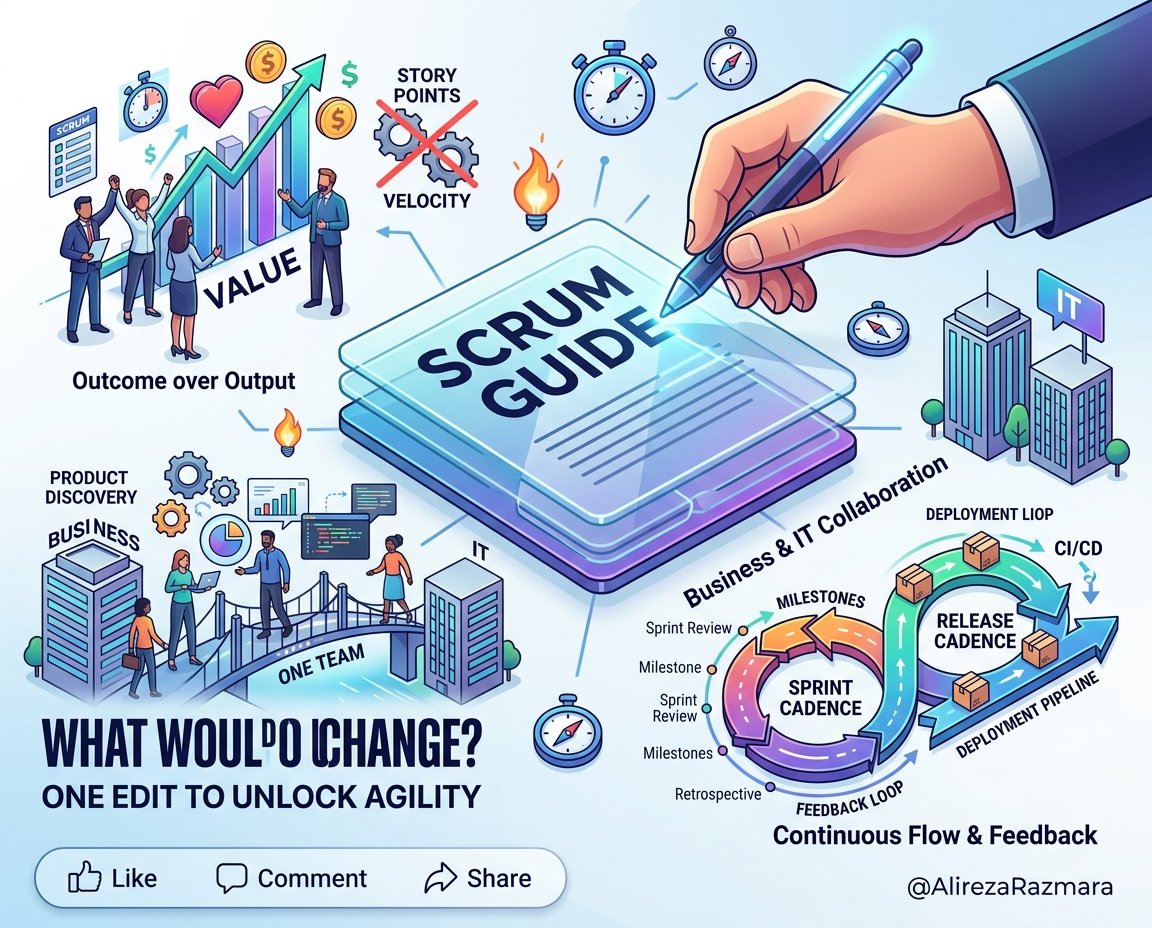
As a Scrum Master and Agile Coach, I have a favorite interview question for senior agile practitioners: If you had the power to change just one thing in the Scrum Guide, what would it be?
It instantly separates textbook regurgitation from battle-tested leadership. Anyone can memorize the 13-page framework. Very few can articulate where it fails under the pressure of real-world software engineering.
The Scrum Guide is intentionally lightweight. Ken Schwaber and Jeff Sutherland built it as a minimal framework, not a comprehensive instruction manual. Yet, in the trenches of modern project delivery, dogmatic interpretations of that minimal text frequently create massive organizational friction. Teams weaponize the guide to defend poor practices, while management misinterprets its artifacts to enforce micromanagement.
If I held the pen for the next revision, I wouldn’t add heavy processes. I would sharpen the language to reflect how modern, high-performing engineering teams actually operate. Here are the three critical adjustments I would make to the Scrum Guide today.
Mandate Outcome Over Output Explicitly
If I could change one thing in the Scrum Guide, I would explicitly mandate measuring validated customer value rather than just team output. Currently, the guide emphasizes creating a “usable Increment,” which inadvertently encourages teams to obsess over velocity, story points, and ticket throughput instead of actual business impact.
We need explicit language holding teams accountable for solving user problems. Right now, a Scrum Team can perfectly execute all five events, maintain pristine artifacts, consistently meet their Sprint Goals, and still build a product that completely fails in the market.
The problem stems from how organizations interpret the Definition of Done. Usually, “Done” means the code is written, tested, and deployed to a staging environment. It rarely means “a customer used this and achieved their desired result.” Because the framework heavily emphasizes the delivery of the Increment, traditional management structures treat Story Points and Velocity as performance scorecards. They are not scorecards. They are capacity planning tools with a high margin of error.
To fix this, the Scrum Guide needs to redefine the purpose of the Sprint. The goal is not merely to ship a feature. The goal is to run an experiment that validates an assumption. By shifting the text to explicitly demand Outcome over Output, we force organizations to ask, “Did this matter to the user?” instead of just asking, “Did we finish all our Jira tickets on time?”
Bridge the “Business vs. IT” Chasm
The Scrum Guide should be updated to require the entire Scrum Team’s direct involvement in strategic product discovery. Under traditional interpretations, the Product Owner is isolated as the sole business representative, turning brilliant engineers into disconnected feature factories.
We see this anti-pattern everywhere. The business talks to the Product Owner. The Product Owner writes the user stories. The developers write the code. This assembly-line mentality completely contradicts the cross-functional collaboration Scrum was meant to foster. When developers are treated as mere order-takers, you strip away technical innovation at the discovery phase. You end up with solutions dictated by stakeholders who do not understand what the technology is actually capable of.
The framework needs to amplify the team’s direct interaction with the customer. The most effective technical solutions emerge when the people writing the code understand the human pain points they are solving firsthand. I would rewrite the accountabilities section to state that product discovery is a collaborative, whole-team effort. The Product Owner might prioritize the backlog and hold the ultimate decision-making authority on value, but they should never act as a protective barrier between developers and users.
Breaking down this wall destroys the toxic “us versus them” dynamic that plagues enterprise IT. It forces business stakeholders to view the Scrum Team as strategic partners, rather than a slow-moving vending machine where requirements go in and code eventually falls out.
Decouple “Sprint Cadence” from “Release Cadence”
I would rewrite the Scrum Guide to draw a hard, undeniable line separating the Sprint feedback loop from the software deployment pipeline. Despite the rise of modern DevOps, Continuous Integration, and Continuous Deployment (CI/CD), many organizations still mistakenly believe you can only ship software at the end of a Sprint.
This is arguably the most damaging misconception in enterprise Agile environments. Shipping code is a highly technical, largely automated process. Reviewing product value is an interactive business process. They do not need to share the same calendar.
You can—and should—deploy code to production multiple times a day. You do not need to wait for the two-week Sprint boundary to push a bug fix, release a microservice, or toggle a feature flag. The Sprint Review is meant to be a strategic alignment meeting where the team and stakeholders inspect the aggregate impact of everything delivered over the past two weeks. It was never meant to be a release gate.
By failing to explicitly separate these concepts, the current Scrum Guide allows traditional Change Advisory Boards (CABs) and compliance teams to hold releases hostage to arbitrary Sprint schedules. If I had the editor access today, I would add a single, bolded line: A Sprint is a cadence for planning and feedback; it is not a constraint on deployment.
Agile is an Empirical Baseline, Not a Rulebook
Scrum was never meant to be rigid. Ken and Jeff built the entire framework on the foundation of empiricism: transparency, inspection, and adaptation. If we treat the Scrum Guide as an untouchable sacred text, we are failing the very first test of agility.
True agility is not about defending the framework. It is about serving the people and the product. When the rules start getting in the way of delivering value, you change the rules. The ideas I have laid out above—focusing on validated outcomes, bringing developers into discovery, and untangling deployment from the Sprint timeline—are simply reflections of how high-performing teams have already adapted.
We need to stop managing by textbook and start leading by reality. The trenches of software development are messy, unpredictable, and highly complex. The frameworks we use to navigate that complexity must evolve alongside the technology we build.
Over to You
If Jeff Sutherland and Ken Schwaber gave you editor access to the Scrum Guide today, what single line would you add, delete, or rewrite?
Would you change the Daily Scrum? Rethink the role of the Scrum Master? Drop your boldest takes, and let’s inspect and adapt together.