
The Anatomy of a Failed Retrospective
Your team walks out of the Sprint Retrospective energized. The whiteboard is covered in sticky notes. You have identified five brilliant ideas to reduce merge conflicts, streamline testing, and improve team communication. Everyone nods in agreement. Fast forward two weeks to the next sprint review. Zero improvement items are completed.
I see this constantly in my work as an Agile Coach. As technical leaders, we obsess over delivery metrics like cycle time, velocity, and sprint burndown. Yet, we completely ignore the most critical engine of long-term velocity: The Improvement Item Completion Rate. When teams fail to execute on their own retrospective action items, they breed cynicism. Agile becomes a meeting, not a mindset.
What is the Improvement Item Completion Rate (IICR)?
The Improvement Item Completion Rate (IICR) is the percentage of retrospective action items a team successfully finishes by the close of the subsequent sprint. It is a direct measure of a team’s ability to evolve its own workflows. To calculate it, divide the number of completed retrospective action items by the total number of items committed to during the retrospective, then multiply by 100.
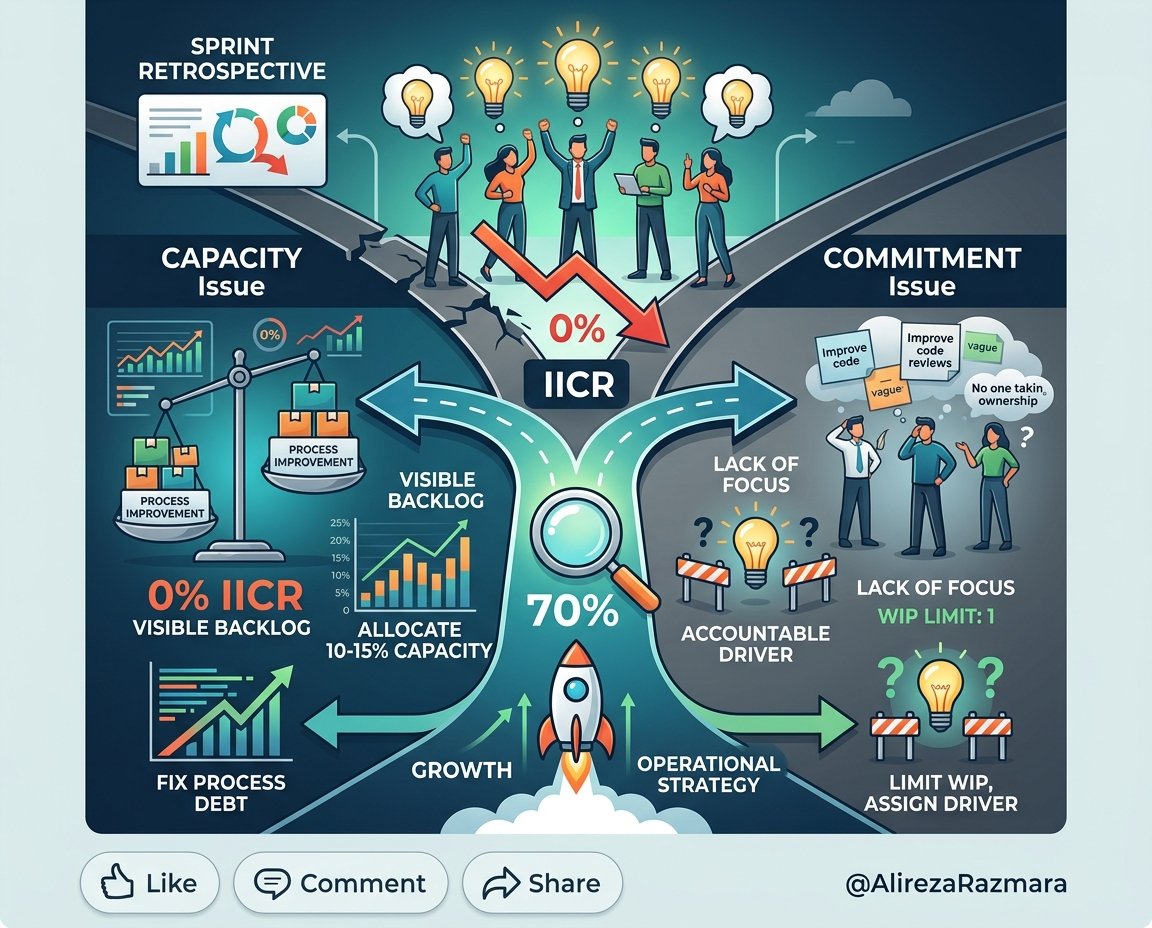
When your IICR consistently drops below 70%, you are facing a critical diagnostic fork in the road. You must determine if the failure stems from a capacity deficit or a commitment collapse. Treating one with the medicine meant for the other will only frustrate your engineering team further. Data-driven Scrum Masters and Technical Leaders use clear signals to diagnose the root cause and apply the right structural fix.
Scenario A: Diagnosing a Capacity Issue
A capacity deficit occurs when teams allocate 100% of their sprint time to feature delivery and bug fixes, leaving zero margin to execute process improvements. The team wants to improve, but the operational reality of the sprint makes it mathematically impossible.
The Symptoms of a Capacity Deficit
The action items are realistic, highly measurable, and clearly owned. An engineer knows exactly what script they need to write to automate a painful deployment step. However, the moment the sprint starts, high-priority fires, unexpected hotfixes, and maximum feature utilization push the improvement item to the back burner. The team feels stressed and apologetic during the next retrospective.
The Data Signature
You can identify a capacity issue by looking at your sprint metrics. You will see a high Sprint Backlog completion rate for product features, accompanied by a 0% to 20% IICR. The team is clearly working hard and delivering value, but they are redlining their engines with no time for maintenance.
The Fix: Budgeting for Process Debt
You must treat process debt with the exact same respect you give technical debt. If an improvement item is not formally represented in the Sprint Backlog, it does not exist. Here is how to fix a capacity deficit structurally:
- Explicit Capacity Allocation: Reserve 10% to 15% of your sprint capacity specifically for continuous improvement. If your team’s velocity is 40 story points, dedicate 4 to 6 points strictly to retrospective items.
- First-Class Backlog Citizens: Improvement items must be written as visible backlog tickets. They need story points, acceptance criteria, and a place on the active sprint board.
- Protect the Boundary: As a Scrum Master or Delivery Lead, you will face pushback from Product Owners wanting more features. You must defend this 15% buffer. Remind stakeholders that spending time sharpening the axe is the only way to chop down trees faster next month.
Scenario B: Diagnosing a Commitment Issue
A commitment collapse happens when retrospective items lack clear accountability, specific execution steps, or the psychological safety required to enact change. Time is available, but the team fails to act because the path forward is ambiguous or intimidating.
The Symptoms of a Commitment Collapse
The action items generated in the retrospective are impossibly vague. You will see sticky notes that say things like ‘Improve code reviews’ or ‘Communicate better.’ Ownership is assigned to ‘the whole team,’ which is a structural guarantee that absolutely no one will do it. Alternatively, an item might require challenging a toxic company policy, and the team lacks the psychological safety to push back.
The Data Signature
The data signature for a commitment issue shows available slack time within the sprint. Engineers might finish their primary tasks early. Velocity might be stable or even fluctuating, but the improvement items remain untouched, forgotten entirely until the Scrum Master brings them up at the next Retrospective.
The Fix: Actionable Experiments and Strict WIP Limits
If the team has time but lacks execution, you need to shift your coaching approach from facilitating wishes to designing rigorous operational experiments. Vague goals kill momentum. Precision drives action.
- Limit Work In Progress (WIP): Stop walking out of retrospectives with five action items. Limit your WIP to exactly one high-impact improvement item per sprint. Focus creates follow-through.
- Assign a Single Driver: ‘The team’ cannot own a ticket. Assign a single accountable driver. This person does not have to do all the work, but they are responsible for ensuring the work moves across the board.
- Design Specific Experiments: Translate vague goals into measurable actions. Change ‘Improve code reviews’ to ‘For the next two weeks, require one senior and one junior engineer to pair-program on all PRs over 200 lines.’ This has a clear boundary, a clear action, and an easy way to measure success.
How to Implement a Continuous Improvement Strategy
Continuous improvement is not an extracurricular activity. It is the core operational strategy of any high-performing Agile team. If you do not budget the capacity and the structural rigor for growth, you are actively scheduling your own stagnation.
To put this into practice tomorrow, start by auditing your last three retrospectives. Look at the action items generated and track exactly how many were completed. Calculate your baseline IICR. Bring this data to your next sprint planning session. Show the team the reality of their follow-through.
Addressing Stakeholder Resistance
One of the hardest parts of enforcing a high IICR is managing stakeholder expectations. Business leaders often view process improvement as a distraction from feature delivery. You must reframe this conversation. Use the language of risk and compounding returns.
Explain that ignoring internal process bottlenecks increases cycle time incrementally every sprint. A deployment process that takes two hours today will take four hours next year if left unoptimized. By investing a small percentage of capacity into workflow improvements now, you are securing faster time-to-market for future quarters. It is an investment, not a tax.
The Bottom Line for Agile Leaders
We need to stop treating retrospective action items as ‘nice-to-haves’ that we only address if we magically find free time on a Friday afternoon. High-performing engineering teams do not rely on magic. They rely on disciplined backlog management and clear prioritization.
Measure your Improvement Item Completion Rate. Diagnose whether your team is starved for capacity or lacking in commitment. Protect the time needed to execute these items, and hold the standard of accountability high. The fastest way to destroy Agile adoption is to ask a team how they want to improve, and then consistently fail to give them the time and structure to actually do it. Fix your IICR, and you will fix your delivery velocity.