
🎧 Listen In: Should the INVEST Framework Be Rigid (17 min)
Why Most Sprint Bottlenecks Start in the Backlog
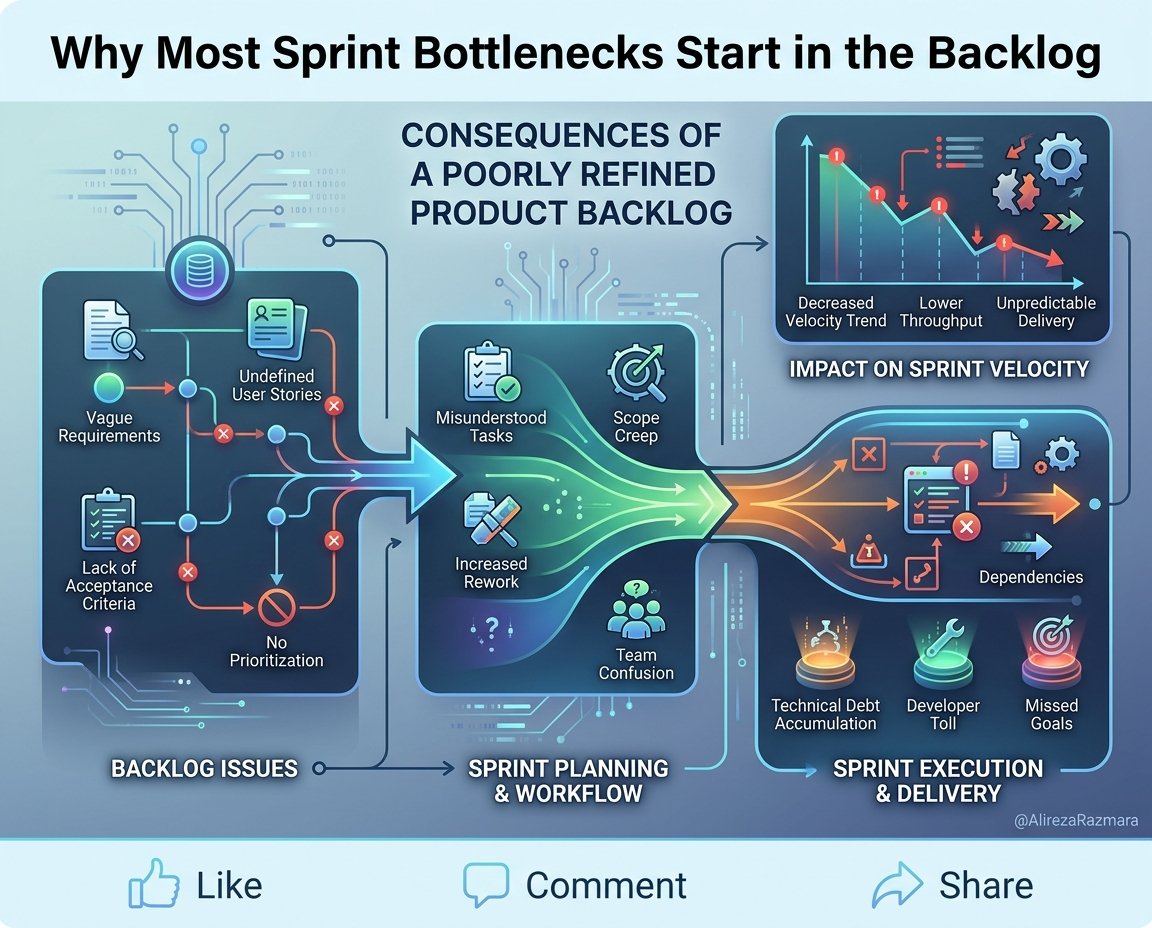
Sprint bottlenecks usually begin in the Product Backlog because poorly refined, ambiguous, or oversized User Stories force developers to figure out requirements during the Sprint rather than writing code. When teams spend their time untangling dependencies instead of executing, value delivery grinds to an absolute halt.
How many times has your team carried over a User Story simply because it was too vague, tightly coupled, or impossibly large? You reach the end of the iteration, and instead of a working software increment, you get a laundry list of entirely preventable technical delays. As a delivery consultant, I see this pattern constantly. We blame the engineers. We blame the CI/CD pipeline. We blame the environment. But the reality is much simpler: garbage in, garbage out.
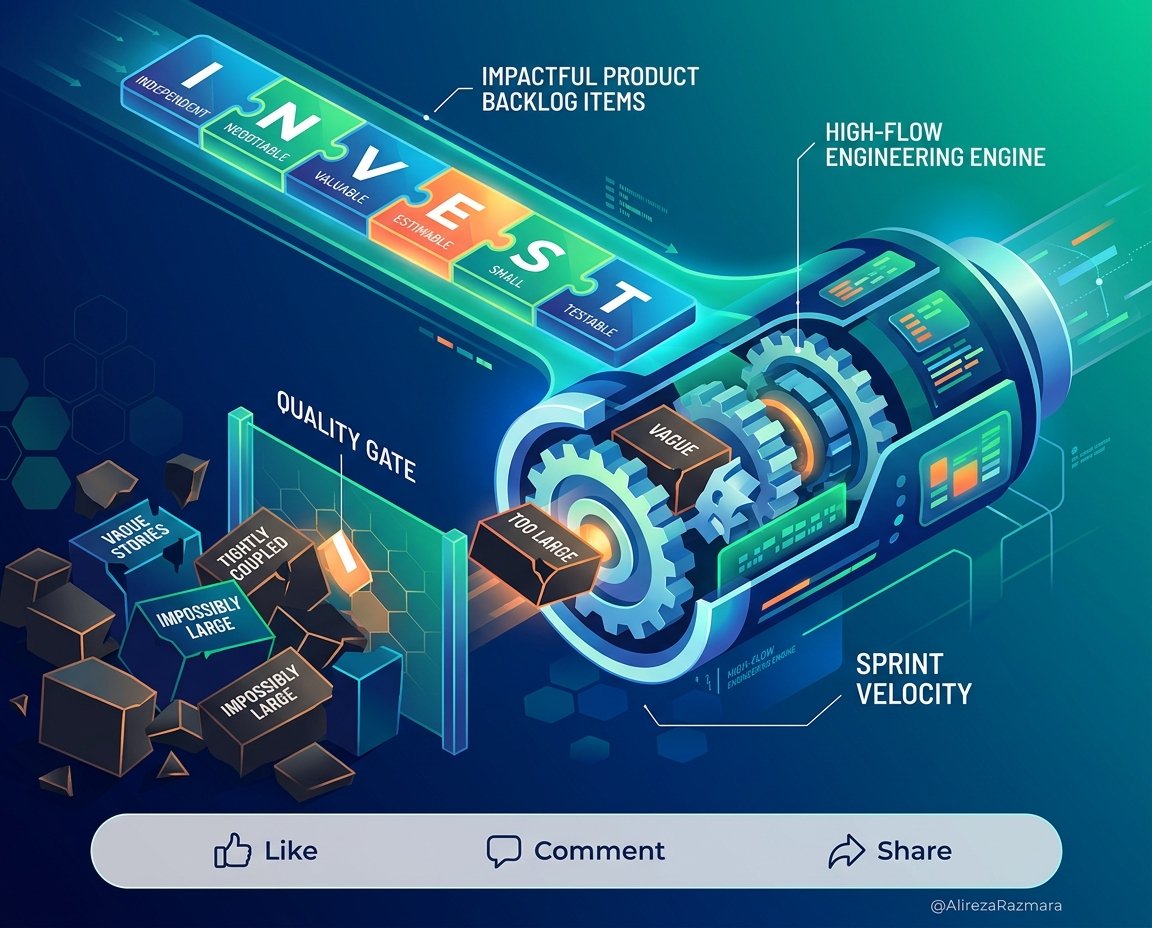
When User Stories read like rigid mini-spec documents rather than invitations to collaborate, you strip your team of their engineering autonomy. To build a high-flow, predictable engineering engine, elite Product Owners and Agile Leaders rely on Bill Wake’s INVEST framework. It serves as your ultimate quality gate for impactful Product Backlog Items.
What is the INVEST Framework in Agile?
The INVEST framework is a set of criteria used by Agile teams to assess the quality and readiness of a User Story before it enters a Sprint. Created by Bill Wake, the acronym stands for Independent, Negotiable, Valuable, Estimable, Small, and Testable. Meeting these six standards ensures a story is ready for seamless execution.
Think of INVEST as a defensive filter. If a story fails even one of these checks during backlog refinement, it is not ready for Sprint Planning. Let us break down exactly how to apply each principle in the real world.
Independent (I): Minimize Unnecessary Dependencies
An independent User Story can be developed, tested, and shipped regardless of the status of other stories. When stories are tightly coupled, you create a domino effect. If one item gets blocked by a missing API endpoint, every story linked to it immediately stalls.
To achieve independence, stop slicing your work by architectural layers. If you create one story for the database, one for the backend logic, and one for the frontend UI, they are entirely dependent on each other. Instead, slice vertically. A story should encompass a tiny slice of the database, the backend, and the frontend required to deliver a specific piece of user functionality. This way, if priority shifts midway through the Sprint, you can still deploy what is finished without leaving fragmented code sitting in branch purgatory.
Negotiable (N): Focus on the Problem, Not the Blueprint
A negotiable User Story captures the underlying business problem and the intended user outcome, leaving the exact technical implementation up for discussion. User Stories are not legally binding contracts. They are placeholders for a conversation.
When Product Owners hand down heavily detailed, prescriptive tickets dictating exactly which variables to name and which buttons to color, they eliminate the team’s ability to innovate. The best technical solutions emerge when developers and business leaders co-create the approach. Bring the “what” and the “why” to refinement. Let the engineering team dictate the “how.”
Valuable (V): Frame Outcomes for the User
A valuable User Story explicitly delivers a measurable benefit to the end user or the business. If the customer gains nothing from the story being completed, you need to drastically rethink why it is in your backlog at all.
We often see backlogs polluted with purely technical tasks masked as User Stories. “Refactor the authentication database” is not a User Story; it is a task. “As a returning user, I want to log in using single sign-on so that I can access my dashboard faster” is a valuable story. Technical debt and refactoring are critical, but they should be framed around the performance, security, or stability value they return to the organization. Always ask: Who actually cares about this work?
Estimable (E): Eradicate Ambiguity
An estimable User Story contains enough clarity, context, and historical precedent for the development team to accurately gauge its complexity. Ambiguity is the absolute enemy of estimation.
If your team throws their hands up during Planning Poker and says they have no idea how to point a story, the story is not ready. This usually happens for one of two reasons: the team lacks the technical domain knowledge, or the acceptance criteria are too muddy. When a story is not estimable, do not force a guess. Send it back to refinement, assign a time-boxed Spike to investigate the technical unknown, and revisit it in the next cycle.
Small (S): Slice for Single-Sprint Delivery
A small User Story can be comfortably designed, coded, tested, and deployed within a single Sprint by a single team. If a story spans multiple Sprints, it is not a story—it is an Epic.
Oversized stories are the number one cause of Sprint carryover. Humans are notoriously bad at estimating large chunks of work. To shrink stories, rely on slicing techniques. You can slice by data type, by user role, by workflow step, or by platform. Instead of “Build a payment gateway,” slice it down to “Process a successful credit card payment.” Then add “Handle declined credit card errors” as a separate story. Smaller batches flow through the testing pipeline faster, drastically reducing the bottlenecks that pile up on the last day of the Sprint.
Testable (T): Define the Finish Line
A testable User Story has clear, objective Acceptance Criteria that allow the team to definitively prove the functionality works as intended. If you cannot test it, you literally do not know if it is “Done.”
Vague criteria like “the page should load fast” or “make the UI user-friendly” are impossible to verify. Instead, use exact parameters: “The dashboard must render within two seconds on a standard 4G connection.” Clear testability ensures quality assurance can automate the checks and engineers know exactly when they have met the requirements. It guarantees verifiable quality and prevents scope creep during the Sprint.
Leadership Insight: INVEST as a Strategic Alignment Tool
It is easy to dismiss backlog frameworks as administrative red tape, but elite Agile Leaders know better. The INVEST framework is a fundamental alignment tool that bridges the gap between high-level business vision and granular technical execution.
When you master vertical slicing with INVEST, Sprint Goals shift from being hopeful wishes to predictable, achievable commitments. As a Scrum Master or Agile Coach, your goal is to protect the team’s focus. By ruthlessly applying these six criteria during backlog refinement, you intercept ambiguity before it ever reaches the engineers. You stop managing carryover and start managing actual value delivery.
How to Implement INVEST in Your Next Refinement Session
Implementing INVEST does not require a massive organizational overhaul. It starts with asking better questions in your next refinement meeting. Try this practical approach:
- Print the criteria: Keep the INVEST acronym visible in your digital whiteboard or physical meeting space.
- Run a quick audit: Pull the top three items from your current backlog. Ask the team to rate them against the six letters. You will quickly spot the weaknesses.
- Challenge the “Small” factor: Whenever a story feels heavy, ask the developers, “What is the thinnest possible slice of this we could deliver by Friday?”
- Enforce the Quality Gate: Agree as a team that no story enters Sprint Planning unless it passes all six checks. Stick to it, even if it means pushing a feature out by a week.
Transforming your backlog takes discipline. But once you stop feeding your team vague, massive, and coupled stories, you will be amazed at how quickly your delivery bottlenecks disappear.