If your organization treats its Scrum Master as a glorified meeting scheduler who simply moves Jira tickets from “To Do” to “Done,” you are throwing money away. I say that with zero hesitation. In the real world of software delivery, the true, transformative return on investment (ROI) of a Scrum Master is rarely contained within the walls of a single development team. It is felt across the entire organization.
When a Scrum Master operates at the strategic level, they evolve from a simple team facilitator into an enterprise-wide change agent. They do not just optimize a two-week sprint cycle; they optimize the entire systemic workflow for business agility. This shift in perspective is what separates a mechanical Agile adoption from a company that can genuinely outmaneuver its competitors.
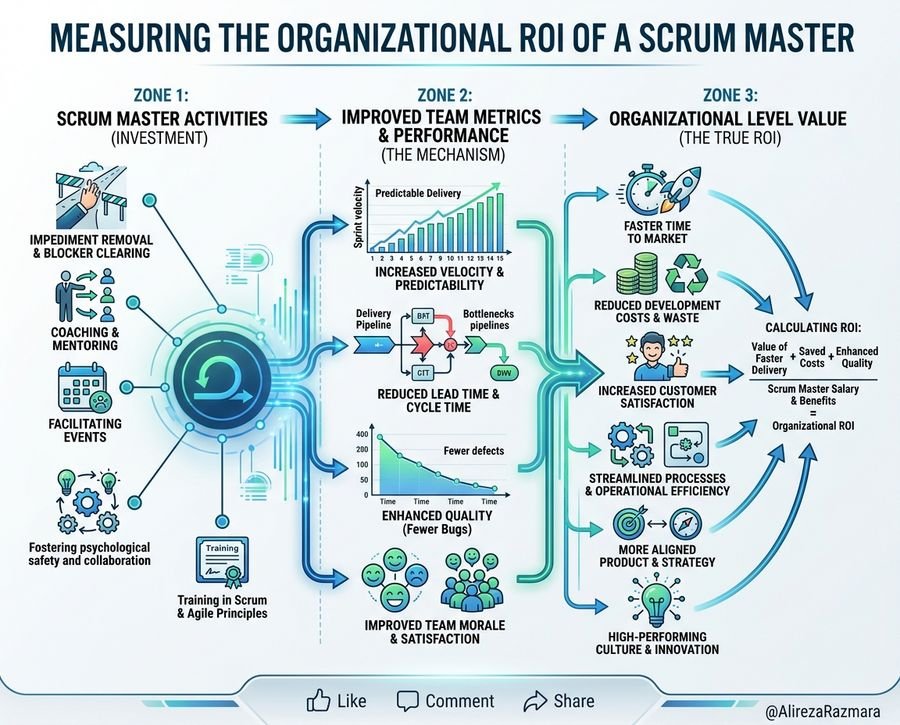
What is the True ROI of a Scrum Master at the Organizational Level?
The true return on investment of a Scrum Master is enterprise-wide business agility. They act as systemic catalysts who optimize the entire company’s workflow for continuous value delivery, rather than just focusing on localized team output. By removing organizational bottlenecks and aligning departments, they reduce time-to-market and lower the cost of friction.
Many leaders fundamentally misunderstand this. They look at the Scrum Guide, see the team-focused events, and assume the Scrum Master is an administrative assistant for developers. That is a massive underutilization of the role. The Scrum Guide explicitly states that the Scrum Master serves the organization in several critical ways. Let’s break down exactly what a great Scrum Master does when they step out of the sprint room and into the broader business ecosystem.
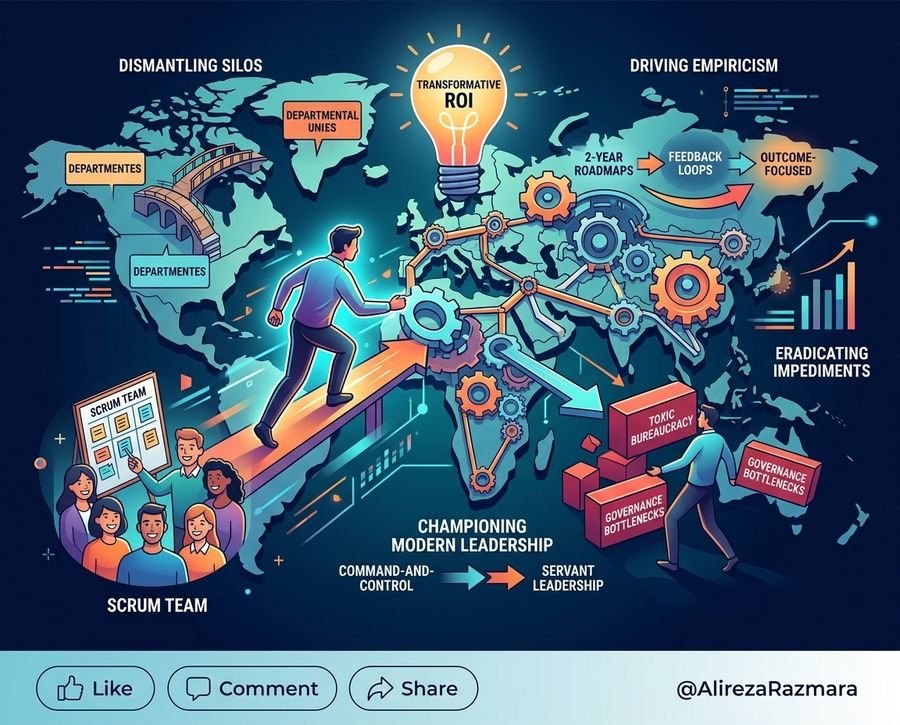
Dismantling Corporate Silos for Continuous Value Delivery
How do Scrum Masters break down organizational silos? They map the actual value stream and force necessary conversations between disconnected departments—such as Tech, Product, Sales, and Executive Leadership—until these groups align on common outcomes instead of territorial handoffs.
Corporate silos are the silent killers of software delivery. I have seen countless environments where Sales promises features without consulting Product, Product writes requirements without talking to Tech, and Tech builds architecture in a vacuum. The result? A disjointed mess that hits production late and fails to solve the customer’s actual problem.
A highly effective Scrum Master spots these chasms. They act as the bridge. Instead of letting teams operate in isolated fiefdoms, they facilitate alignment workshops, refine cross-departmental communication channels, and ensure that everyone understands the shared goal. They shift the internal narrative from “My department finished our part” to “Did we actually deliver value to the user today?” This kind of systemic alignment drastically reduces friction, rework, and internal politics.
Driving Real Empiricism in Executive Planning
Scrum Masters drive empiricism by coaching executive leadership to abandon fixed, output-driven roadmaps in favor of outcome-focused planning based on continuous customer feedback and real market data. They force the organization to look at actual working software rather than speculative status reports.
We have all seen the traditional two-year Gantt chart roadmap. It is a work of fiction. Executives love them because they provide a false sense of certainty, but the market does not care about your internal milestones. When reality deviates from the plan, organizations often double down on bad bets just to stay “on schedule.”
A great Scrum Master intervenes here. They gently but firmly challenge leadership to shorten their feedback loops. They use Sprint Reviews not just as a demo session for the team, but as a strategic pivot point for stakeholders. By asking questions like, “Based on what we built this sprint, does this feature still make sense for the market?” they shift the organization from predictive, rigid planning to adaptive, empirical planning. This saves companies millions of dollars that would otherwise be wasted building features nobody wants.
Eradicating Systemic Impediments and Approval Bottlenecks
How do great Scrum Masters remove systemic impediments? They trace team-level blockers back to their organizational root causes—such as outdated governance, toxic bureaucracy, or slow approval processes—and partner directly with leadership to permanently eliminate them.
Team-level blockers are almost always symptoms of a larger organizational disease. Let’s say a development team keeps missing its sprint goals because provisioning a test environment takes four days. A weak Scrum Master will note this on the retrospective board, complain about it, and accept it as a reality of the company. They treat the symptom.
A strategic Scrum Master hunts down the root cause. They map the process, gather the lead time and cycle time metrics, and take that hard data to the VP of Engineering or the IT Operations Director. They explain the financial cost of this delay and advocate for automated provisioning or policy changes. Whether it is an overly rigid Change Advisory Board (CAB), fragmented deployment pipelines, or conflicting departmental priorities, the Scrum Master shines a spotlight on the dysfunction and refuses to look away until the system is fixed.
Championing the Shift to Modern Servant Leadership
Scrum Masters champion modern leadership by guiding executives away from traditional command-and-control management toward a servant leadership model. They build environments rooted in trust, psychological safety, and high accountability, which are critical prerequisites for innovation.
Agile transformations frequently stall at the middle-management layer. Managers who built their careers on telling people exactly what to do suddenly find themselves in an environment where teams are expected to self-manage. This creates friction. Managers resort to micromanagement, demand arbitrary velocity metrics, and punish failure.
The Scrum Master steps in as an executive coach. They work with managers and leaders to redefine their roles. Instead of asking, “Why isn’t this done yet?” they teach leaders to ask, “What is in your way, and how can I help you remove it?” They foster psychological safety, proving to leadership that when teams are not terrified of making mistakes, they innovate faster, fix bugs sooner, and take true ownership of the product. This cultural shift is arguably the most difficult part of business agility, and it requires a Scrum Master with deep emotional intelligence and firm resolve.
How to Empower Your Scrum Master for Enterprise Change
If you want to realize this organizational ROI, you have to fundamentally change how you position your Scrum Masters. You cannot box them into an administrative corner and expect enterprise-level results. Here are three pragmatic steps you can take immediately:
- Give them a seat at the leadership table: Stop treating them as junior project managers. Invite them to portfolio planning sessions, leadership syncs, and strategic offsites. They need visibility into the company’s macro goals to align the micro execution.
- Measure system flow, not team velocity: If you judge a Scrum Master by how many story points their team burns down, you are incentivizing the wrong behavior. Measure them by lead time to market, deployment frequency, and the reduction of organizational bottlenecks.
- Empower them to challenge the status quo: A Scrum Master’s job is to hold up a mirror to the organization. Sometimes the reflection is ugly. Leadership must back the Scrum Master when they point out flawed processes or toxic cultural traits. If they fear for their job every time they challenge a bad policy, they will stop trying.
A Scrum Master is a catalyst for organizational evolution. When fully empowered, they do not just help you ship software a little bit faster—they future-proof your business by building a resilient, adaptive, and highly aligned enterprise. It is time to stop viewing them as team assistants and start leveraging them as the strategic assets they truly are.