

Why Scrum Masters Need a Personal Retrospective
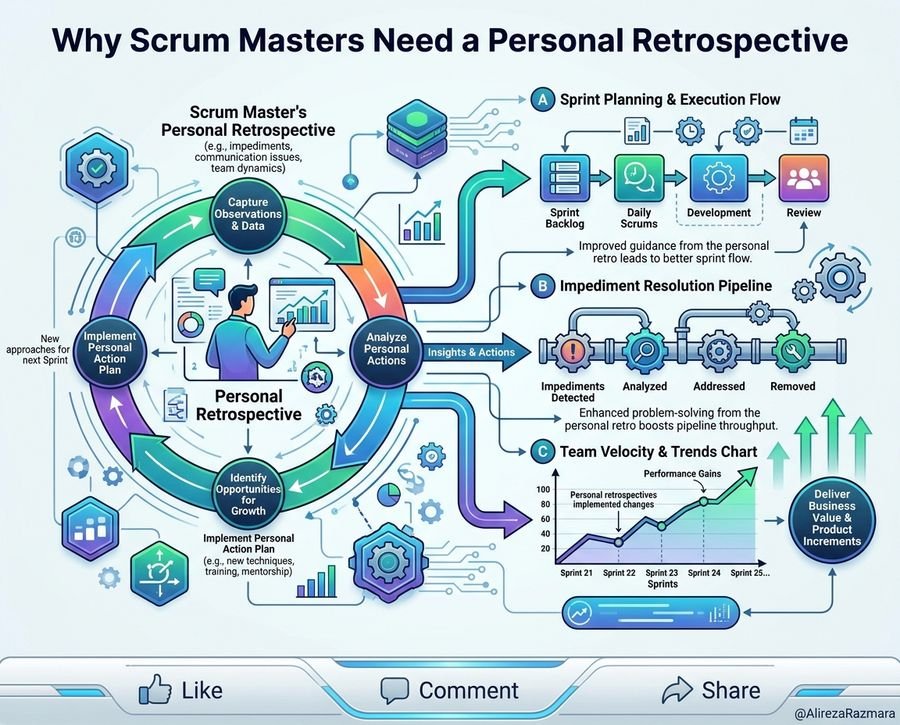
A Scrum Master personal retrospective is a structured self-evaluation where an Agile leader assesses their direct impact on team autonomy, psychological safety, and value delivery. Instead of analyzing team velocity or burndown charts, you measure your own behavioral patterns and coaching blind spots. Continuous self-improvement for an Agile Coach is the actual catalyst for team maturity.
We teach development teams to “inspect and adapt” every single sprint. We hold retrospectives religiously, breaking down what went wrong and how we can collaborate better. But when was the last time you turned that exact same lens inward? The hardest retrospective you will ever facilitate isn’t with a fractured, underperforming team. It is the one you hold with yourself.
Without radical self-awareness, Agile leaders hit a ceiling. When the coach stops learning, the team stops growing. If you want to identify your personal blind spots and level up your servant leadership, you need objective data. Here are five real-world signals to evaluate your true impact on your team.
5 Real-World Signals to Evaluate Your Agile Leadership Impact
1. The Vacation Test: Are You a Single Point of Failure?
The Vacation Test evaluates a team’s ability to self-organize and maintain delivery momentum when the Scrum Master or Agile Coach is absent. If sprint events stall, decisions freeze, and conflict resolution halts the moment you log off for a week, you have failed this test.
True success in an Agile environment is building a team that thrives without you. Many well-meaning Scrum Masters fall into the trap of over-facilitation. You schedule every meeting, write every Jira ticket, update the boards, and mediate every minor dispute between Developers and the Product Owner. This feels highly productive, but it actively destroys autonomy.
Stepping away for a week is the fastest way to expose where you have become a single point of failure. If the Daily Scrum turns into chaos or the sprint review falls apart when you leave, your primary goal for the next sprint is obvious. You need to coach someone else on the team to handle those exact processes. Stop driving the car; teach them how to navigate.
2. Your Question-to-Statement Ratio: Are You Creating Dependency?
The question-to-statement ratio measures how often you provide direct solutions versus asking powerful questions that guide the team to their own answers. An effective Agile Coach should spend 80% of their time asking, listening, and observing, rather than explicitly telling people what to do.
Track your communication during your next Backlog Refinement or Sprint Planning session. Are you prescribing fixes? Are you dictating the technical approach? When you constantly provide the answers, you create dependency. The team learns to wait for your instruction rather than flexing their own problem-solving muscles.
Shift your vocabulary. When a Developer says they are blocked, do not immediately say, “I will go talk to the database team for you.” Instead, ask, “What is the best way for us to unblock this right now, and who do you need to speak with?” You are there to hold up a mirror and facilitate critical thinking, not to hand out a map.
3. The Retro Engagement Meter: Who Owns the Conversation?
The Retro Engagement Meter assesses team participation during retrospective events, serving as a direct indicator of psychological safety. If your team sits in silence, gives passive head nods, or waits for you to drive the entire discussion, trust is fundamentally fractured.
A healthy sprint retrospective is loud, heavily debated, and entirely owned by the Developers and Product Owner. Your role is simply to keep the conversation inside the agreed-upon guardrails. When you find yourself pulling teeth just to get a single action item on the board, it is time to look inward at your facilitation style.
Are you shutting down dissenting opinions? Do you allow stakeholders or management to weaponize sprint metrics, making the team afraid to speak up? Silence in a retro is never just a lack of things to say. It is a loud, blaring indicator that the team feels unsafe, unheard, or convinced that speaking up will not lead to actual change. Fix the environment, and the engagement will follow.
4. The Personal 360 Feedback Loop: Do You Ask for Feedback?
A Personal 360 Retrospective is a targeted feedback loop where a Scrum Master explicitly asks their Developers, Product Owner, and Tech Leads for anonymous critiques on their coaching style. You cannot fix your leadership blind spots if you do not know where they are.
Stop guessing what the team needs from you. Run a simple, transparent survey using the classic Start/Stop/Continue format. Ask them directly:
- What should I START doing to support you better?
- What should I STOP doing that is currently getting in your way?
- What should I CONTINUE doing that provides real value?
Make this process anonymous to lower the barrier for honest, raw feedback. Once you collect the data, you must show vulnerability. Read the results back to the team out loud. Acknowledge your areas for growth, own your mistakes, and commit to one specific, actionable change for the next sprint. Modeling this behavior builds massive trust and proves that you practice exactly what you preach.
5. Value Delivery vs. Administrative Upkeep: Are You Just a Jira Admin?
Evaluating value delivery versus administrative upkeep determines if a Scrum Master is acting as a true organizational change agent or just a highly paid secretary. Your impact is measured by improved team flow and the removal of systemic organizational blockers, not by maintaining a tidy project management board.
It is incredibly easy to hide behind admin work. Moving cards across columns, updating sprint goals in Confluence, and sending out calendar invites feels like real work. But it rarely accelerates value delivery. Assess your last 30 days on the job.
Have you challenged a broken company policy? Have you shielded the development team from disruptive stakeholders? Have you worked with management to streamline a cumbersome CI/CD approval process? If your entire week is spent clicking buttons in software rather than having difficult, systemic conversations with leadership, your focus is entirely in the wrong place. Elevate your role from administrator to actual coach.
How to Implement a Scrum Master Self-Retrospective Routine
Building a self-reflection routine requires dedicating a specific time box at the end of every sprint solely for your own continuous improvement. Treat this personal retrospective with the exact same rigor and discipline you apply to team ceremonies.
Block out thirty minutes on your calendar on the last Friday of the sprint. Open a private document and review your notes from the past two weeks. Ask yourself hard questions: Did you talk too much during planning? Did you fail to hold the Product Owner accountable for an ambiguous user story? Did you avoid a necessary conflict because it felt uncomfortable?
Document one personal action item for the upcoming sprint. Keep it highly tactical. For example: “I will not speak for the first five minutes of the Daily Scrum.” Measure your progress against this single goal. By isolating one coaching behavior at a time, you make personal growth manageable and measurable.
The Bottom Line on Agile Leadership Self-Awareness
Great Agile leadership relies on radical self-awareness and the willingness to continuously inspect and adapt your coaching stance. You cannot expect a software development team to embrace vulnerability and relentless improvement if you do not model that exact behavior first.
The teams you coach are a direct reflection of the leadership you provide. If they are complacent, look at your own complacency. If they are dependent, look at how you might be enabling them. The hardest retrospective you will ever run is looking in the mirror and admitting that the bottleneck preventing the team from reaching high performance might just be you. Embrace the discomfort. That is where real Agile mastery begins.