
Listen In: Human Scrum Values Versus Automated Pipelines (22 min)
Mechanics Without Values is Just Micromanagement
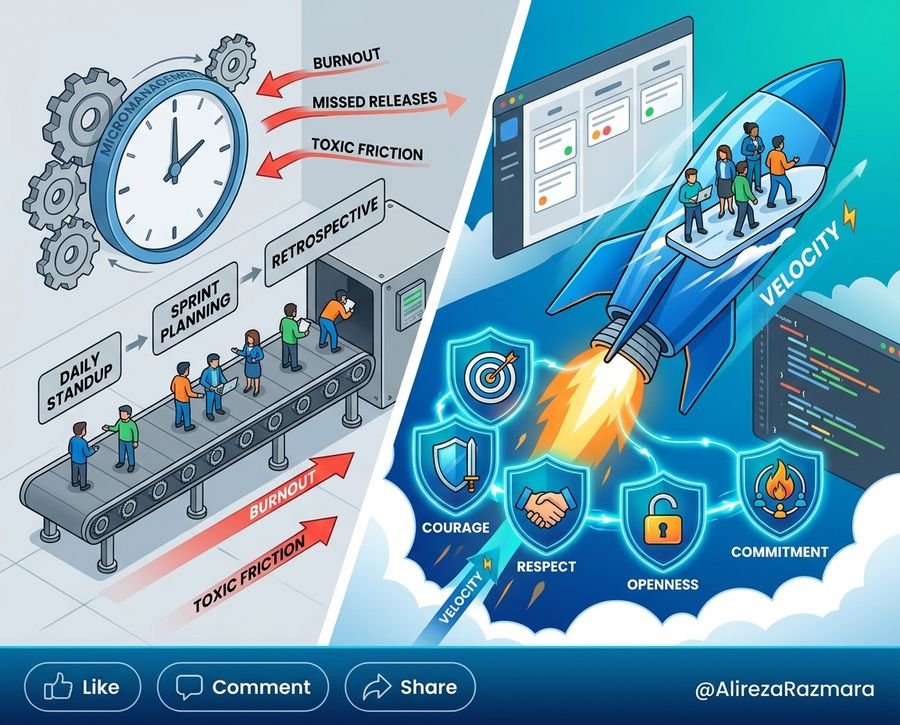
I have spent over a decade coaching software engineering teams. During that time, I have seen dozens of organizations execute the mechanical motions of Scrum—Daily Standups, Sprints, Retrospectives—yet still suffer from massive burnout, missed releases, and toxic friction. Why does this happen? Because adopting the meetings without internalizing the mindset creates a heavy, restrictive process. Mechanics without values is just micromanagement with extra steps.
The five Scrum values are not feel-good corporate fluff designed for motivational posters in the breakroom. They are practical, high-ROI engineering principles designed specifically to handle complex software environments. When tech leaders actively model these values, engineering teams do not just ship code faster. They build higher-quality products, experience lower turnover, and maintain a sustainable pace that prevents late-night firefighting.
Processes give your team structure, but values give your team velocity. Let us break down how to operationalize the five Scrum values to fix real-world delivery pain points.
Focus: Stop Starting, Start Finishing
The Scrum value of Focus means ruthlessly protecting your engineers from mid-sprint scope creep and limiting Work-In-Progress (WIP) so they can finish what they start. It is about prioritizing the Sprint Goal over reactive side-quests and isolated distractions.
Context switching is the silent killer of engineering velocity. Every time a developer is pulled from a deep, flow-state coding session to answer an “urgent but not important” question, it takes them 20 minutes to get their mental model back on track. When teams lack focus, you see sprint boards with 15 tickets “In Progress” and nothing moved to “Done” by Thursday afternoon.
To operationalize Focus, Product Owners and Scrum Masters must act as shields. If a stakeholder demands a new feature mid-sprint, the answer should not be a flat “no,” but rather a strict trade-off conversation: “We can add this to the current sprint, but we must remove something of equal size to maintain focus. What should we drop?” This forces the business to put a true value on their interruptions.
Courage: The Bravery to Push Back and Fail Openly
Courage in Scrum is the bravery to push back on unrealistic deadlines, address crippling technical debt early, and admit mistakes without fear of retaliation. It is the psychological safety required for a team to say “we were wrong” or “this architecture is failing” before it reaches production.
Software development is inherently unpredictable. You are solving problems that have often never been solved in your specific codebase before. If your engineers lack the courage to tell leadership that a highly anticipated feature will take three weeks instead of three days, you are setting up a death march. Developers will cut corners, skip writing automated tests, and ship brittle code just to appease a timeline.
You build courage by rewarding the messenger, not shooting them. When a Junior Developer highlights a critical flaw in a Senior Architect’s design during a refinement session, praise that behavior publicly. When a sprint fails to meet its goal, leadership must ask “What did our system lack?” instead of “Who dropped the ball?”
Respect: Trusting the Team’s Autonomy
The Scrum value of Respect means trusting developers to self-organize, estimate their own work, and solve technical problems without being dictated to. It requires valuing every perspective on the team and recognizing that the people closest to the code know best how to write it.
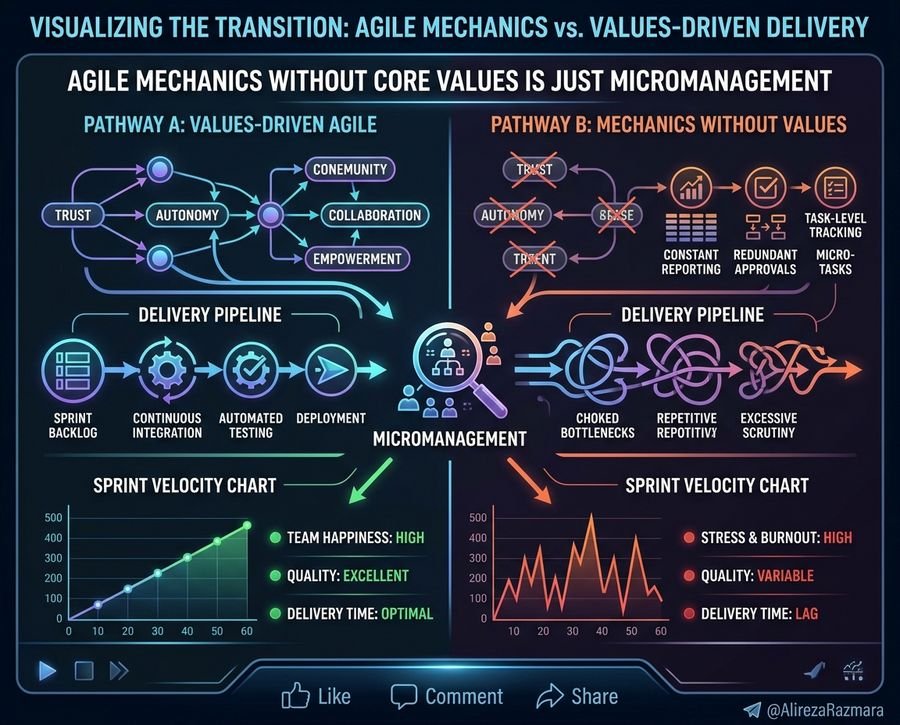
A blatant violation of Respect happens when managers or Tech Leads assign specific Jira tickets to specific developers during Sprint Planning. This strips away the team’s autonomy, creates massive single points of failure, and kills cross-training. You hired smart people; you need to let them do their jobs.
Operationalize Respect by clearly separating the “What” from the “How.” The Product Owner owns the “What” (the problem to solve and the priority). The Development Team exclusively owns the “How” (the technical implementation and the effort estimation). Present your team with clear business constraints, step back, and respect their ability to engineer the right solution.
Openness: Radical Transparency and Zero Surprises
Openness is radical transparency around blockers, actual velocity, and systemic failures. It guarantees zero surprises on Sprint Review day because everyone—from the engineering team to the stakeholders—knows exactly what is happening in real-time.
Hiding bad news does not fix broken code. If a third-party API is completely undocumented and it is stalling the backend team, openness dictates that this blocker is raised immediately at the Daily Scrum, not hidden until the end of the sprint out of embarrassment. “Watermelon metrics”—status reports that look green on the outside but are bleeding red on the inside—thrive in environments where openness is punished.
To foster openness, make your Sprint Reviews working sessions rather than theatrical presentations. Stop using PowerPoint slides to summarize work. Show the actual working software, warts and all. If a feature crashed during the demo, use that moment to openly discuss technical constraints with stakeholders. Transparency builds trust far faster than perfection.
Commitment: Owning the Sprint Goal Together
Commitment in Scrum means owning the Sprint Goal as a unified team, rather than acting like individual mercenaries just closing isolated tickets. It is a shared, collective promise to support each other across the finish line.
A major anti-pattern in Agile teams is the “my ticket is done” mentality. When developers only care about moving their specific tasks to the “Done” column, you do not have a cohesive team. You have a group of freelancers sharing a Jira board. If the backend tickets are finished but the frontend tickets are stalled, the entire team fails the Sprint Goal.
True commitment looks like a backend engineer helping a QA tester write automated test scripts on the final day of the sprint just to get the increment shipped. You drive this value by shifting your metrics. Stop tracking individual developer output. Stop measuring lines of code or individual story points. Measure team outcomes and sprint goal success rates. When the team is evaluated as a single unit, commitment naturally follows.
Putting Values into Practice Tomorrow
You cannot mandate values through a memo. You have to bake them into your daily operations. Start your next Retrospective by asking the team to rate themselves on a scale of 1 to 5 for each of these Scrum values. Ask them: Where are we strong? Where are we faking it?
When you start treating Focus, Courage, Respect, Openness, and Commitment as hard engineering constraints rather than soft HR suggestions, you stop doing Agile and start actually being Agile.