
Listen In: Why Chasing Agile Velocity Backfires (15 min)
What is Agile Velocity, Really?
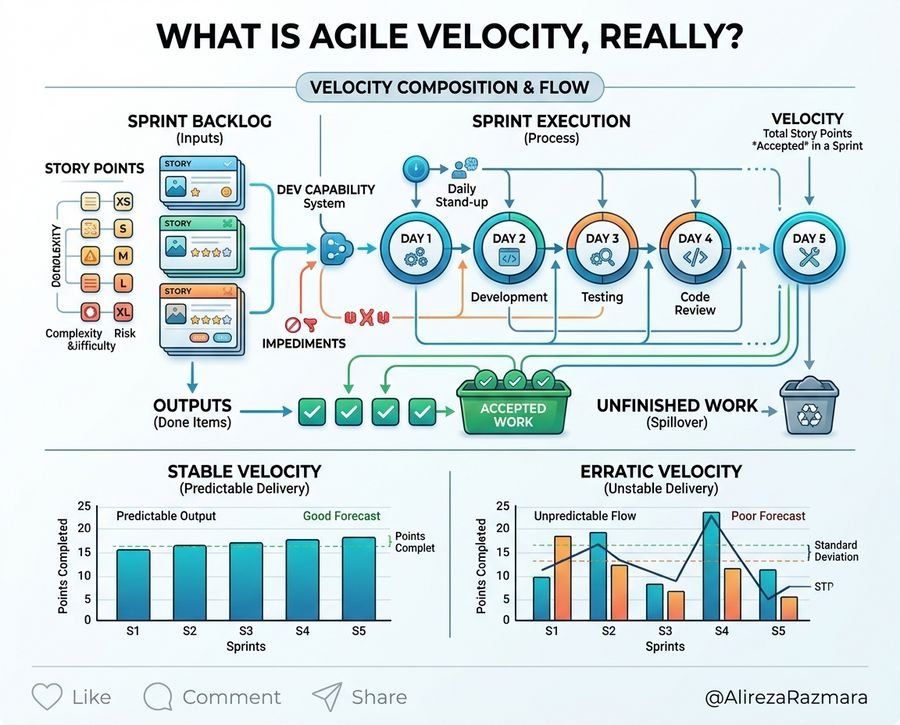
Agile velocity is a capacity planning tool used to forecast how much work a development team can complete in a single sprint. It is calculated by adding up the story points of all fully completed backlog items at the end of an iteration. Velocity is a mirror reflecting your team’s current capacity, not a scoreboard for measuring developer productivity.
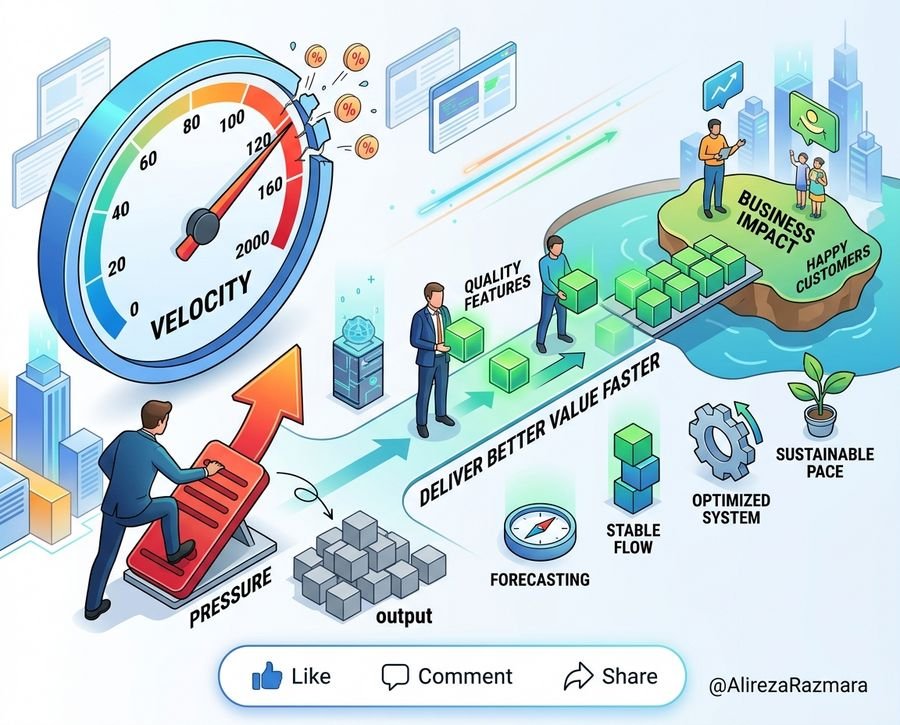
Think of velocity strictly as a compass. A compass tells you if you are heading in the right direction and roughly when you might arrive based on your current pace. When leadership treats velocity like an accelerator pedal, the entire system breaks down.
Story points are relative estimates of effort, complexity, and uncertainty. They are inherently subjective. If an engineering team realizes their performance is being judged by the raw number of points they burn, they will naturally—and often unconsciously—protect themselves by padding their estimates. An 8-point task silently transforms into a 13-point task. The burn-down chart looks fantastic for the executives, but the actual business value delivered remains exactly the same. You have not increased speed; you have simply ruined your forecasting tool.
Why Chasing Higher Velocity Destroys Productivity
Demanding higher velocity destroys productivity by incentivizing teams to game metrics, cut corners on code quality, and abandon sustainable work paces. This creates a vicious cycle of story point inflation and technical debt that ultimately slows down overall product delivery.
You get exactly what you measure. If the engineering mandate from the top down is “do more points,” the team will absolutely deliver more points. But how do they achieve that? Usually by skipping automated tests, ignoring code refactoring, rushing through peer reviews, and neglecting documentation.
This is the literal definition of false speed. Fast-tracking a feature today by accumulating technical debt means you will pay a massive, compounding interest rate on bug fixes tomorrow.
Worse, a relentless push for peak numbers leads directly to developer burnout. Agile frameworks like Scrum were originally designed to create a sustainable pace of work. Sprinting continuously without breathing room or slack time is a guaranteed recipe for losing your best senior engineers. Real productivity stems from a healthy, continuous flow of work, not from heroic, coffee-fueled overtime efforts at the end of every two-week cycle.
Predictability Over Peak Numbers
Predictable velocity is vastly superior to high velocity because it enables accurate release planning and builds critical trust with business stakeholders. A stable average allows product owners to confidently promise features to customers without relying on volatile overtime spikes.
Imagine you are a product manager trying to coordinate a major product launch. The marketing team needs a firm date. The sales team needs a date to close contracts. If your engineering team’s velocity wildly fluctuates between 30 and 70 points per sprint, you cannot commit to a roadmap. You are flying blind into the release cycle.
A team that consistently delivers 45 points sprint after sprint is a highly mature team. They understand their capacity, they break down stories effectively during backlog refinement, and they manage blockers efficiently. If you see a sudden, massive spike in velocity, do not celebrate immediately. Investigate it. It often means the team overcommitted, rushed sloppy work, or pulled in easy low-value tasks while actively ignoring complex architectural needs. Stability is the true hallmark of high-performing Agile teams.
Value Delivered Over Points Burned
Delivering high business value is the ultimate goal of software development, whereas burning story points is merely an administrative tracking mechanism. Launching a single, highly impactful feature that directly solves a user pain point beats delivering fifty points of unused bloatware every single time.
We often forget why we are building software in the first place. It is not to drag Jira tickets to the “Done” column. It is to solve complex customer problems and generate business revenue. High velocity that only delivers features nobody uses is just fast-tracking waste. You are efficiently building the wrong thing.
As a tech leader, you must shift your measurement criteria from raw output to actionable outcomes. Ask your teams entirely different questions during Sprint Reviews:
- Are users actually engaging with the new release?
- Did the latest sprint reduce our customer support ticket volume?
- Did we improve page load times by 200 milliseconds, thereby reducing bounce rate?
Quality and business impact beat raw speed. When a team obsesses over value, they naturally trim the fat from the product backlog. They write less code, which is ironically the most efficient way to maintain a lean, profitable product.
How to Actually Move Faster: Optimize the System
To genuinely increase delivery speed, engineering leaders must optimize the workflow system rather than pressuring individual developers. This means strictly limiting work-in-progress (WIP), automating CI/CD deployment pipelines, and aggressively clearing organizational dependencies.
Stop looking at the developers and start looking at the environment they are forced to operate in. If you want to move faster, you have to remove the systemic friction slowing the team down.
Strictly Limit Work-In-Progress (WIP)
Context switching is a massive productivity killer. When engineers juggle four tasks simultaneously, nothing actually gets finished. Implement strict WIP limits on your Agile board. Force the team to swarm on a few priority items, complete them fully, and then move on. To borrow a classic Agile axiom: stop starting and start finishing. According to Little’s Law, if you want things to move through your system faster, you must decrease the amount of work currently in progress.
Automate Deployment Pipelines
If your team spends two full days manually testing, verifying, and deploying code at the end of every sprint, you are bleeding precious capacity. Invest heavily in continuous integration and continuous deployment (CI/CD). Automated testing frees up developers to do what you actually pay them a premium for: writing logic and solving problems.
Clear Organizational Dependencies
How often is a developer blocked waiting for database access, third-party API keys, or cross-department approvals? As a Scrum Master, Agile Coach, or Engineering Manager, your primary job is to bulldoze these roadblocks. Speed is the natural byproduct of a friction-free environment.
Handling Executive Pressure to Boost Velocity
Handle executive pressure by reframing the conversation entirely away from velocity and toward cycle time, lead time, and customer value. Educate leadership that velocity is purely an internal team metric, and present them with flow metrics that accurately reflect time-to-market.
This is arguably the hardest part of tech leadership. Your CEO or VP of Engineering looks at a quarterly dashboard and explicitly asks for a 20% velocity increase next quarter. How do you respond without sounding defensive or dismissive?
Do not just say no. Translate their request into a language that aligns with business goals. Executives do not actually care about arbitrary story points; they care about time-to-market and ROI.
Use this script as a baseline: “I completely understand the goal is to get features to our users faster. However, instead of pushing the team to inflate their estimation points to make the charts look better, let’s optimize our Cycle Time. Right now, it takes us an average of 8 days to get a piece of code from ‘In-Progress’ to ‘Production’. If we approve the budget for this new automated testing tool and remove the manual QA bottleneck, I estimate we can drop that to 4 days.”
Redirect their anxiety toward systemic improvements. Show them the tangible cost of technical debt. When you successfully shift the engineering culture from “do more points” to “deliver better value faster,” the organizational tension naturally diffuses. You align the business and the development team around a shared reality.
Velocity is a powerful metric when used correctly. It keeps teams honest about their capacity and provides a realistic horizon for product launches. But the exact moment it becomes a management target, it ceases to be a good measure. Protect your teams from the pressure to game the system. Focus on flow, predictability, and genuine value. The speed will naturally follow.