
🎧 Listen In: Scrumban Versus the Two Week Sprint (16 min)
Picture this: It is Friday afternoon. Your team is staring at the Jira board during Sprint Planning. Half the team is stressed because they barely crammed last sprint’s scope into the two-week timebox, while the product owner is frustrated because an urgent customer request had to be pushed to the backlog. You feel suffocated by rigid sprints, but the thought of moving to pure Kanban terrifies your stakeholders who rely on structured updates.
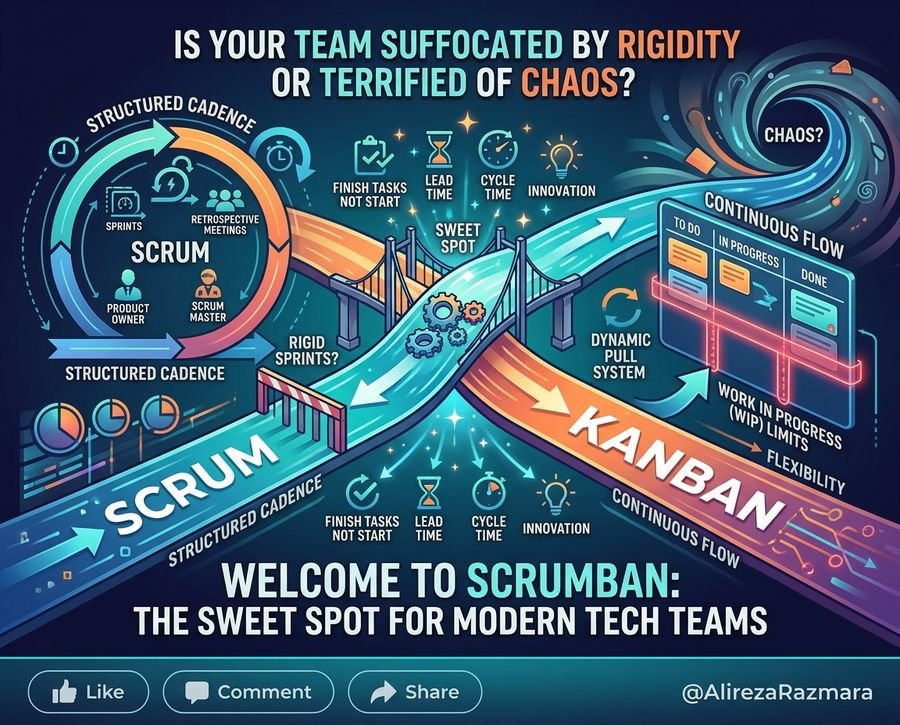
You do not have to choose between rigidity and chaos. Welcome to Scrumban—the sweet spot designed for modern tech teams who need structural guardrails alongside continuous flow.
Most engineering leaders believe they must lock themselves into a single methodology. But in dynamic technical environments, rigid processes kill innovation, while pure ad-hoc workflows kill delivery predictability. By bridging the gap, Scrumban offers a pragmatic alternative for teams ready to evolve their agile practices.
What is Scrumban?
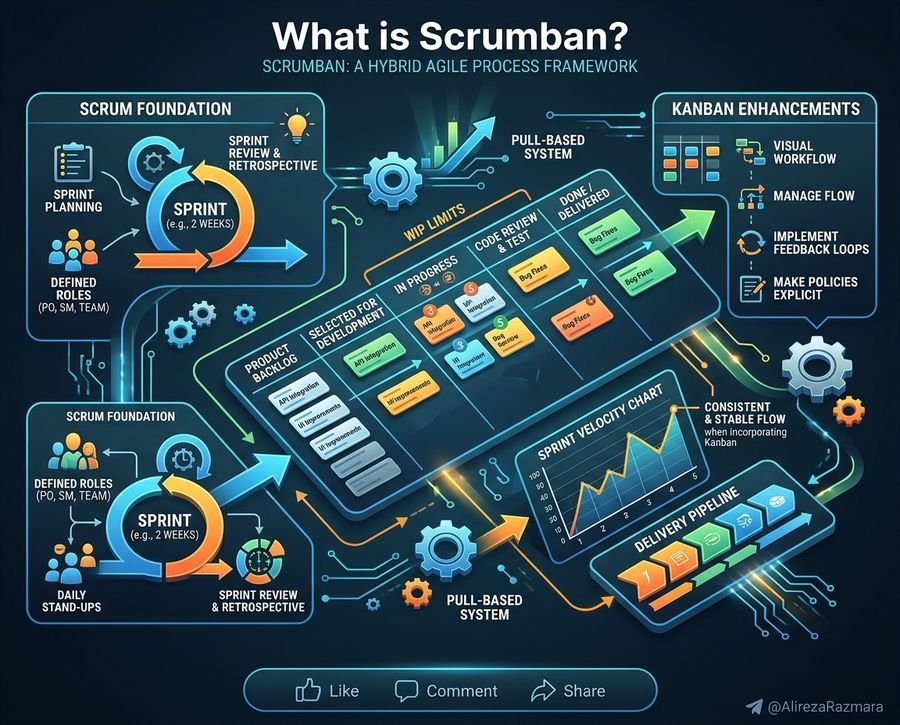
Scrumban is a hybrid Agile framework that merges the structured cadences and role clarity of Scrum with the continuous, pull-based workflow and strict Work in Progress (WIP) limits of Kanban. It exists to give technical teams predictability without forcing work into arbitrary fixed-length timeboxes.
Originally introduced as a transitional mechanism for teams moving from Scrum to Kanban, it quickly proved its worth as a standalone methodology. In traditional Scrum, the team commits to a specific batch of work over a fixed sprint. In Kanban, work flows continuously from left to right. Scrumban takes the best of both worlds: you keep your retrospectives, prioritization sessions, and daily stand-ups, but you drop the artificial sprint boundaries in favor of a continuous pull system.
This framework respects the psychological need for team alignment while acknowledging the reality of modern software development: priorities shift, bugs happen, and deployment pipelines do not care what day of the sprint it is.
Scrum vs. Kanban vs. Scrumban: The Core Differences
Understanding the difference comes down to how work is batched and how planning is triggered. Scrum relies on fixed batches and fixed cadences, Kanban relies on continuous flow with no mandated cadences, and Scrumban relies on continuous flow with dynamic, threshold-based cadences.
- Scrum: Highly structured. Work is locked into 1-4 week sprints. Changes during the sprint are heavily discouraged. Heavy emphasis on estimation (story points) and velocity.
- Kanban: Highly flexible. Work is pulled continuously. No required roles or recurring meetings. The only strict rule is limiting work in progress to prevent bottlenecks.
- Scrumban: The middle ground. Work is pulled continuously, but you retain essential meetings like retrospectives and daily standups. Planning is triggered only when the backlog drops below a certain threshold.
Why High-Performing Teams Are Shifting to Scrumban
Engineering teams transition to Scrumban to eliminate the rush of end-of-sprint delivery, reduce context switching, and focus entirely on finishing software rather than merely starting a batch of tickets. The shift is driven by a need for sustainable delivery metrics over arbitrary estimations.
Continuous Flow, Zero Sprint Panic
Instead of cramming a negotiated scope into a fixed 14-day window, teams pull high-priority tasks on demand. If a critical P1 bug drops on a Tuesday, you do not have to blow up the entire sprint to fix it or negotiate with stakeholders about what falls out of scope. You simply slot the critical issue at the top of the queue, and the next available developer pulls it. This eliminates the dreaded “end of sprint crunch” where quality drops because developers are rushing to close tickets before the sprint review.
Strict WIP Limits Prevent Developer Burnout
Context switching destroys developer productivity. Scrumban enforces strict limits on how many items can live in a specific column at once. For example, if your “In Review” column has a WIP limit of three, and there are currently three pull requests waiting for review, no developer can pull new work from the backlog. They are forced to swarm the board, review the open code, and push it to completion. The primary focus shifts heavily to finishing software, not just moving tasks to “In Progress.”
On-Demand Planning Cadences
Long, exhausting sprint planning sessions drain morale and often result in inaccurate estimations. Scrumban replaces them with dynamic planning. You establish a backlog threshold—say, five tickets. When the “To Do” column drops to five items, it triggers a refinement and planning session. You plan only when you need to, keeping the team focused on coding rather than sitting in hours of administrative meetings.
Advanced Flow Metrics Over Arbitrary Velocity
Velocity is easily manipulated and highly subjective to team inflation. Scrumban shifts the focus to actionable flow metrics. You start measuring Lead Time (how long a ticket takes from customer request to production) and Cycle Time (how long a ticket takes from a developer starting work to production). These are hard, objective data points that allow engineering leaders to accurately forecast delivery dates based on historical flow, not story point guesses.
When is Scrumban the Right Move?
Scrumban works best for maintenance and support teams, fast-growing tech startups with constantly shifting priorities, and mature Scrum teams scaling toward Continuous Deployment (CD). It thrives in environments where strict predictability is less critical than rapid adaptability.
1. Maintenance and Support Teams: Help desk escalations, infrastructure alerts, and production bugs do not respect sprint boundaries. Trying to run a strict two-week sprint in a Tier 3 support environment usually results in a sprint backlog that is 80% abandoned by day three. Scrumban allows these teams to handle unpredictable daily inputs while maintaining a structured queue.
2. Fast-Scaling Startups: Product market fit is a moving target. If your startup’s product roadmap changes weekly based on sudden user feedback or investor pivots, rigid Scrum becomes a frustrating straitjacket. Scrumban allows the Product Owner to reprioritize the backlog daily without disrupting the engineering team’s current work.
3. Mature Engineering Teams using CI/CD: If your DevOps maturity allows you to deploy code multiple times a day behind feature flags, batching work into two-week chunks is an administrative bottleneck. High-performing teams use Scrumban to feed their deployment pipelines continuously, deploying value the minute a ticket passes QA.
How to Transition Your Team to Scrumban
Start by visualizing your current process exactly as it is, apply strict WIP limits to expose bottlenecks, and slowly decouple your planning sessions from a fixed calendar cadence. Do not overhaul everything overnight; agility requires iterative change.
Step 1: Keep Your Ceremonies (For Now)
When transitioning, do not drop your Daily Standups or Retrospectives. These ceremonies maintain team alignment and psychological safety during the change. You can eventually reduce their frequency as the team matures in the pull system, but in the beginning, stability is key.
Step 2: Visualize the Board and Introduce WIP Limits
Map your exact current workflow. If QA is a separate step, make it a column. Then, introduce WIP limits. This will be the hardest part of the transition. Developers will instinctively push back when they are blocked from starting a new ticket. Hold the line as a Coach or Scrum Master. Use these moments to teach the team how to swarm bottlenecks. If QA is overloaded, developers must pause coding and help test.
Step 3: Decouple Planning from Delivery
Stop doing massive bi-weekly sprint planning. Instead, define your order point. Decide that whenever the “Ready for Dev” column has fewer than a set number of tasks, a replenishment meeting is triggered. This forces the Product Owner to keep the backlog ruthlessly ordered at all times, ensuring the team is always pulling the highest value work.
Step 4: Shift from Push to Pull
Work is no longer assigned to developers during planning. Instead, developers pull work from the top of the prioritized backlog when they have capacity. This empowers the team, builds autonomy, and ensures that work is only started when there is a realistic runway to finish it.
The Role of Leadership in a Scrumban Environment
Scrum Masters and Product Owners must shift their mindsets from managing scope to managing flow and prioritization. In a Scrumban system, the focus of leadership evolves.
For Product Owners, the responsibility intensifies. Because developers are pulling work continuously, the top of the backlog must always be refined, properly detailed, and aligned with business goals. There is no longer a “Sprint Planning buffer” to figure things out. If the backlog is messy, the team pulls messy work.
For Scrum Masters and Agile Coaches, the role shifts toward systems thinking. Instead of policing timeboxes and velocity charts, you become a flow master. Your primary tool is the cumulative flow diagram. You look for widening bands that indicate bottlenecks. You coach the team on limiting WIP, unblocking tasks, and improving their Cycle Time.
Agility Over Dogma
True agility is not about dogmatically following a framework rulebook. It is about tailoring your processes to deliver value quickly, sustainably, and reliably without breaking your engineering culture.
If your team is exhausted by the artificial constraints of traditional sprints, yet your stakeholders require more visibility than an unstructured Kanban board provides, it is time to evaluate your workflow. Scrumban offers the necessary guardrails for complex product development while granting the freedom to adapt to reality instantly. Focus on flow, limit your work in progress, and watch your team’s delivery—and morale—soar.