
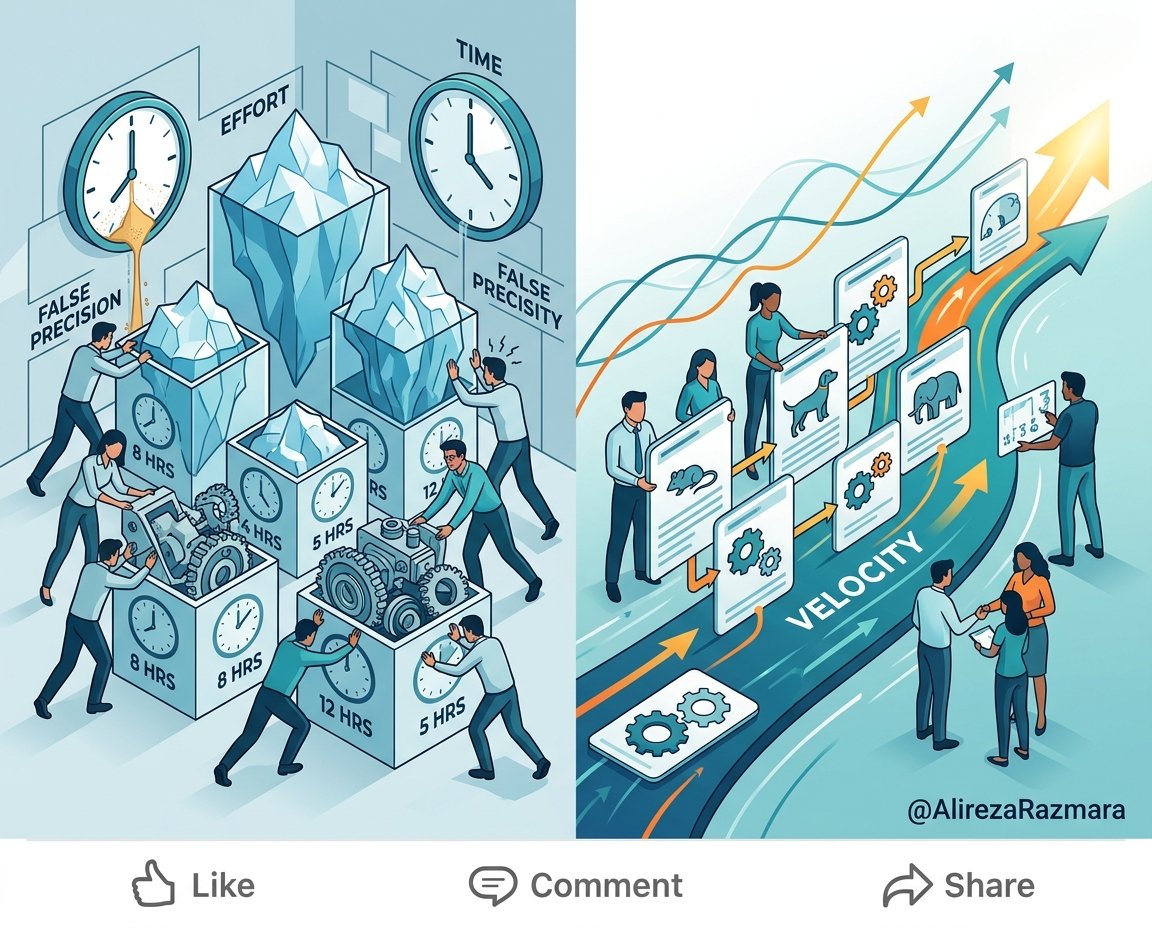
One of the most persistent and damaging anti-patterns I encounter in software development teams is the urge to equate User Stories to hours or days. When I sit in on a new client’s backlog refinement session, it usually only takes a few minutes before someone asks, ‘How many hours will this take?’ Leaders and project managers often push for this metric. They ask, ‘Why can’t we just use time? Isn’t it more accurate?’
The short answer is no. Estimating stories in time gives an illusion of control, not actual predictability.
Software engineering is complex knowledge work, not an assembly line. When you attempt to treat code like a predictable manufacturing process, you set your team up for failure. True Agile teams size their work by complexity, risk, and effort using Story Points. They do not use the clock. Here is exactly why estimating in hours is quietly sabotaging your team’s agility and what you should be doing instead.
Why Is Estimating in Hours an Agile Anti-Pattern?
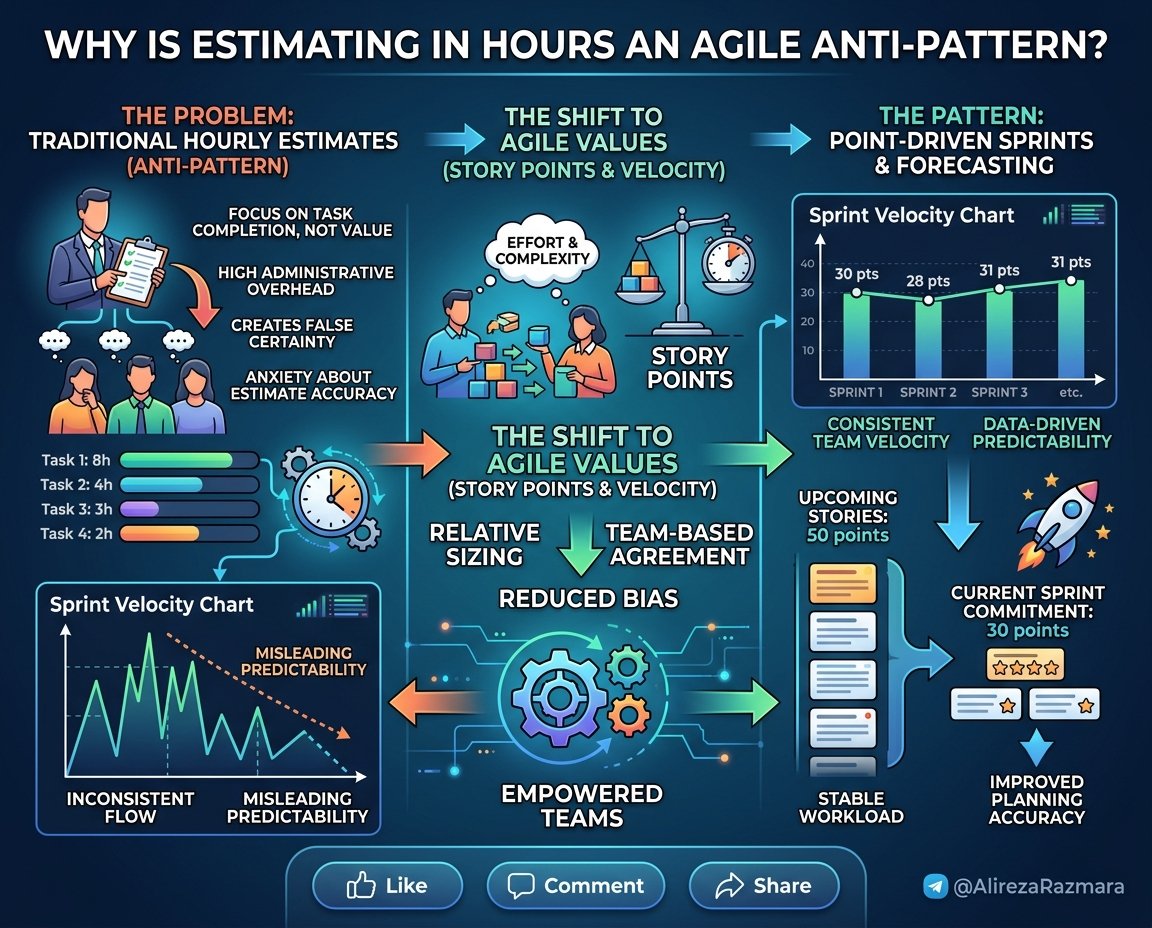
Estimating user stories in hours is an anti-pattern because it creates an illusion of precision while ignoring the inherent uncertainty of software engineering. It fails to account for varying developer skill levels, invites micromanagement, and actively penalizes the discovery process. True agility relies on measuring effort and complexity, rather than tracking absolute clock time.
When a team estimates a feature will take exactly 14 hours, stakeholders take that number straight to the bank. It looks precise on a spreadsheet. It feels actionable. But that precision is entirely fake. In reality, that 14-hour estimate does not account for the hidden legacy code refactoring needed, the undocumented API rate limit the team will discover on day two, or the time spent waiting on a third-party vendor to approve access.
Time-based estimates assume a frictionless environment. Because software development is fundamentally an act of discovery, friction is guaranteed. By sizing with Story Points instead of time, you acknowledge that unknown variables exist. You measure the size of the rock you need to move, rather than pretending you know exactly how many seconds it will take to push it up the hill.
The Skill Variance Problem: The “Who” Dictates the “How Long”
Time estimates fluctuate dramatically depending on who does the work, making absolute hours a highly unstable metric for team planning. A senior engineer might finish a specific database migration in three hours, while a junior developer might need two full days to complete the exact same task.
Does the actual size of the requirement change based on who picks up the Jira ticket? Absolutely not. The work is the work. If you estimate your backlog in hours, your entire sprint forecast must change depending on resource allocation. You find yourself playing an impossible game of calendar tetris, matching specific tickets to specific developers during Sprint Planning.
This severely limits cross-functionality. Story points solve this by keeping the size objective, regardless of the assignee. A 5-point story is a 5-point story whether your tech lead builds it or your newest hire tackles it. The junior developer will simply burn through fewer points in a two-week sprint than the senior developer. By decoupling the estimate from the individual, the team can plan around total capacity (Velocity) rather than tracking individual timesheets.
Humans Fail at Absolute Time But Excel at Relative Sizing
Human cognitive processes are poorly equipped to predict exact absolute timeframes for complex tasks, but we are highly accurate at comparing the relative size of two different things. This psychological reality is the core engine behind relative estimation frameworks in Agile.
Try guessing the exact weight of a fully grown elephant in kilograms. Unless you work at a zoo, you will likely fail. But if I put an elephant next to a lion and ask you which one is heavier, you instantly know the answer. You also know the elephant is significantly heavier, not just a little bit. This is relative sizing.
Story points rely on relative sizing using the Fibonacci sequence (1, 2, 3, 5, 8, 13). This scale drastically reduces cognitive load and cuts down on endless estimation debates. Instead of arguing whether a login screen will take 6 hours or 8.5 hours, the team simply agrees: ‘This login screen is slightly more complex than the password reset feature we built last sprint, so it’s a 5.’ The conversation shifts from accounting to architectural complexity.
How False Precision Destroys Psychological Safety
When developers provide time estimates, stakeholders instantly treat them as rigid commitments rather than educated forecasts. This dynamic forces developers to defensively pad their estimates or cut engineering corners to meet arbitrary deadlines, ultimately destroying team psychological safety.
Have you ever been asked: ‘You said this would take 8 hours yesterday, why did it take 12?’ That question is poison to a high-performing Agile team. It immediately puts the engineer on the defensive. The next time you ask that engineer for an estimate, they will give you 24 hours just to protect themselves.
Time-tracking breeds a culture of micromanagement. It shifts the focus away from delivering customer value and places it squarely on tracking input metrics. Story points, on the other hand, embrace uncertainty. They allow teams to forecast delivery safely without turning every ticket into a high-stakes contract. When psychological safety improves, code quality improves, and teams are more willing to tackle technical debt rather than rushing to beat a stopwatch.
Transitioning Your Team from Hours to Story Points
To transition a team from hours to story points, establish a baseline reference story that everyone agrees represents a standard size, such as a ‘3’. You then compare all future backlog items to this baseline story, judging them strictly on complexity, risk, and technical effort.
Start by running a backlog refinement session and picking a recently completed, well-understood piece of work. Let’s say it was adding a new text field to an existing form. Call that a 3. Now, look at the next item in your backlog: integrating a new payment gateway. Is integrating the gateway harder, riskier, and more complex than adding a text field? Yes. Is it slightly harder, or massively harder? The team discusses and might vote it an 8 using Planning Poker cards.
During this transition, you must fiercely protect the team from time-mapping. Someone will inevitably ask, ‘So, does a 3 mean two days?’ You must answer firmly: ‘No, a 3 means it is roughly the same effort as the form field update we did last month.’ Break the mental habit of clock-watching immediately.
Handling Leadership Pressure: Translating Points to Time
You should never directly map a single story point to a specific number of hours or days. Instead, calculate the team’s velocity over several sprints to forecast how many total points the team can realistically deliver within a standard timebox.
Executives and product managers need to know when a feature will be delivered. That is a valid business need. But the way you answer that question changes. When a stakeholder demands a timeline, you do not look at an hour estimate. You look at your backlog and your velocity.
If a new epic is estimated at 40 points, and your team’s historical velocity proves they complete about 20 points per sprint, you can confidently forecast that the epic will take two sprints to deliver. You have successfully answered the ‘When will it be done?’ question using empirical data, all without forcing a single developer to guess how many hours a specific database query will take.
Agile is not about tracking every minute spent in a seat. It is about maximizing value delivery and enabling flow. Stop treating your engineers like factory workers punching a clock. Measure outcomes, embrace relative sizing, and watch your team’s predictability and morale soar.