
🎧 Listen In: Does Strict Timeboxing Destroy Software Architecture (16 min)
The Trap of Parkinson’s Law in Software Delivery
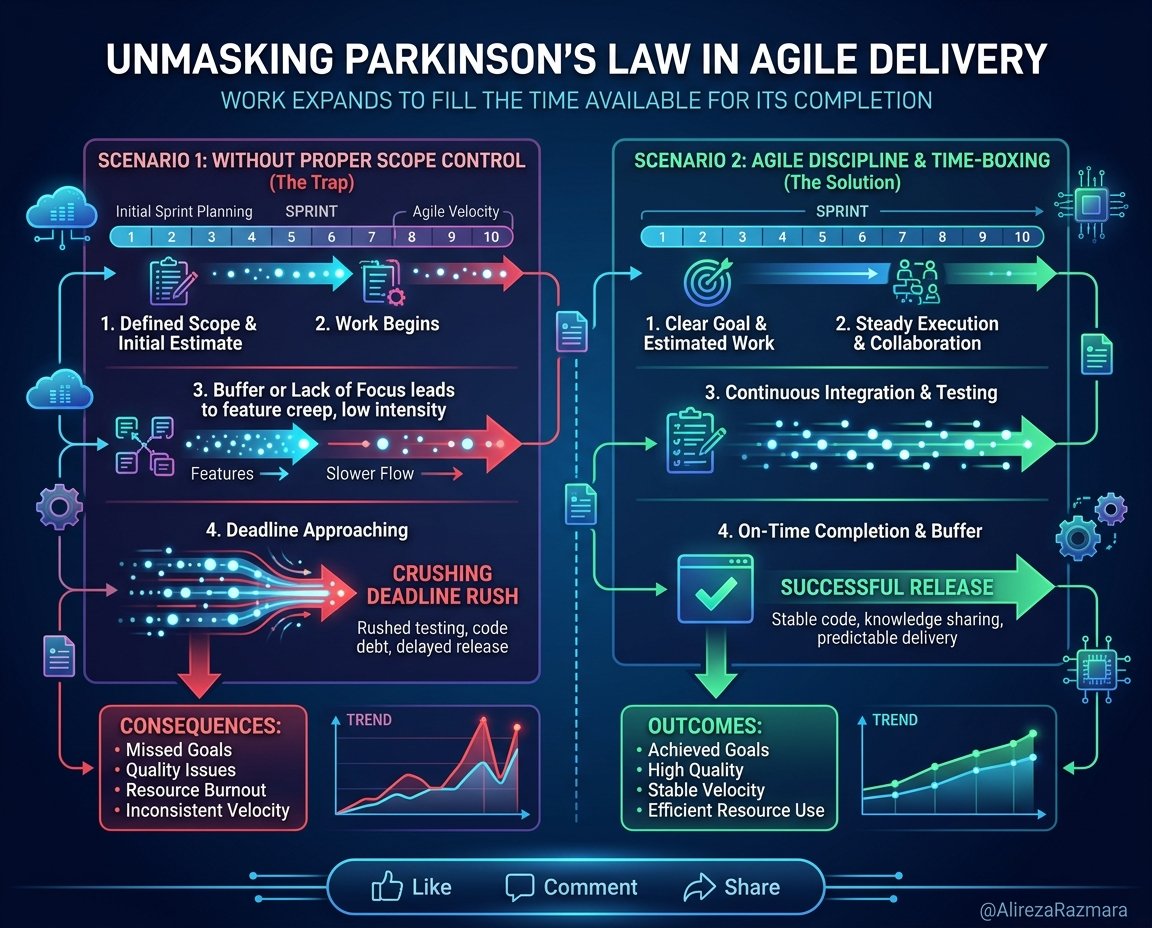
“Work expands to fill the time available for its completion.”
That is Parkinson’s Law, and if you have ever spent any time in an engineering department, you have seen it in action. If you schedule a routine sync for 60 minutes, the discussion will miraculously stretch to 60 minutes. Give a relatively straightforward feature a runway of six months, and the team will easily spend six months tweaking, refactoring, and debating the perfect architecture before shipping.
In Agile environments, and specifically within the Scrum framework, we flip this script using one of our most effective, yet frequently misunderstood, tools: timeboxing. Far too many engineering teams and middle managers view timeboxes as stressful, rigid deadlines handed down from on high. As a delivery consultant and Agile Coach, I see them entirely differently.
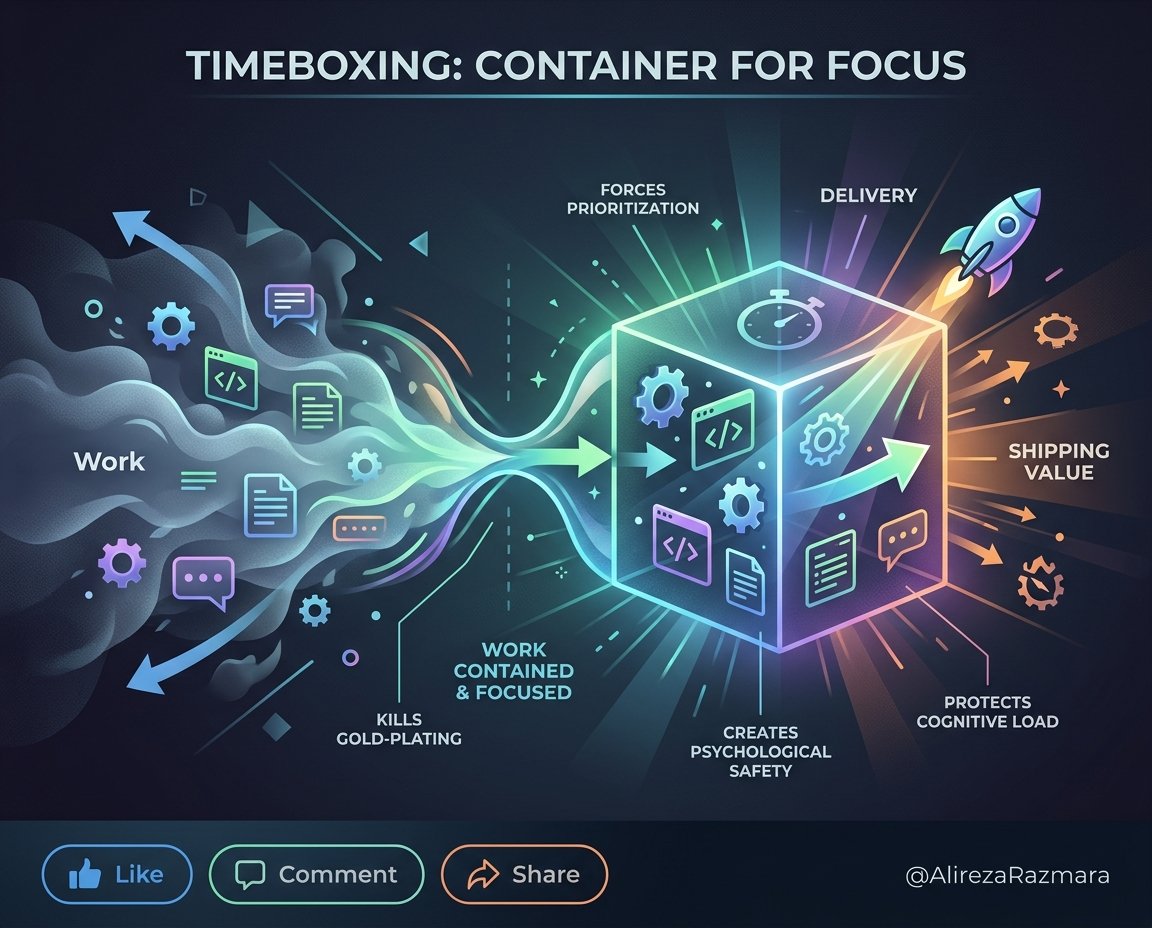
A timebox is not a countdown to panic. It is a container for focus.
What is Timeboxing in Scrum?
Timeboxing in Scrum is the practice of allocating a fixed, maximum duration to an activity, event, or task. Once that specific time limit expires, the work or discussion immediately stops, and the team reviews the outcome to determine the next step. You do not extend the meeting, and you do not silently push the deadline.
Scrum is built entirely around this concept. Every official Scrum event is timeboxed to ensure momentum and predictability. The Sprint itself is a timebox of one month or less. The Daily Scrum is strictly capped at 15 minutes. Sprint Planning, Sprint Review, and Sprint Retrospective all have maximum durations dictated by the length of the Sprint.
By putting a hard stop on activities, teams are forced to focus on the immediate objective. The constraint dictates the behavior. Instead of asking, “How long will it take to build the perfect feature?” the team asks, “What is the most valuable thing we can build and test within the next two weeks?” This subtle shift is what separates high-performing squads from teams that constantly spin their wheels.
How Does Parkinson’s Law Sabotage Engineering Teams?
Parkinson’s Law sabotages engineering teams by causing work to naturally drift toward complexity, filling whatever loose timeline is provided. Without strict time boundaries, developers often fall victim to scope creep, endless architectural debates, and the pursuit of technical perfectionism rather than delivering iterative value.
I see this constantly during backlog refinement. A developer brings up a small enhancement. Someone else asks a “what if” question about scaling for a million users. Suddenly, a simple user story devolves into a whiteboard session mapping out a massive microservices migration. Because no one put a cap on the conversation, the scope expanded to fill the vacuum of available time.
When timelines are vague, urgency drops. Decision fatigue sets in. Teams burn countless hours on trivial details because they lack a forcing function to make a call and move forward. Timeboxing provides that exact forcing function.
The Core Benefits of Strict Timeboxing
Tech leaders protect timeboxes because these boundaries are essential for maintaining sustainable team velocity and preventing burnout. Rather than acting as punitive deadlines, strict time constraints serve as protective guardrails. Here is how enforcing the clock transforms team dynamics.
Forces Ruthless Prioritization
When time is fixed, scope becomes the variable. This constraint forces teams to stop debating low-value details and focus entirely on what delivers the highest business value right now. You cannot build everything in a two-week Sprint, so you have to choose what matters most.
If a product owner knows they only have two hours for Sprint Planning, they will walk in with a prioritized backlog. If a developer knows they only have a three-day timebox to investigate a new API, they will focus on testing the core endpoints rather than building out a fully polished integration.
Kills “Gold-Plating” and Over-Engineering
A strict timebox stops teams from over-engineering solutions because it prioritizes shipping a functional, inspectable increment over a flawless one. Perfection is the enemy of delivery, and engineers love to perfect their code.
Gold-plating happens when developers add features or architectural complexities that were never asked for, simply because they think it makes the product better. By keeping Sprints and tasks tightly timeboxed, developers must ship a working increment by the deadline. It encourages the “make it work, make it right, make it fast” mindset, ensuring that the business actually gets to validate the software early.
Protects Cognitive Load
Clear time limits create urgency, drive faster alignment, and preserve your developers’ deep-work capacity. Endless meetings and circular debates drain mental energy and cause decision fatigue, leaving engineers too exhausted to actually write code.
By keeping the Daily Scrum strictly to 15 minutes, you ensure developers can get back to their complex problem-solving without context switching for an hour. Time limits on meetings signal respect for the team’s time and mental bandwidth.
Creates Psychological Safety
Expirations provide a safe boundary to evaluate progress without blame. When a timebox expires, you do not extend the clock—you stop, inspect the reality of the situation, and adapt your plan.
If a team fails to complete a story within a Sprint, the timebox allows them to say, “Here is what we learned within our budget. The complexity was higher than expected. How should we pivot?” It shifts the conversation from a personal failure to a system-level discovery. This prevents the “death march” culture where developers are forced to work weekends just to hit an arbitrary release date.
Actionable Strategies to Enforce Timeboxing Without Micromanaging
You implement timeboxes successfully by framing them as protective guardrails rather than punishments, and by honoring them consistently across the organization. It requires discipline, but it should never feel like micromanagement. Here are practical ways to embed this habit.
- Use a Visible Timer: In virtual meetings, use Zoom or Teams apps that display a countdown. In physical rooms, put a timer on the screen. It shifts the “bad guy” role from the Scrum Master to the clock.
- Timebox Technical Spikes: Never let a developer disappear for two weeks to “research” a solution. Give them a strictly timeboxed Spike (e.g., “Spend exactly 8 hours investigating this library”). When the 8 hours are up, they must present their findings, even if the finding is “this library is a mess.”
- Cut Off Tangents in the Daily Scrum: When a Daily Scrum devolves into a technical problem-solving session, step in gently but firmly. Say, “This is a critical conversation, but we only have five minutes left. Let’s park this for the “16th minute” and finish the board walk first.”
- Respect the End of the Meeting: If a meeting is scheduled for 45 minutes, end it at 45 minutes. Do not say, “Let’s just take five more minutes to wrap this up.” If you consistently run over, the team will realize your timeboxes are meaningless “flexible guidelines.” Stop the meeting, note what is unresolved, and schedule a follow-up if necessary.
What to Do When the Clock Runs Out
When a timebox ends before the intended goal is reached, the team must immediately pause to ask: “Do we invest more time, or do we pivot based on what we just learned?” You never silently roll over the time budget without a conscious conversation.
This is where true agility happens. If a one-hour design discussion fails to produce a consensus, extending the meeting by another hour rarely helps. Instead, the expiration forces the team to acknowledge the deadlock. Perhaps you need more data. Perhaps the Product Owner needs to make an executive call. Or perhaps the task needs to be broken down further.
Timeboxing is not about rushing your developers; it is about providing a structured environment where they can innovate safely without burning out. Parkinson’s Law will always try to creep into your project plans. But with disciplined timeboxing, you reclaim control of the clock.
Discipline creates freedom. Cadence creates predictability.
How does your team treat timeboxes? Are they strict, non-negotiable boundaries, or do they regularly get pushed when conversations get interesting? Drop your thoughts in the comments below!