
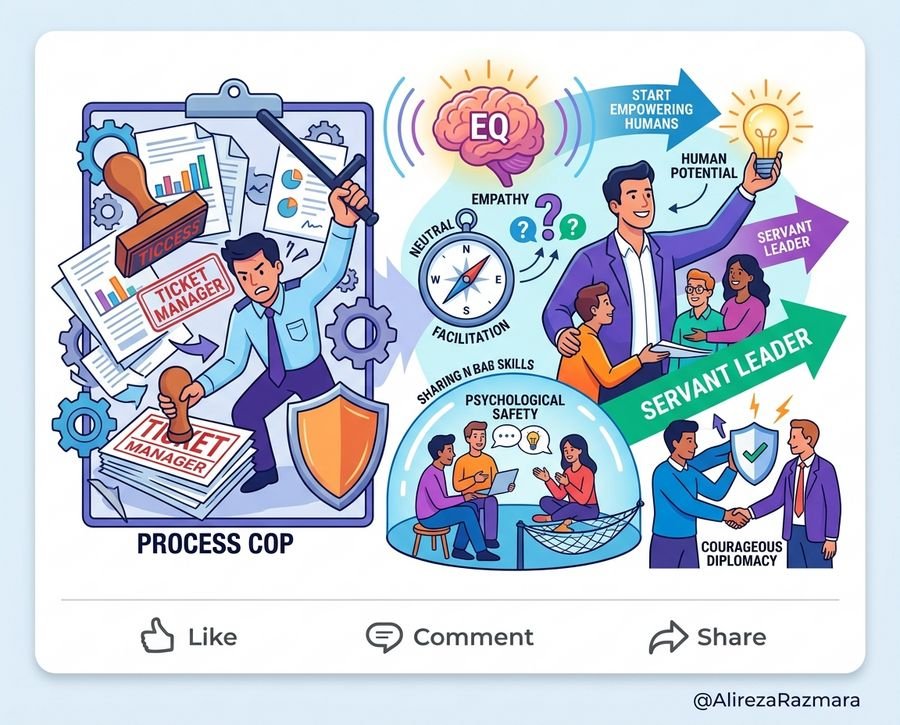
Let’s be brutally honest. If your primary contribution to your tech organization is moving Jira tickets across a digital board and reminding people to speak at the daily stand-up, you are severely underperforming as an Agile leader. You are acting as a process cop, not a servant leader. In my years of coaching software delivery teams, I’ve learned one immutable truth: Frameworks do not ship software. Empowered, aligned people do.
Agile frameworks are mechanically simple to understand. You can read the Scrum Guide in a single afternoon. But human dynamics are incredibly complex. A good Scrum Master knows the rules of the framework. A great Scrum Master understands human psychology, group dynamics, and the nuanced art of leading without formal authority.
If you want to elevate your impact and become a true force multiplier for your organization, you must look beyond the mechanics of agile ceremonies. You need to master the interpersonal tools that unlock human potential. Here is a field-tested guide to the non-negotiable soft skills every high-value Agile Coach and Scrum Master must master.
What Separates a Process Cop from a Servant Leader?
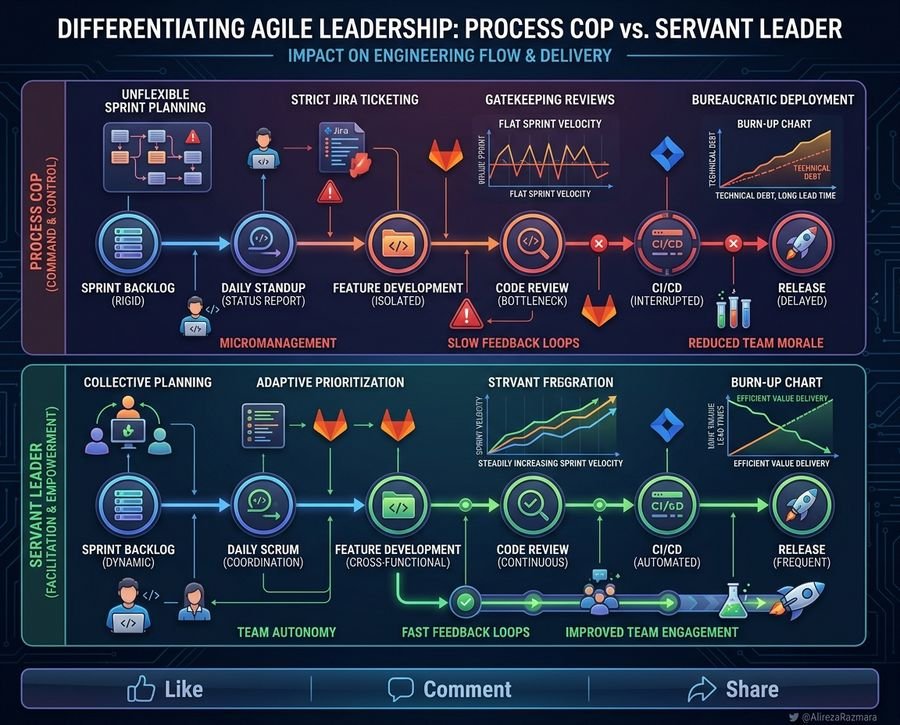
A servant leader prioritizes the growth, well-being, and autonomy of their team members above rigid adherence to a framework. While a process cop strictly enforces the rules of Scrum to check a compliance box, a servant leader uses the framework as a flexible tool to remove friction and enable high performance.
The transition starts with a mindset shift. Process cops focus on outputs: story points delivered, velocity charts, and burndown metrics. Servant leaders focus on outcomes: value delivered to the customer, team health, and continuous improvement. When you focus entirely on the mechanics of the process, your team will eventually figure out how to game the metrics. They will inflate story points. They will avoid taking on risky, innovative work because it might ruin the sprint commitment.
Your value is not in ensuring a meeting ends exactly at the 15-minute mark. Your value is ensuring that those 15 minutes were highly collaborative, uncovered blocked work, and aligned the team for the next 24 hours of development. To achieve that, you have to develop a specific set of interpersonal skills.
How Does High Emotional Intelligence (EQ) Impact Agile Delivery?
High Emotional Intelligence (EQ) is the ability to detect silent friction, impending burnout, and low morale before they derail a sprint. It requires a leader to actively read the room and understand the behavioral baselines of their team members rather than solely relying on sprint metrics.
Reading the room is a critical survival skill in technical project delivery. Let’s look at a common scenario. It is Tuesday morning during the daily scrum. A normally talkative, highly engaged senior engineer gives a blunt, one-word update, sighs heavily, and turns off their camera. A process cop checks off the engineer’s name and moves immediately to the next person. A high-EQ servant leader notes the behavioral shift, recognizes the potential for burnout or frustration, and quietly schedules a private, 15-minute check-in later that day.
Teams rarely announce that they are falling apart. The signs are subtle. It looks like skipped code reviews, shorter tempers in refinement sessions, and a sudden reluctance to volunteer for complex stories. By mastering EQ, you intercept these issues early. You address the human element before it mutates into a massive delivery delay. You learn to listen to what is not being said during the retrospective.
What is the Role of Neutral Facilitation in Scrum?
Mastery of neutral facilitation means asking powerful, open-ended questions that lead the team to discover their own solutions rather than feeding them the answers. Your role is to guide the structure of the conversation, ensure all voices are heard, and maintain focus, but you must never dictate the technical outcome.
Many technically competent Scrum Masters struggle with this. If you transitioned from a developer or QA role into an Agile leadership position, your instinct is often to solve the problem for the team. You see the architectural flaw, or you know exactly how to unblock the pipeline, so you jump in and tell them what to do. This is a massive mistake.
When you solve the problem for the team, you strip them of their autonomy. You teach them to rely on you as a crutch. Instead, lean into the power of the coaching stance. Use framing questions like:
- “What is the actual problem we are trying to solve here?”
- “If we take this approach, what downstream impacts will it have on the API team?”
- “What is the simplest thing we can build right now to validate this assumption?”
Neutral facilitation also means actively managing the room dynamics. When the loudest, most extroverted tech lead dominates the sprint planning session, the neutral facilitator skillfully redirects the flow: “We have a strong proposal from Alex on the backend strategy. Sarah, based on your work with the database last sprint, where do you see potential risks with this approach?” You are not dictating the work; you are engineering the environment where the best ideas can surface.
How Do You Cultivate Psychological Safety in Tech Teams?
You cultivate psychological safety by treating mistakes as neutral data points rather than character flaws. It requires creating and vigorously defending an environment where failure is viewed strictly as a learning opportunity, and where every voice is respected without fear of ridicule or retaliation.
Innovation dies in a culture of fear. If a software engineer ships a bug that brings down the production environment, how does leadership react? If the immediate response is a witch hunt to find out “Who broke the build?”, your team will immediately stop taking risks. They will hide their mistakes. They will point fingers. Trust will evaporate.
A great Agile Coach shifts the narrative from blame to systemic improvement. You lead the blameless post-mortem. You change the question from “Who did this?” to “What gap in our testing suite or deployment pipeline allowed this code to reach production?”
Psychological safety extends to how ideas are received. When a junior developer suggests an unconventional approach during backlog refinement, they must be met with curiosity rather than instant dismissal. When people feel safe to speak up, they identify risks earlier, collaborate more freely, and ultimately build better software.
Why is Courageous Diplomacy Crucial for Agile Leaders?
Courageous diplomacy is the ability to comfortably and respectfully push back against unreasonable demands from executives and stakeholders while maintaining trust. It involves shielding the development team from scope creep and context switching so they can focus on delivering the sprint goal.
We all know the aggressive stakeholder. They bypass the Product Owner, tap a developer on the shoulder (or send a direct Slack message), and say, “I just need this one tiny feature added. It will only take a day.” If you let this happen, your sprint is compromised. The development team loses focus, technical debt accumulates, and predictability shatters.
Protecting the team requires serious courage. You have to be willing to look a Vice President in the eye and say, “No, not right now.” But you cannot just say no and walk away. That is where the diplomacy comes in. You must reframe the conversation around trade-offs.
Instead of a flat rejection, a skilled Scrum Master says: “We can absolutely prioritize this new feature for you. However, our sprint capacity is full. If we bring this in today, we must remove feature X from the current sprint to make room. Are you comfortable delaying feature X until next month?” This forces the stakeholder to take ownership of the prioritization decision without overwhelming the engineering team.
Moving Forward: Becoming a Force Multiplier
Agile is not a spectator sport, and leading an Agile team is not an administrative task. It is a highly demanding leadership role that requires deep emotional intelligence, sharp facilitation skills, a commitment to psychological safety, and the courage to protect your people.
When you stop obsessing over moving tickets and start focusing on empowering humans, everything changes. The velocity will naturally increase. The quality of the software will improve. Retention rates will rise. You stop being a localized process administrator and transform into a strategic asset for the entire organization.
Over to you: In your experience, what is the ONE soft skill that completely transformed your team’s delivery and culture? Let’s discuss it in the comments below!