Listen In: Escaping the Water-Scrum Fall Trap (19 min)
We have all sat through the presentation. A 12-month project roadmap, meticulously planned down to the hour, color-coded and confidently displayed on a slide. Fast-forward six months: market demands shift, a competitor launches a disruptive feature, and customer needs evolve entirely. You stick to the plan and end up delivering a feature-complete product that absolutely nobody wants anymore.
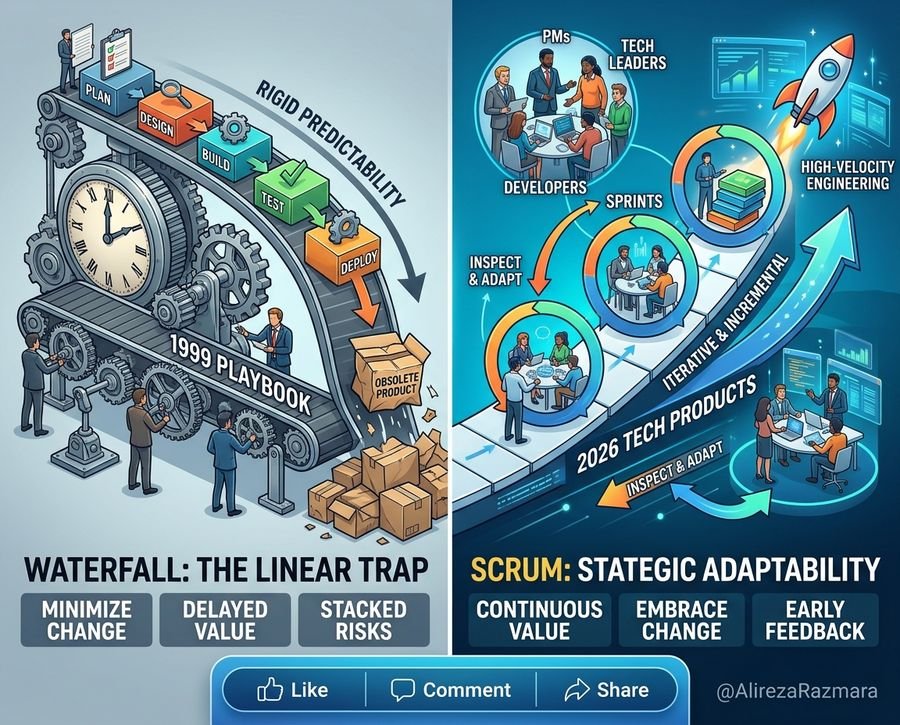
That is the classic Waterfall trap. If you are still managing 2026 tech products with a 1999 playbook, your delivery model is actively sabotaging your engineering talent.
In high-velocity engineering, the debate is no longer a simple methodology clash between Waterfall and Scrum. The real friction lies in a deeper cultural divide: Rigid Predictability vs. Strategic Adaptability. Let us break down what this shift actually looks like on the ground for Tech Leaders, Product Managers, and Developers, and how to stop trying to control the uncontrollable.
What is the core difference between Waterfall and Scrum in software delivery?
The core difference between Waterfall and Scrum is how they manage uncertainty. Waterfall assumes absolute predictability and executes work in a strict, sequential line. Scrum assumes that software development is inherently complex and executes work in short, iterative loops to gather immediate feedback.
This fundamental difference dictates everything from how a team handles a shifting requirement to when a business actually sees a return on its investment. To understand the impact, you have to look at the anatomy of both frameworks through the lens of a modern product lifecycle.
The Waterfall Model: Linear and Sequential
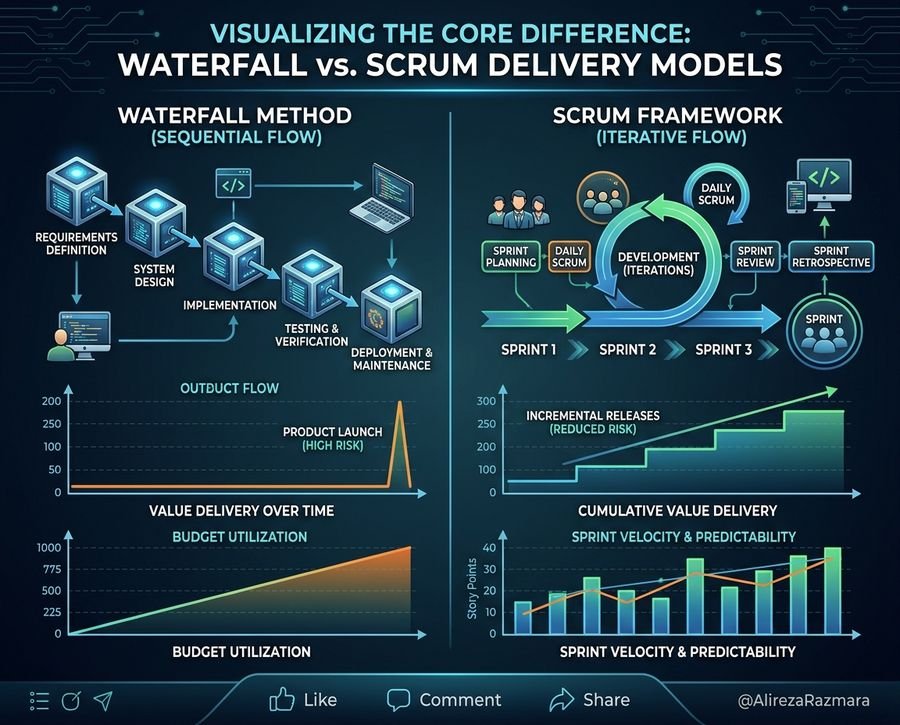
Waterfall relies on a heavy, upfront assumption that you know exactly what the customer wants and that nothing will change while you build it. The execution follows a strict path: Plan ➔ Design ➔ Build ➔ Test ➔ Deploy.
- Risk Profile: Completely stacked at the end. You only discover bad assumptions, architectural flaws, or market shifts when development is effectively over. This is exactly when fixing those mistakes is the most expensive and demoralizing.
- Value Realization: Severely delayed. The customer sees zero tangible value until the final deployment. Your engineering team operates as a sunk cost for months on end.
- Mindset: “Follow the plan, minimize change.” Change is treated as a failure in upfront planning rather than a natural part of product discovery.
The Scrum Advantage: Iterative and Incremental
Scrum does not pretend to predict the future. Instead, it relies on empiricism. Teams work in 1-to-4-week Sprints, explicitly designed to deliver a potentially shippable increment of value by the end of each cycle.
- Risk Profile: Mitigated daily. Built-in feedback loops—like the Daily Scrum, Sprint Review, and Retrospective—force teams to confront reality early. You find out your assumptions are wrong in week two, not month ten.
- Value Realization: Early and frequent. Cash flow, user validation, and stakeholder trust start building in Sprint 1. If funding is cut halfway through a project, you still have a working, partially featured product.
- Mindset: “Inspect, adapt, and pivot based on real data.” Change is expected, welcomed, and utilized as a competitive advantage.
Why does the Waterfall model fail modern tech products?
Waterfall fails modern tech products because it treats software engineering like an industrial assembly line rather than a process of continuous discovery. It forces teams to lock in scope when they have the least amount of information about the actual user problem.
Think about the lifecycle of a modern application. Integrations update continuously. Security vulnerabilities appear overnight. User expectations are shaped by consumer apps that ship updates daily. A rigid plan assumes you can pause this external ecosystem while you build.
When you force a high-performing engineering team into a linear roadmap, you strip away their ability to solve problems creatively. They stop asking, “Will this solve the user’s pain?” and start asking, “Does this match the specification document from nine months ago?” You trade market relevance for a false sense of internal predictability. The product might launch exactly on time and completely within budget, but if it solves a problem that no longer exists, the entire initiative is a failure.
How does Scrum enforce daily risk mitigation and early value realization?
Scrum enforces risk mitigation by breaking down massive, opaque delivery timelines into transparent, time-boxed increments. It forces early value realization by requiring cross-functional teams to integrate, test, and present functional software at the end of every single Sprint.
This shift from theoretical progress to empirical progress changes the entire conversation between engineering and the business. Instead of reporting that a feature is “80% coded” (a metric that means absolutely nothing to a customer), the team demonstrates a working piece of software.
These short cycles act as a radar system. If a specific API integration is significantly harder than expected, you find out in the first Sprint, giving leadership the time to adjust scope or allocate different resources. The Sprint Review acts as a forcing function for alignment. When stakeholders actually touch the software, they often realize their original requests need modification. Adapting to that realization in week three is a minor pivot; adapting to it in month nine is a crisis.
What is the leadership shift required for true Agile transformation?
The leadership shift requires abandoning command-and-control management in favor of Servant Leadership. Leaders must stop dictating exactly how work should be done and start providing clear strategic goals, trusting autonomous, cross-functional teams to determine the best technical solutions.
Waterfall assumes total certainty in a complex world. It comforts executives with Gantt charts and rigid deadlines. Scrum requires a fundamentally different psychological posture from leadership: the acceptance that complexity requires empiricism.
Transitioning to Agile is rarely a tooling problem. You can buy Jira, schedule 15-minute daily meetings, and re-title your Project Managers as Scrum Masters, but without a shift in leadership behavior, nothing changes. True tech leaders step back from micromanaging tasks and focus on removing systemic blockers.
Servant Leadership in this context means protecting the team from outside interference during a Sprint. It means facilitating psychological safety so developers can admit when an architectural approach is failing without fear of punitive action. Stop trying to engineer certainty. Start building organizational systems that thrive on shifting variables.
How can you identify and fix a “Waterfall in Disguise” environment?
You can identify a “Waterfall in Disguise” (often called Water-Scrum-Fall) if your organization uses Sprints but still mandates locked 12-month roadmaps, separates development from QA testing by weeks, and treats production deployments as rare, high-stress events.
This hybrid model is incredibly common and represents the worst of both worlds. Teams suffer the overhead and meeting frequency of Scrum while retaining the rigid, unchangeable scope of Waterfall. The symptoms are obvious if you look closely at team behavior:
- Sprints are just artificial slices of a fixed plan: The Product Owner has no authority to alter the backlog based on feedback. The team is just chewing through a pre-ordained list of tasks.
- Integration and Testing are deferred: Developers code for three Sprints, and then a “Hardening Sprint” or QA phase is required because the software is not actually kept in a shippable state.
- Zero direct user feedback: Sprint Reviews are internal status meetings for managers rather than working sessions with real customers or stakeholders.
To fix this, you have to break the sequential phases. Start by defining what “Done” actually means. A story is not done when the code is written; it is done when it is integrated, tested, and ready to ship. Give your Product Owners actual authority to say “no” to stakeholders and cut scope that no longer adds value.
High-velocity engineering relies on trusting the feedback loop. Drop the illusion of perfect upfront planning. Empower your teams, ship small increments, measure the impact, and adapt aggressively. The market will reward your adaptability long before it praises your initial plan.